Black-bellied Cuckoo

Black-bellied Cuckoo

Piaya melanogaster

Silhouette: Nicolas Huet le Jeune and Jean-Gabriel Prêtre (vectorized by T. Michael Keesey) · PhyloPic

LCLeast ConcernNTVUENCR
Daily sighting probability <5% · Rare
at Anavilhanas National Park

In 3 days ~10% in a week ~20%

15 Verified sightings at Anavilhanas National Park From 2019 to 2026
446 In all 7 parks
November Best month
☀️ Diurnal When it's spotted

About the Black-bellied Cuckoo

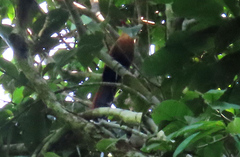
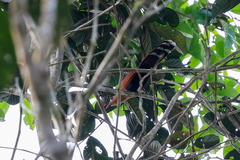
The black-bellied cuckoo or black-bellied squirrel cuckoo (Piaya melanogaster) is a bird of the family Cuculidae found in the Amazon region. Even though this species has a wide distribution, little is known about its ecology and natural history. The word melanogaster means "black belly"; it has Greek roots, melas meaning "black" and gaster meaning "belly".

The average length of adults is between 38 and 40.5 cm. The beak is of an intense purple/red color, the iris is dark red with a blue orbital skin and one yellow mole at the anterior side of each eye. The head is grey and contrasts with the ruffled back. The throat and chest are brown-reddish, cinnamon color and the belly and undertail coverts are black. The tail is black with conspicuous white stripes. The juveniles resemble adults.

P. melanogaster occurs within the range of the similar squirrel cuckoo (Piaya cayana). Black-bellied cuckoos are distinguished by a dark face and grey crown. The squirrel cuckoo has exposed yellow-greenish skin in the orbital area, the chest plumage is grey and it lacks the characteristic hood of the black-bellied cuckoo.

Their characteristic song is "dyerií-dyu, dyerií-dyu... Wikipedia →

Sounds

Call0:24

Brazil · 2026

© JAYRSON ARAUJO DE OLIVEIRA · XC1183880 · CC BY-NC-SA 4.0

Song0:16

Ecuador · 1990

© Robert S. Ridgely · XC274948 · CC BY-NC-SA 4.0

Recording0:17

Colombia · 2001

© Mauricio Álvarez-Rebolledo (Colección de Sonidos Ambientales - Instituto Humboldt) · XC525405 · CC BY-NC-SA 4.0

Global Distribution

Parks Where Found

# Park Country Daily sighting probability
1 Yasuní National Park 🇪🇨 Ecuador
~10%
2 Anavilhanas National Park 🇧🇷 Brazil
<5%
3 Cuyabeno Wildlife Reserve 🇪🇨 Ecuador
<5%
4 Brownsberg Nature Park 🇸🇷 Suriname
<5%
5 Manu National Park 🇵🇪 Peru
<5%
6 Amacayacu National Natural Park 🇨🇴 Colombia
<5%
7 Tambopata National Reserve 🇵🇪 Peru
<5%

Before you go

What are the chances of seeing a Black-bellied Cuckoo in Anavilhanas National Park?

Rare

Under 5% of wildlife watchers report a Black-bellied Cuckoo sighting in Anavilhanas National Park on a given day, based on 15 verified sightings from GBIF citizen-science data from 2019 to 2026. It is the 197th most-seen of the 291 birds we can rate there. Over three days the chance rises to about 10%, and over a week to about 20%, if each day is a fresh chance.

When is the best time to see a Black-bellied Cuckoo in Anavilhanas National Park?

January, April, July and November

In those months about 10% of wildlife watchers report a Black-bellied Cuckoo in Anavilhanas National Park on a given day, against under 5% in February–March, May–June, August–October and December, the lowest months.

What time of day is best to see a Black-bellied Cuckoo?

Between 8 and 11 am

Across all the parks we cover, that three-hour window holds the most Black-bellied Cuckoo sightings with a recorded time, and about 8 in 10 of them come between 6 am and 6 pm: it is a daytime animal.

Is Anavilhanas National Park the best place to see a Black-bellied Cuckoo?

2nd of 7

Of the 7 parks where we can rate Black-bellied Cuckoo sightings, Anavilhanas National Park ranks 2nd at under 5%. The best odds are in Yasuní National Park (Ecuador, about 10%).

Where does the Black-bellied Cuckoo sighting chance come from?

GBIF citizen-science records

It is estimated from how often the Black-bellied Cuckoo is recorded against all the birds logged in Anavilhanas National Park (15 verified sightings from 2019 to 2026), calibrated against known sighting rates. Figures are rounded to the nearest 10% because citizen-science data supports honest approximations, not decimals, and months with records from fewer than five people show "—". How it works.

← Back to Anavilhanas National Park