
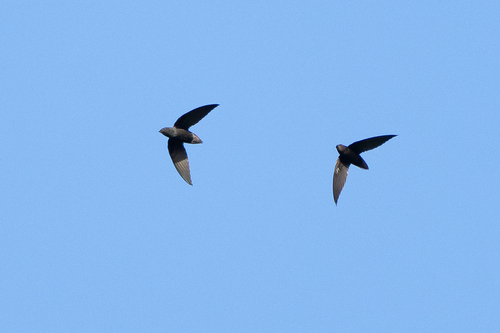
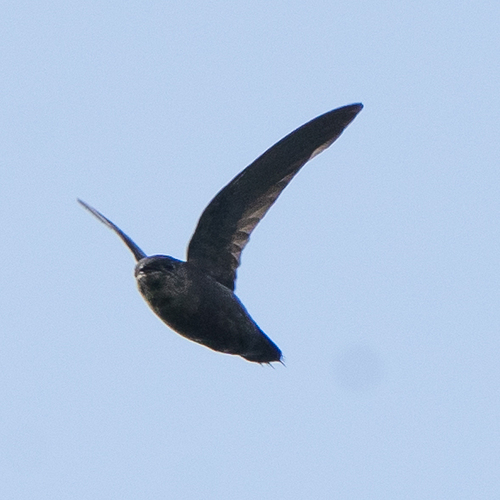
White-chinned Sapphire

White-chinned Sapphire

Chlorestes cyanus

Silhouette: Ferran Sayol · PhyloPic

LCLeast ConcernNTVUENCR
Daily sighting probability <5% · Rare
at Anavilhanas National Park

In 3 days <5% in a week ~10%

5 Verified sightings at Anavilhanas National Park From 2019 to 2026
864 In all 8 parks
August Best month
☀️ Diurnal When it's spotted

About the White-chinned Sapphire

The White-chinned sapphire (Chlorestes cyanus) is a small species of hummingbird in the family Trochilidae. It is found in northern and eastern South America. It inhabits a variety of environments, including lowland tropical forests, woodland edges, and clearings with scattered trees. This species is known for its distinctive steel-blue tail and sexual dimorphism, with males displaying a violet-blue head and throat and a coral-red bill, while females have subdued green plumage. The White-chinned sapphire feeds primarily on nectar from flowering plants but also consumes small arthropods such as insects and spiders. It is non-migratory species and occurs as a year round resident throughout much of its range.

This species was formerly placed in the genus Hylocharis. A molecular phylogenetic study published in 2014 found that Hylocharis was polyphyletic. In the revised classification to create monophyletic genera, the white-chinned sapphire was moved to Chlorestes.

The white-chinned sapphire is a South American hummingbird, found across much of northern and eastern South America. Prior to 2007, this bird was widespread in the Amazon Rainforest at altitudes below 600m, extending... Wikipedia →

Sounds

Song0:27

Brazil · 2025

© JAYRSON ARAUJO DE OLIVEIRA · XC1044488 · CC BY-NC-SA 4.0

Call1:08

Colombia · 2022

© Frank Lambert · XC1040007 · CC BY-NC-ND 4.0

Uncertain0:14

Bolivia · 2020

© Jacob Wijpkema · XC606493 · CC BY-NC-SA 4.0

Global Distribution

Parks Where Found

# Park Country Daily sighting probability
1 Tayrona National Natural Park 🇨🇴 Colombia
~30%
2 Brownsberg Nature Park 🇸🇷 Suriname
~10%
3 Serra dos Órgãos National Park 🇧🇷 Brazil
~10%
4 Manu National Park 🇵🇪 Peru
~10%
5 Tambopata National Reserve 🇵🇪 Peru
<5%
6 Anavilhanas National Park 🇧🇷 Brazil
<5%
7 Henri Pittier National Park 🇻🇪 Venezuela
<5%
8 Itatiaia National Park 🇧🇷 Brazil
<5%

Cities Where Found

# City Country Daily sighting probability
1 Niterói 🇧🇷 Brazil
<5%

Before you go

What are the chances of seeing a White-chinned Sapphire in Anavilhanas National Park?

Rare

Under 5% of wildlife watchers report a White-chinned Sapphire sighting in Anavilhanas National Park on a given day, based on 5 verified sightings from GBIF citizen-science data from 2019 to 2026. It is the 275th most-seen of the 291 birds we can rate there. Over three days the chance rises to under 5%, and over a week to about 10%, if each day is a fresh chance.

When is the best time to see a White-chinned Sapphire in Anavilhanas National Park?

August

In that month about 10% of wildlife watchers report a White-chinned Sapphire in Anavilhanas National Park on a given day, against under 5% in September to July, the lowest months. That is one of Anavilhanas National Park's driest months, with about 75 mm of rain against 340 mm in March.

What time of day is best to see a White-chinned Sapphire?

Between 8 and 11 am

Across all the parks we cover, that three-hour window holds the most White-chinned Sapphire sightings with a recorded time, and about 9 in 10 of them come between 6 am and 6 pm: it is a daytime animal.

Where does the White-chinned Sapphire sighting chance come from?

GBIF citizen-science records

It is estimated from how often the White-chinned Sapphire is recorded against all the birds logged in Anavilhanas National Park (5 verified sightings from 2019 to 2026), calibrated against known sighting rates. Figures are rounded to the nearest 10% because citizen-science data supports honest approximations, not decimals, and months with records from fewer than five people show "—". How it works.

← Back to Anavilhanas National Park