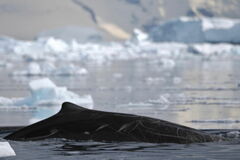
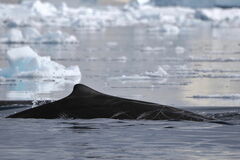
Arnoux's Beaked Whale

Arnoux's Beaked Whale

Berardius arnuxii

Silhouette: Chris huh · PhyloPic

LCLeast ConcernNTVUENCR
Daily sighting probability ~10% · With luck
at Antarctic Peninsula & South Shetland Islands

In 3 days ~30% in a week ~50%

9 Verified sightings at Antarctic Peninsula & South Shetland Islands From 2019 to 2026
9 In 1 park
November Best month
☀️🌙 Day & Night When it's spotted

About the Arnoux's Beaked Whale

Arnoux's beaked whale (Berardius arnuxii), also called the southern four-toothed whale, southern beaked whale, New Zealand beaked whale, southern giant bottlenose whale and southern porpoise whale is one of the species of Berardius. Arnoux's and Baird's beaked whales are so similar that researchers debated whether or not they are simply two populations of the same species, until genetic evidence and their wide geographical separation led them to be classified as separate. Little is known about their behavior due to infrequent encounters with live individuals.

Named Berardius arnuxii in 1851 for the French surgeon, M. Arnoux, who presented the skull to the Paris Museum of Natural History in 1846. Arnoux's and Baird's beaked whales, have very similar features and would be indistinguishable at sea if they did not exist in disjoint locations. Both whales reach similar sizes, have bulbous melons, and long prominent beaks. Their lower jaw is longer than the upper, and once sexual maturity is reached the front teeth are visible even when the mouth is fully closed. The Baird's and Arnoux's beaked whales are the only whales in the Ziphiidae family where both...
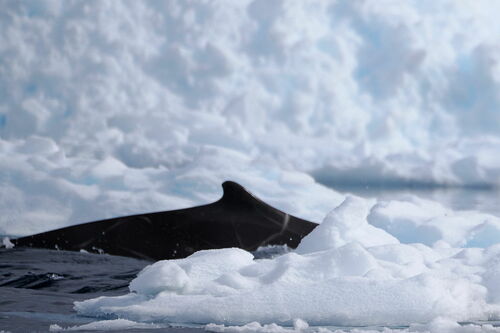
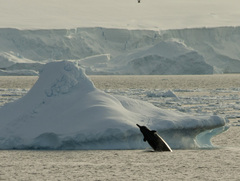
Wikipedia →

Global Distribution

Parks Where Found

# Park Country Daily sighting probability
1 Antarctic Peninsula & South Shetland Islands 🇦🇶 Antarctica
~10%

More parks will be added in future updates.

Before you go

What are the chances of seeing an Arnoux's Beaked Whale in Antarctic Peninsula & South Shetland Islands?

With luck

About 10% of wildlife watchers report an Arnoux's Beaked Whale sighting in Antarctic Peninsula & South Shetland Islands on a given day, based on 9 verified sightings from GBIF citizen-science data from 2019 to 2026. It is the 10th most-seen of the 11 mammals we can rate there. Over three days the chance rises to about 30%, and over a week to about 50%, if each day is a fresh chance.

When is the best time to see an Arnoux's Beaked Whale in Antarctic Peninsula & South Shetland Islands?

March and November

In those months about 20% of wildlife watchers report an Arnoux's Beaked Whale in Antarctic Peninsula & South Shetland Islands on a given day, against under 5% in April–June, October and December–January, the lowest months. July to September have too few records to rate.

What time of day is best to see an Arnoux's Beaked Whale?

Between 9 am and noon

Across all the parks we cover, that three-hour window holds the most Arnoux's Beaked Whale sightings with a recorded time, and about 6 in 10 of them come between 6 am and 6 pm: it is seen both by day and at night.

Where else can you see an Arnoux's Beaked Whale?

Only Antarctic Peninsula & South Shetland Islands, in our data

Antarctic Peninsula & South Shetland Islands is the only park on Wallace's Line with enough records to rate Arnoux's Beaked Whale sightings: about 10% of wildlife watchers there report one on a given day.

Which relatives of the Arnoux's Beaked Whale live in Antarctic Peninsula & South Shetland Islands?

Same order: Cetacea

The closest relatives of the Arnoux's Beaked Whale that you can see in Antarctic Peninsula & South Shetland Islands (order Cetacea) are Humpback Whale (about 90%), Killer Whale (about 50%) and Antarctic Minke Whale (about 30%), with each one's daily chance of a sighting.

Where does the Arnoux's Beaked Whale sighting chance come from?

GBIF citizen-science records

It is estimated from how often the Arnoux's Beaked Whale is recorded against all the mammals logged in Antarctic Peninsula & South Shetland Islands (9 verified sightings from 2019 to 2026), calibrated against known sighting rates. Figures are rounded to the nearest 10% because citizen-science data supports honest approximations, not decimals, and months with records from fewer than five people show "—". How it works.

← Back to Antarctic Peninsula & South Shetland Islands