Fin Whale

Fin Whale

Balaenoptera physalus

Silhouette: Chris huh · PhyloPic

LCNTVUVulnerableENCR
Daily sighting probability ~30% · Possible
at Antarctic Peninsula & South Shetland Islands

In 3 days ~70% in a week ~90%

185 Verified sightings at Antarctic Peninsula & South Shetland Islands From 2019 to 2026
343 In all 5 parks
November Best month
☀️ Diurnal When it's spotted

About the Fin Whale

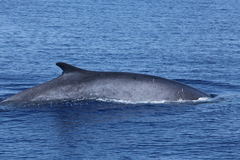
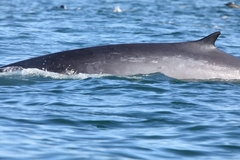
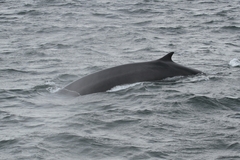
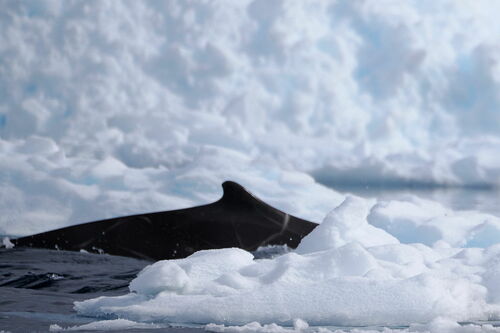
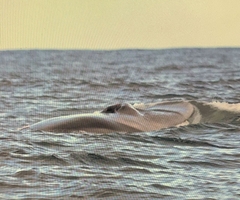
The fin whale (Balaenoptera physalus), also known as the finback whale or common rorqual, is a species of baleen whale and the second-longest cetacean after the blue whale. The biggest individual reportedly measured 26–27.3 m (85–90 ft) in length, with a maximum recorded weight of 65.5 to 120 tonnes (72.2 to 132.3 short tons; 64.5 to 118.1 long tons). The fin whale's body is long, slender, and brownish-gray in color, with a paler underside to appear less conspicuous from below (countershading).

At least two recognized subspecies exist, one in the North Atlantic and one across the Southern Hemisphere. The species is found in all the major oceans, from polar to tropical waters, and is absent only from waters close to the pack ice at the poles and relatively small areas of water away from the open ocean. The highest population density occurs in temperate and cool waters. Its prey mainly consists of smaller schooling fish, small squid, and crustaceans, including copepods and krill. Mating takes place in temperate, low-latitude seas during the winter. Fin whales are often observed in pods of 6–10 animals, with whom they communicate using frequency-modulated sounds, ranging from 16 to 40 hertz.

Like all other large whales, the fin whale was a prized kill during the "heyday" of whaling from 1840 to 1861. This remained so into the 20th century, but decades of overharvesting contributed to declining numbers through the late 20th century. Over 725,000 fin whales were reportedly taken from the Southern Hemisphere between 1905 and 1976. Postrecovery numbers of the southern subspecies are predicted to be less than 50% of the prewhaling population, even by 2010, due to long-lasting impacts of whaling and slow recovery rates. In the North Atlantic, it is considered to be fully recovered from past exploitation, while in other oceans, it is still in the process of recovery. As of 2018, it was assessed as vulnerable by the International Union for the Conservation of Nature.

Wikipedia →

Global Distribution

Parks Where Found

# Park Country Daily sighting probability
1 Antarctic Peninsula & South Shetland Islands 🇦🇶 Antarctica
~30%
2 Kenai Fjords National Park 🇺🇸 United States
~30%
3 Svalbard 🇳🇴 Norway
~20%
4 Bahía de Loreto National Park 🇲🇽 Mexico
~20%
5 Great Bear Rainforest 🇨🇦 Canada
~10%

Zoos & Centres Where Found

# Zoo / Centre Country
1 Copenhagen Zoo 🇩🇰 Denmark In captivity
2 Zoológico de Concepción 🇨🇱 Chile In captivity
3 Acuario de Sevilla 🇪🇸 Spain In captivity
4 Parque Marino de La Magdalena 🇪🇸 Spain In captivity

Before you go

What are the chances of seeing a Fin Whale in Antarctic Peninsula & South Shetland Islands?

Possible

About 30% of wildlife watchers report a Fin Whale sighting in Antarctic Peninsula & South Shetland Islands on a given day, based on 185 verified sightings from GBIF citizen-science data from 2019 to 2026. It is the 9th most-seen of the 11 mammals we can rate there. Over three days the chance rises to about 70%, and over a week to about 90%, if each day is a fresh chance.

When is the best time to see a Fin Whale in Antarctic Peninsula & South Shetland Islands?

February–March and November

In those months about 40% of wildlife watchers report a Fin Whale in Antarctic Peninsula & South Shetland Islands on a given day, against about 10% in April–June and October, the lowest months. July to September have too few records to rate.

What time of day is best to see a Fin Whale?

Between 3 and 6 pm

Across all the parks we cover, that three-hour window holds the most Fin Whale sightings with a recorded time, and about 8 in 10 of them come between 6 am and 6 pm: it is a daytime animal.

Is Antarctic Peninsula & South Shetland Islands the best place to see a Fin Whale?

Yes

Of the 5 parks where we can rate Fin Whale sightings, Antarctic Peninsula & South Shetland Islands has the highest daily chance: about 30%. Next come Kenai Fjords National Park (United States, about 30%) and Svalbard (Norway, about 20%).

Which relatives of the Fin Whale live in Antarctic Peninsula & South Shetland Islands?

Same genus: Balaenoptera

The closest relatives of the Fin Whale that you can see in Antarctic Peninsula & South Shetland Islands (genus Balaenoptera) are Antarctic Minke Whale (about 30%) and Blue Whale (about 10%), with each one's daily chance of a sighting.

Where does the Fin Whale sighting chance come from?

GBIF citizen-science records

It is estimated from how often the Fin Whale is recorded against all the mammals logged in Antarctic Peninsula & South Shetland Islands (185 verified sightings from 2019 to 2026), calibrated against known sighting rates. Figures are rounded to the nearest 10% because citizen-science data supports honest approximations, not decimals, and months with records from fewer than five people show "—". How it works.

← Back to Antarctic Peninsula & South Shetland Islands