Crabeater Seal

Crabeater Seal

Lobodon carcinophaga

Silhouette: Margot Michaud · PhyloPic

LCLeast ConcernNTVUENCR
Daily sighting probability ~80% · Very likely
at Antarctic Peninsula & South Shetland Islands

In 3 days >90%

584 Verified sightings at Antarctic Peninsula & South Shetland Islands From 2019 to 2026
584 In 1 park
February Best month
☀️ Diurnal When it's spotted

About the Crabeater Seal

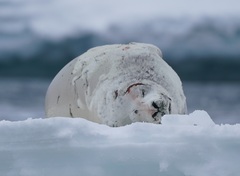
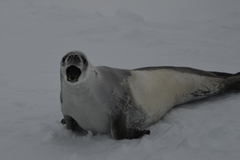
The crabeater seal (Lobodon carcinophaga), also known as the krill-eater seal, is a true seal with a circumpolar distribution around the coast of Antarctica. They are the only member of the genus Lobodon. They are medium- to large-sized (over 2 m (6.6 ft) in length), relatively slender and pale-colored, found primarily on the free-floating pack ice that extends seasonally out from the Antarctic coast, which they use as a platform for resting, mating, social aggregation and accessing their prey. They are by far the most abundant seal species in the world. While population estimates are uncertain, there are at least 7 million and possibly as many as 75 million individuals. This success of this species is due to its specialized predation on the abundant Antarctic krill of the Southern Ocean, for which it has uniquely adapted, sieve-like tooth structure. Indeed, its scientific name, translated as "lobe-toothed (lobodon) crab eater (carcinophaga)", refers specifically to the finely lobed teeth adapted to filtering their small crustacean prey.

Despite its name, the crabeater seal does not eat crabs. As well as being an important krill predator, the crabeater seal's pups are an important component of the diet of leopard seals (H. leptonyx).

Wikipedia →

Global Distribution

Parks Where Found

# Park Country Daily sighting probability
1 Antarctic Peninsula & South Shetland Islands 🇦🇶 Antarctica
~80%

More parks will be added in future updates.

Before you go

What are the chances of seeing a Crabeater Seal in Antarctic Peninsula & South Shetland Islands?

Very likely

About 80% of wildlife watchers report a Crabeater Seal sighting in Antarctic Peninsula & South Shetland Islands on a given day, based on 584 verified sightings from GBIF citizen-science data from 2019 to 2026. It is the 3rd most-seen of the 11 mammals we can rate there. Over three days the chance rises to over 90%, if each day is a fresh chance.

When is the best time to see a Crabeater Seal in Antarctic Peninsula & South Shetland Islands?

January–February and June

In those months about 80% of wildlife watchers report a Crabeater Seal in Antarctic Peninsula & South Shetland Islands on a given day, against about 30% in May, the lowest month. July to September have too few records to rate.

What time of day is best to see a Crabeater Seal?

Between 9 am and noon

Across all the parks we cover, that three-hour window holds the most Crabeater Seal sightings with a recorded time, and about 9 in 10 of them come between 6 am and 6 pm: it is a daytime animal.

Where else can you see a Crabeater Seal?

Only Antarctic Peninsula & South Shetland Islands, in our data

Antarctic Peninsula & South Shetland Islands is the only park on Wallace's Line with enough records to rate Crabeater Seal sightings: about 80% of wildlife watchers there report one on a given day.

Which relatives of the Crabeater Seal live in Antarctic Peninsula & South Shetland Islands?

Same family: Phocidae

The closest relatives of the Crabeater Seal that you can see in Antarctic Peninsula & South Shetland Islands (family Phocidae, Earless Seals) are Weddell Seal (about 80%), Leopard Seal (about 70%) and Southern Elephant Seal (about 50%), with each one's daily chance of a sighting.

Where does the Crabeater Seal sighting chance come from?

GBIF citizen-science records

It is estimated from how often the Crabeater Seal is recorded against all the mammals logged in Antarctic Peninsula & South Shetland Islands (584 verified sightings from 2019 to 2026), calibrated against known sighting rates. Figures are rounded to the nearest 10% because citizen-science data supports honest approximations, not decimals, and months with records from fewer than five people show "—". How it works.

← Back to Antarctic Peninsula & South Shetland Islands