Leopard Seal

Leopard Seal

Hydrurga leptonyx

Silhouette: Margot Michaud · PhyloPic

LCLeast ConcernNTVUENCR
Daily sighting probability ~70% · Very likely
at Antarctic Peninsula & South Shetland Islands

In 3 days >90%

512 Verified sightings at Antarctic Peninsula & South Shetland Islands From 2019 to 2026
547 In all 4 parks
June Best month
☀️ Diurnal When it's spotted

About the Leopard Seal

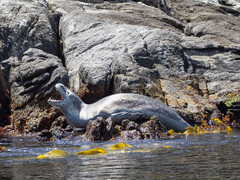
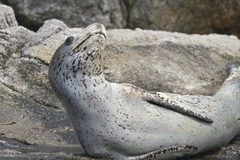
The leopard seal (Hydrurga leptonyx), also referred to as the sea leopard, is a long and muscular seal native to the Southern Ocean of Antarctica and southern Patagonia. It is the second largest species of seal in the Antarctic (after the southern elephant seal). It is the same length as, but half the weight of, a walrus. Its fur coat is countershaded, being silver on the bottom and dark gray on the top, and is distinctive for its leopard-like pattern of dark spots.

The leopard seal is an apex predator, with massive jaws, and teeth which are 2.5 cm (1 in) long. It feeds on a wide range of prey including its fellow pinnipeds, cephalopods, krill, fish, and birds, particularly penguins. Its only natural predator is the orca. It uses its hearing and whiskers to track prey underwater.

It is the only species in the genus Hydrurga. Its closest relatives are the Ross seal, the crabeater seal, and the Weddell seal, which are all Antarctic seals of the tribe Lobodontini. Henri Marie Ducrotay de Blainville, a French zoologist, described the leopard seal in 1820 from a stuffed specimen from the collection of one M. Hauville, in Le Havre. The skin that produced...

Wikipedia →

Global Distribution

Parks Where Found

# Park Country Daily sighting probability
1 Antarctic Peninsula & South Shetland Islands 🇦🇶 Antarctica
~70%
2 South Georgia and the South Sandwich Islands 🇬🇸 South Georgia and the South Sandwich Islands
~30%
3 Great Otway National Park 🇦🇺 Australia
~10%
4 Table Mountain National Park 🇿🇦 South Africa
<5%

Cities Where Found

# City Country Daily sighting probability
1 Auckland 🇳🇿 New Zealand
<5%

Zoos & Centres Where Found

# Zoo / Centre Country
1 Taronga Zoo 🇦🇺 Australia In captivity

Before you go

What are the chances of seeing a Leopard Seal in Antarctic Peninsula & South Shetland Islands?

Very likely

About 70% of wildlife watchers report a Leopard Seal sighting in Antarctic Peninsula & South Shetland Islands on a given day, based on 512 verified sightings from GBIF citizen-science data from 2019 to 2026. It is the 4th most-seen of the 11 mammals we can rate there. Over three days the chance rises to over 90%, if each day is a fresh chance.

When is the best time to see a Leopard Seal in Antarctic Peninsula & South Shetland Islands?

January–April and June

In those months about 80% of wildlife watchers report a Leopard Seal in Antarctic Peninsula & South Shetland Islands on a given day, against about 20% in October, the lowest month. July to September have too few records to rate.

What time of day is best to see a Leopard Seal?

Between 3 and 6 pm

Across all the parks we cover, that three-hour window holds the most Leopard Seal sightings with a recorded time, and about 7 in 10 of them come between 6 am and 6 pm: it is a daytime animal.

Is Antarctic Peninsula & South Shetland Islands the best place to see a Leopard Seal?

Yes

Of the 4 parks where we can rate Leopard Seal sightings, Antarctic Peninsula & South Shetland Islands has the highest daily chance: about 70%. Next come South Georgia and the South Sandwich Islands (South Georgia and the South Sandwich Islands, about 30%) and Great Otway National Park (Australia, about 10%).

Which relatives of the Leopard Seal live in Antarctic Peninsula & South Shetland Islands?

Same family: Phocidae

The closest relatives of the Leopard Seal that you can see in Antarctic Peninsula & South Shetland Islands (family Phocidae, Earless Seals) are Weddell Seal (about 80%), Crabeater Seal (about 80%) and Southern Elephant Seal (about 50%), with each one's daily chance of a sighting.

Where does the Leopard Seal sighting chance come from?

GBIF citizen-science records

It is estimated from how often the Leopard Seal is recorded against all the mammals logged in Antarctic Peninsula & South Shetland Islands (512 verified sightings from 2019 to 2026), calibrated against known sighting rates. Figures are rounded to the nearest 10% because citizen-science data supports honest approximations, not decimals, and months with records from fewer than five people show "—". How it works.

← Back to Antarctic Peninsula & South Shetland Islands