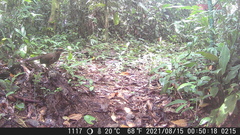
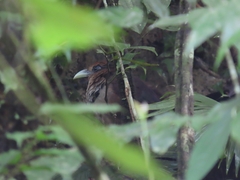
Rufous-vented Ground-Cuckoo

Rufous-vented Ground-Cuckoo

Neomorphus geoffroyi

Silhouette: Nicolas Huet le Jeune and Jean-Gabriel Prêtre (vectorized by T. Michael Keesey) · PhyloPic

LCNTVUVulnerableENCR
Daily sighting probability <5% · Rare
at Arenal Volcano National Park

In 3 days <5%

51 Verified sightings at Arenal Volcano National Park From 2019 to 2026
170 In all 7 parks
February Best month
☀️ Diurnal When it's spotted

About the Rufous-vented Ground-Cuckoo

The rufous-vented ground cuckoo (Neomorphus geoffroyi) is a Vulnerable species of cuckoo in the tribe Neomorphini of subfamily Crotophaginae. It is found in Bolivia, Brazil, Colombia, Costa Rica, Ecuador, Nicaragua, Panama, and Peru.

The International Ornithological Committee's Handbook of the Birds of the World adds a seventh, N. g. squamiger, that the other systems treat as the separate species scaled ground cuckoo. In the early 20th century subspecies N. g. salvini was considered by some authors as a separate species but that treatment did not gain wide acceptance.

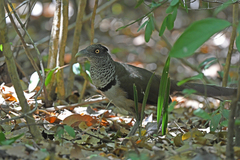
The rufous-vented ground cuckoo is 45 to 51 cm (18 to 20 in) long, about half of which is its tail, and weighs about 300 to 400 g (11 to 14 oz). Adults have a heavy decurved bill that is pale grayish green to horn-colored at its base with a yellow tip. All subspecies have a shaggy, glossy blue... Wikipedia →

Sounds

Bill snaps1:18

Brazil · 2023

© Marco Cruz · XC843687 · CC BY-NC-ND 4.0

Call0:28

Bolivia · 2022

© Dušan M. Brinkhuizen · XC738794 · CC BY-NC-ND 4.0

Song0:20

Ecuador · 2010

© Andrew Spencer · XC61276 · CC BY-NC-ND 2.5

Global Distribution

Parks Where Found

# Park Country Daily sighting probability
1 Rincón de la Vieja National Park 🇨🇷 Costa Rica
<5%
2 Chagres National Park 🇵🇦 Panama
<5%
3 Arenal Volcano National Park 🇨🇷 Costa Rica
<5%
4 Tapantí-Macizo de la Muerte National Park 🇨🇷 Costa Rica
<5%
5 Manu National Park 🇵🇪 Peru
<5%
6 Soberanía National Park 🇵🇦 Panama
<5%
7 Tambopata National Reserve 🇵🇪 Peru
<5%

Before you go

What are the chances of seeing a Rufous-vented Ground-Cuckoo in Arenal Volcano National Park?

Rare

Under 5% of wildlife watchers report a Rufous-vented Ground-Cuckoo sighting in Arenal Volcano National Park on a given day, based on 51 verified sightings from GBIF citizen-science data from 2019 to 2026. It is the 398th most-seen of the 503 birds we can rate there. Over three days the chance rises to under 5%, if each day is a fresh chance.

When is the best time to see a Rufous-vented Ground-Cuckoo in Arenal Volcano National Park?

Any time of year

In every month with enough records, under 5% of wildlife watchers report a Rufous-vented Ground-Cuckoo in Arenal Volcano National Park on a given day, so our monthly data shows no clear season.

What time of day is best to see a Rufous-vented Ground-Cuckoo?

Between 10 am and 1 pm

Across all the parks we cover, that three-hour window holds the most Rufous-vented Ground-Cuckoo sightings with a recorded time, and about 9 in 10 of them come between 6 am and 6 pm: it is a daytime animal.

Is Arenal Volcano National Park the best place to see a Rufous-vented Ground-Cuckoo?

Among the best

Of the 7 parks where we can rate Rufous-vented Ground-Cuckoo sightings, Arenal Volcano National Park ranks 3rd at under 5%, level with the leaders once rounded. The best odds are in Rincón de la Vieja National Park (Costa Rica, under 5%) and Chagres National Park (Panama, under 5%).

Which relatives of the Rufous-vented Ground-Cuckoo live in Arenal Volcano National Park?

Same family: Cuculidae

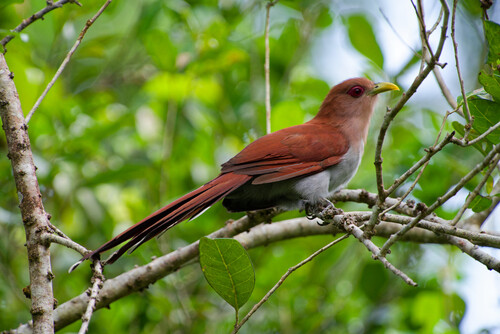
The closest relatives of the Rufous-vented Ground-Cuckoo that you can see in Arenal Volcano National Park (family Cuculidae, Cuckoos) are Squirrel Cuckoo (about 10%) and Groove-billed Ani (about 10%), with each one's daily chance of a sighting.

Where does the Rufous-vented Ground-Cuckoo sighting chance come from?

GBIF citizen-science records

It is estimated from how often the Rufous-vented Ground-Cuckoo is recorded against all the birds logged in Arenal Volcano National Park (51 verified sightings from 2019 to 2026), calibrated against known sighting rates. Figures are rounded to the nearest 10% because citizen-science data supports honest approximations, not decimals, and months with records from fewer than five people show "—". How it works.

← Back to Arenal Volcano National Park