South American Forest Racer

South American Forest Racer

Dendrophidion percarinatum

Silhouette: Alex Slavenko · PhyloPic

LCLeast ConcernNTVUENCR
Daily sighting probability ~10% · With luck
at Arenal Volcano National Park

In 3 days ~20% in a week ~50%

13 Verified sightings at Arenal Volcano National Park From 2019 to 2026
64 In all 6 parks
May Best month
☀️ Diurnal When it's spotted

About the South American Forest Racer

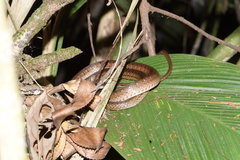
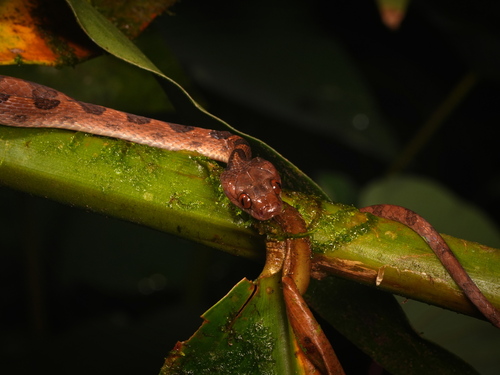
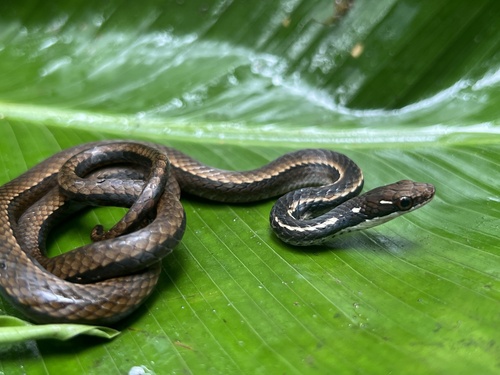
Dendrophidion percarinatum, commonly known as the South American forest racer, is a snake in the family Colubridae. It is found in forests in Central and northern South America. Dendrophidion percarinatum is a forest snake that lives on the forest floor. Its size varies from 40.1 to 85.2 cm (15.8 to 33.5 in). It has 147 to 170 ventral scales, 84 to 106 dorsal scales, and 133 to 164 subcaudal scales. One main characteristic is the presence of a divided anal plate. Its coloration is dark brown or gray dorsally, with a lighter, cream color on its underbelly. Additionally, on its dorsal side, it has black cross bars with light dots that cover most of the snake's body.

Dendrophidion percarinatum is found in Honduras, Nicaragua, Costa Rica, Panama, northern Colombia and northwestern Venezuela, with the population in Venezuela believed to be a distinct population from the rest of the range. It is normally found at elevations <1000 m but has been found up to 1200 m in southwestern Costa Rica.

Dendrophidion percarinatum is a diurnal and semi-arboreal snake that primarily consumes frogs, lizards, and other small animals that live... Wikipedia →

Global Distribution

Parks Where Found

# Park Country Daily sighting probability
1 Piedras Blancas National Park 🇨🇷 Costa Rica
~20%
2 Corcovado National Park 🇨🇷 Costa Rica
~10%
3 Soberanía National Park 🇵🇦 Panama
~10%
4 Manuel Antonio National Park 🇨🇷 Costa Rica
~10%
5 Arenal Volcano National Park 🇨🇷 Costa Rica
~10%
6 Carara National Park 🇨🇷 Costa Rica
~10%

Before you go

What are the chances of seeing a South American Forest Racer in Arenal Volcano National Park?

With luck

About 10% of wildlife watchers report a South American Forest Racer sighting in Arenal Volcano National Park on a given day, based on 13 verified sightings from GBIF citizen-science data from 2019 to 2026. It is the 43rd most-seen of the 64 reptiles we can rate there. Over three days the chance rises to about 20%, and over a week to about 50%, if each day is a fresh chance.

When is the best time to see a South American Forest Racer in Arenal Volcano National Park?

May

In that month about 20% of wildlife watchers report a South American Forest Racer in Arenal Volcano National Park on a given day, against under 5% in February, August and November, the lowest months.

What time of day is best to see a South American Forest Racer?

Between 8 and 11 am

Across all the parks we cover, that three-hour window holds the most South American Forest Racer sightings with a recorded time, and about 7 in 10 of them come between 6 am and 6 pm: it is a daytime animal.

Is Arenal Volcano National Park the best place to see a South American Forest Racer?

5th of 6

Of the 6 parks where we can rate South American Forest Racer sightings, Arenal Volcano National Park ranks 5th at about 10%. The best odds are in Piedras Blancas National Park (Costa Rica, about 20%), Corcovado National Park (Costa Rica, about 10%) and Soberanía National Park (Panama, about 10%).

Which relatives of the South American Forest Racer live in Arenal Volcano National Park?

Same family: Colubridae

The closest relatives of the South American Forest Racer that you can see in Arenal Volcano National Park (family Colubridae, Colubrid Snakes) are Ornate Cat-eyed Snake (about 30%), Cloudy Snail-eating Snake (about 20%) and Blunthead Tree Snake (about 20%), with each one's daily chance of a sighting.

Where does the South American Forest Racer sighting chance come from?

GBIF citizen-science records

It is estimated from how often the South American Forest Racer is recorded against all the reptiles logged in Arenal Volcano National Park (13 verified sightings from 2019 to 2026), calibrated against known sighting rates. Figures are rounded to the nearest 10% because citizen-science data supports honest approximations, not decimals, and months with records from fewer than five people show "—". How it works.

← Back to Arenal Volcano National Park