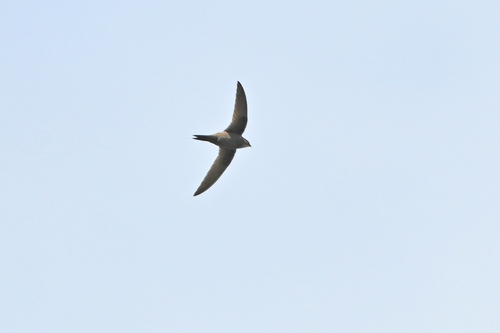
Horus Swift

Horus Swift

Apus horus

Silhouette: Ferran Sayol · PhyloPic

LCLeast ConcernNTVUENCR
Daily sighting probability ~10% · With luck
at Arusha National Park

In 3 days ~20% in a week ~50%

49 Verified sightings at Arusha National Park From 2019 to 2026
666 In all 22 parks
March Best month
☀️ Diurnal When it's spotted

About the Horus Swift

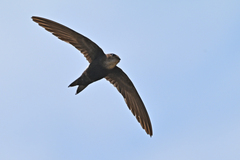
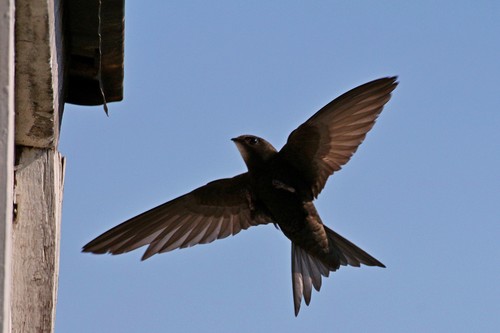
The Horus swift (Apus horus) is a small bird in the swift family Apodidae that is found in sub-Saharan Africa. Horus, whose name this bird commemorates, was the ancient Egyptian god of the sun, son of Osiris and Isis. The Horus swift was formally described in 1869 by the German explorer and ornithologist Theodor von Heuglin under the binomial name Cypselus horus. The specific epithet is from Ancient Egyptian mythology: Horus was the god of the sun. This species is now one of 20 swifts placed in the genus Apus that was introduced in 1777 by the Italian naturalist Giovanni Antonio Scopoli. The species is treated as monotypic.

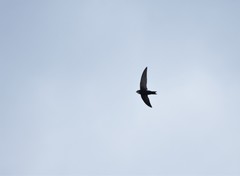
The Horus swift is 13–15 cm (5.1–5.9 in) long and quite bulky. It appears entirely blackish except for a white patch on the chin and a white rump. It has a medium length forked tail. It has a fluttering flight like little swift. The little swift has a square tail, and more extensive white on the rump than Horus, and white-rumped swift has a more deeply forked tail and a narrower white band... Wikipedia →

Sounds

Call0:52

Senegal · 2026

© Peter Boesman · XC1081085 · CC BY-NC-ND 4.0

Call0:44

Senegal · 2018

© Bram Piot · XC438048 · CC BY-NC-SA 4.0

Global Distribution

Parks Where Found

# Park Country Daily sighting probability
1 Arusha National Park 🇹🇿 Tanzania
~10%
2 South Luangwa National Park 🇿🇲 Zambia
~10%
3 Mana Pools National Park 🇿🇼 Zimbabwe
~10%
4 Golden Gate Highlands National Park 🇿🇦 South Africa
~10%
5 De Hoop Nature Reserve 🇿🇦 South Africa
~10%
6 Lake Nakuru National Park 🇰🇪 Kenya
<5%
7 Masai Mara National Reserve 🇰🇪 Kenya
<5%
8 Tarangire National Park 🇹🇿 Tanzania
<5%
9 Kibale National Park 🇺🇬 Uganda
<5%
10 Serengeti National Park 🇹🇿 Tanzania
<5%
11 Amboseli National Park 🇰🇪 Kenya
<5%
12 Addo Elephant National Park 🇿🇦 South Africa
<5%
13 Hwange National Park 🇿🇼 Zimbabwe
<5%
14 Lower Zambezi National Park 🇿🇲 Zambia
<5%
15 Queen Elizabeth National Park 🇺🇬 Uganda
<5%
16 Ngorongoro Conservation Area 🇹🇿 Tanzania
<5%
17 Garden Route National Park 🇿🇦 South Africa
<5%
18 Murchison Falls National Park 🇺🇬 Uganda
<5%
19 Kruger National Park 🇿🇦 South Africa
<5%
20 Bwindi Impenetrable National Park 🇺🇬 Uganda
<5%
21 Lake Mburo National Park 🇺🇬 Uganda
<5%
22 Nyungwe National Park 🇷🇼 Rwanda
<5%

Before you go

What are the chances of seeing a Horus Swift in Arusha National Park?

With luck

About 10% of wildlife watchers report a Horus Swift sighting in Arusha National Park on a given day, based on 49 verified sightings from GBIF citizen-science data from 2019 to 2026. It is the 171st most-seen of the 373 birds we can rate there. Over three days the chance rises to about 20%, and over a week to about 50%, if each day is a fresh chance.

When is the best time to see a Horus Swift in Arusha National Park?

March

In that month about 30% of wildlife watchers report a Horus Swift in Arusha National Park on a given day, against under 5% in January and May–November, the lowest months.

What time of day is best to see a Horus Swift?

Between 9 am and noon

Across all the parks we cover, that three-hour window holds the most Horus Swift sightings with a recorded time, and about 9 in 10 of them come between 6 am and 6 pm: it is a daytime animal.

Is Arusha National Park the best place to see a Horus Swift?

Yes

Of the 22 parks where we can rate Horus Swift sightings, Arusha National Park has the highest daily chance: about 10%. Next come South Luangwa National Park (Zambia, about 10%) and Mana Pools National Park (Zimbabwe, about 10%).

Which relatives of the Horus Swift live in Arusha National Park?

Same genus: Apus

The closest relatives of the Horus Swift that you can see in Arusha National Park (genus Apus, Typical Swifts) are Little Swift (about 20%), White-rumped Swift (about 10%) and Nyanza Swift (about 10%), with each one's daily chance of a sighting.

Where does the Horus Swift sighting chance come from?

GBIF citizen-science records

It is estimated from how often the Horus Swift is recorded against all the birds logged in Arusha National Park (49 verified sightings from 2019 to 2026), calibrated against known sighting rates. Figures are rounded to the nearest 10% because citizen-science data supports honest approximations, not decimals, and months with records from fewer than five people show "—". How it works.

← Back to Arusha National Park