Suni

Suni

Neotragus moschatus

Silhouette: [unknown] · PhyloPic

Daily sighting probability ~30% · Possible
at Arusha National Park

In 3 days ~60% in a week ~90%

7 Verified sightings at Arusha National Park From 2019 to 2026
46 In all 4 parks
January Best month
☀️ Diurnal When it's spotted

About the Suni

The suni (Nesotragus moschatus) is a small antelope of the family Bovidae, and one of the smallest ungulates on earth. It occurs in dense underbrush from central Kenya to KwaZulu-Natal in South Africa. It is also found on the island of Zanzibar off of Tanzania.

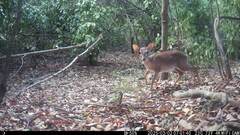
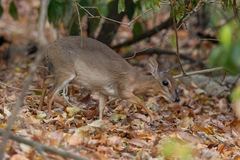
Suni are around 30 to 43 centimetres (12 to 17 inches) high at the shoulder and weigh 4.5 to 5.4 kilograms (9 lb 15 oz to 11 lb 14 oz). They are usually reddish brown, darker on their back than their sides and legs. The belly, chin, throat and insides of legs are white. The nostrils are prominent red, and there are black rings around the eyes and above the hooves. Males have horns 8–13 cm (3–5 in) long, that are ridged most of their length and curve backwards close to their heads. Females do not have horns. Suni can make weak barking and whistling sounds.

Suni feed on leaves, fungi, fruits and flowers, and need almost no free water. They are shy, most active at night, and sleep during the day in a shady, sheltered area. They are social but males defend a territory of about three hectares. They scent-mark the boundaries with secretions from their preorbital glands. There may be an individual or communal dung pile on the periphery of the territory. A male usually takes one mate, but other females may share his territory. A single calf is born weighing about two pounds, after a gestation of 183 days.

Felids, raptors, snakes, and other meat-eaters prey on suni. For protection, they are well camouflaged in dry grass and keep very still. When a predator is almost on top of them, they spring out and bound away into the underbrush. Wikipedia →

Global Distribution

Parks Where Found

# Park Country Daily sighting probability
1 Aberdare National Park 🇰🇪 Kenya
~60%
2 Nairobi National Park 🇰🇪 Kenya
~30%
3 Arusha National Park 🇹🇿 Tanzania
~30%
4 uMkhuze Game Reserve 🇿🇦 South Africa
~20%

Cities Where Found

# City Country Daily sighting probability
1 Nairobi 🇰🇪 Kenya
~40%

Zoos & Centres Where Found

# Zoo / Centre Country
1 Jardim Zoológico de Maputo 🇲🇿 Mozambique In captivity
2 Tortoise Sanctuary 🇹🇿 Tanzania In captivity
3 Exotic Animal World 🇿🇦 South Africa In captivity

Before you go

What are the chances of seeing a Suni in Arusha National Park?

Possible

About 30% of wildlife watchers report a Suni sighting in Arusha National Park on a given day, based on 7 verified sightings from GBIF citizen-science data from 2019 to 2026. It is the 12th most-seen of the 16 mammals we can rate there. Over three days the chance rises to about 60%, and over a week to about 90%, if each day is a fresh chance.

When is the best time to see a Suni in Arusha National Park?

January and November

In those months about 50% of wildlife watchers report a Suni in Arusha National Park on a given day, against under 5% in February–June, September and December, the lowest months.

What time of day is best to see a Suni?

Between 5 and 8 am

Across all the parks we cover, that three-hour window holds the most Suni sightings with a recorded time, and about 7 in 10 of them come between 6 am and 6 pm: it is a daytime animal.

Which relatives of the Suni live in Arusha National Park?

Same family: Bovidae

The closest relatives of the Suni that you can see in Arusha National Park (family Bovidae, Bovids) are Waterbuck (about 80%), Northern Bushbuck (about 80%) and African Buffalo (about 60%), with each one's daily chance of a sighting.

Where does the Suni sighting chance come from?

GBIF citizen-science records

It is estimated from how often the Suni is recorded against all the mammals logged in Arusha National Park (7 verified sightings from 2019 to 2026), calibrated against known sighting rates. Figures are rounded to the nearest 10% because citizen-science data supports honest approximations, not decimals, and months with records from fewer than five people show "—". How it works.

← Back to Arusha National Park