


Completed


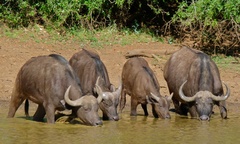


African Buffalo
Syncerus caffer
Silhouette: Jan A. Venter, Herbert H. T. Prins, David A. Balfour & Rob Slotow (vectorized by T. Michael Keesey) · PhyloPic
- KingdomAnimalia (Animals)
- PhylumChordata (Chordates)
- ClassMammalia (Mammals)
- OrderArtiodactyla (Even-toed Ungulates and Cetaceans)
- FamilyBovidae (Bovids)
- GenusSyncerus (African Buffaloes)
- SpeciesSyncerus caffer (African Buffalo)
In 3 days ~90% in a week >90%
82 Verified sightings at Arusha National Park From 2019 to 2026
5,499 In all 41 parks
July Best month
☀️ Diurnal When it's spotted


Completed
About the African Buffalo
The African buffalo (Syncerus caffer) is a large species of true buffalo native to Sub-Saharan Africa, where it is found in a number of disconnected ranges stretching from south-eastern Senegal through West and Central Africa to South Africa. The adult African buffalo's horns are its characteristic feature: they have fused bases that form a continuous bone shield, referred to as a "boss", across the top of the head. The African buffalo is more closely related to Asian buffalo (Bubalus) species than it is to other bovids such as American bison or domestic cattle. Its unpredictable temperament may be part of the reason that the African buffalo has never been domesticated and has no domesticated descendants, unlike the wild yak and wild water buffalo, which are the ancestors of the domestic yak and water buffalo, respectively. Natural predators of adult African buffaloes include lions, African wild dogs, spotted hyenas, and Nile crocodiles. As one of the Big Five game animals, the Cape buffalo (Syncerus caffer caffer), the largest subspecies native to eastern and southern Africa, is a sought-after trophy in hunting.
The African buffalo is a very robust species. Its shoulder... Wikipedia →
Sounds
Call0:22
Gabon · 2019
© Étienne Leroy · XC960200 · CC BY-NC-SA 4.0
Recording0:37
South Africa · 2025
© Sascha Schumann · iNaturalist · CC BY-NC 4.0
Recording0:16
Congo - Brazzaville · 2019
© Mathias D'haen · iNaturalist · CC BY-NC 4.0
Recent sightings of African Buffalo in Arusha National Park
LIVEiNaturalistGlobal Distribution
Parks Where Found
Zoos & Centres Where Found
Closest Relatives at Arusha National Park


Before you go
What are the chances of seeing an African Buffalo in Arusha National Park?
Likely
About 60% of wildlife watchers report an African Buffalo sighting in Arusha National Park on a given day, based on 82 verified sightings from GBIF citizen-science data from 2019 to 2026. It is the 8th most-seen of the 16 mammals we can rate there. Over three days the chance rises to about 90%, and over a week to over 90%, if each day is a fresh chance.
When is the best time to see an African Buffalo in Arusha National Park?
April–May, July and November
In those months about 70% of wildlife watchers report an African Buffalo in Arusha National Park on a given day, against about 40% in June, the lowest month. Those are among Arusha National Park's wettest months, with about 240 mm of rain a month against 65 mm in September.
What time of day is best to see an African Buffalo?
Between 7 and 10 am
Across all the parks we cover, that three-hour window holds the most African Buffalo sightings with a recorded time, and about 9 in 10 of them come between 6 am and 6 pm: it is a daytime animal.
Is Arusha National Park the best place to see an African Buffalo?
11th of 41
Of the 41 parks where we can rate African Buffalo sightings, Arusha National Park ranks 11th at about 60%. The best odds are in Kidepo Valley National Park (Uganda, about 80%), Aberdare National Park (Kenya, about 80%) and Murchison Falls National Park (Uganda, about 70%). All parks ranked.
Which relatives of the African Buffalo live in Arusha National Park?
Same family: Bovidae
The closest relatives of the African Buffalo that you can see in Arusha National Park (family Bovidae, Bovids) are Waterbuck (about 80%), Northern Bushbuck (about 80%) and Natal Duiker (about 50%), with each one's daily chance of a sighting.
Where does the African Buffalo sighting chance come from?
GBIF citizen-science records
It is estimated from how often the African Buffalo is recorded against all the mammals logged in Arusha National Park (82 verified sightings from 2019 to 2026), calibrated against known sighting rates. Figures are rounded to the nearest 10% because citizen-science data supports honest approximations, not decimals, and months with records from fewer than five people show "—". How it works.
