Red-crowned Barbet

Red-crowned Barbet

Psilopogon rafflesii

Silhouette: Vijay Cavale (photo), John E. McCormack, Michael G. Harvey, Brant C. Faircloth, Nicholas G. Crawford, Travis C. Glenn, Robb T. Brumfield & T. Michael Keesey · PhyloPic

LCNTNear ThreatenedVUENCR
Daily sighting probability ~30% · Possible
at Bako National Park

In 3 days ~70% in a week ~90%

59 Verified sightings at Bako National Park From 2019 to 2026
424 In all 7 parks
June Best month
🌅 Crepuscular When it's spotted

About the Red-crowned Barbet

The red-crowned barbet (Psilopogon rafflesii) is part of one of the two subfamilies of Megalaimidae birds. it is in the order of woodpeckers (Piciformes) and their relatives. It is distributed in Myanmar, Thailand, Malaysia, Singapore, Indonesia and Brunei. Its natural habitats are subtropical or tropical moist lowland forests and plantations with a distribution area of 3,180,000 km2 (1,230,000 sq mi).

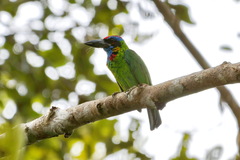
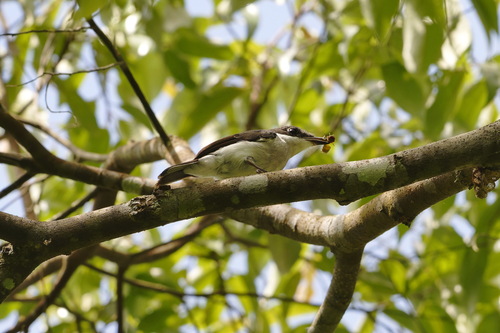
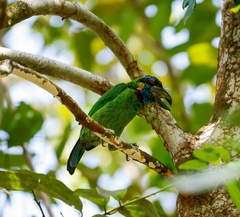
The red-crowned barbet is a medium-large tropical bird, 24.5–27 cm (9.6–10.6 in) long and 99–150 g (3.5–5.3 oz) in weight. Both sexes are primarily green, with a red crown, red spots below the eyes, and a red mark on the side of the neck. The barbet wears a blue throat and broad supercilia accompanied by a black and yellow face. Immature and females resemble males with a duller colour scheme called monomorphism.

The red-crowned barbet belongs to the woodpecker order Piciformes in the family of Psilopogon. This lineage of the Barbet family can be traced to America, Asia and Africa. They separated into the New World (Americas) and the Old World (Asia and Africa) Barbets. Such genus of the Americas is the Toucan barbet, which separated before the Gilded barbet... Wikipedia →

Sounds

Call0:37

Malaysia · 2026

© Ding Li Yong · XC1186803 · CC BY-NC-ND 4.0

Song0:28

Malaysia · 2024

© Lim Ying Hien · XC947267 · CC BY-NC-ND 4.0

Call0:47

Singapore · 2022

© Joshua Chong · XC766580 · CC BY-NC-SA 4.0

Global Distribution

Parks Where Found

# Park Country Daily sighting probability
1 Way Kambas National Park 🇮🇩 Indonesia
~70%
2 Tanjung Puting National Park 🇮🇩 Indonesia
~50%
3 Bako National Park 🇲🇾 Malaysia
~30%
4 Taman Negara National Park 🇲🇾 Malaysia
<5%
5 Danum Valley Conservation Area 🇲🇾 Malaysia
<5%
6 Sepilok 🇲🇾 Malaysia
<5%
7 Kinabalu Park 🇲🇾 Malaysia
<5%

Cities Where Found

# City Country Daily sighting probability
1 Singapore 🇸🇬 Singapore
~10%
2 Kuching 🇲🇾 Malaysia
<5%

Before you go

What are the chances of seeing a Red-crowned Barbet in Bako National Park?

Possible

About 30% of wildlife watchers report a Red-crowned Barbet sighting in Bako National Park on a given day, based on 59 verified sightings from GBIF citizen-science data from 2019 to 2026. It is the 23rd most-seen of the 70 birds we can rate there. Over three days the chance rises to about 70%, and over a week to about 90%, if each day is a fresh chance.

When is the best time to see a Red-crowned Barbet in Bako National Park?

June

In that month about 40% of wildlife watchers report a Red-crowned Barbet in Bako National Park on a given day, against about 20% in July and October, the lowest months. November and December have too few records to rate.

What time of day is best to see a Red-crowned Barbet?

Between 1 and 4 am

Across all the parks we cover, that three-hour window holds the most Red-crowned Barbet sightings with a recorded time, and about 7 in 10 of them come between 6 pm and 6 am: it is most active around dawn and dusk.

Is Bako National Park the best place to see a Red-crowned Barbet?

3rd of 7

Of the 7 parks where we can rate Red-crowned Barbet sightings, Bako National Park ranks 3rd at about 30%. The best odds are in Way Kambas National Park (Indonesia, about 70%) and Tanjung Puting National Park (Indonesia, about 50%).

Which relatives of the Red-crowned Barbet live in Bako National Park?

Same genus: Psilopogon

The closest relatives of the Red-crowned Barbet that you can see in Bako National Park (genus Psilopogon, Typical Asian Barbets) are Black-eared Barbet (about 10%) and Red-throated Barbet (about 10%), with each one's daily chance of a sighting.

Where does the Red-crowned Barbet sighting chance come from?

GBIF citizen-science records

It is estimated from how often the Red-crowned Barbet is recorded against all the birds logged in Bako National Park (59 verified sightings from 2019 to 2026), calibrated against known sighting rates. Figures are rounded to the nearest 10% because citizen-science data supports honest approximations, not decimals, and months with records from fewer than five people show "—". How it works.

← Back to Bako National Park