Abyssinian Ground-Thrush

Abyssinian Ground-Thrush

Geokichla piaggiae

Silhouette: Francesco "Architetto" Rollandin · PhyloPic

LCLeast ConcernNTVUENCR
Daily sighting probability ~10% · With luck
at Bale Mountains National Park

In 3 days ~30% in a week ~60%

26 Verified sightings at Bale Mountains National Park From 2019 to 2026
138 In all 6 parks
July Best month
☀️ Diurnal When it's spotted

About the Abyssinian Ground-Thrush

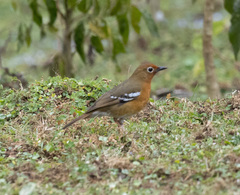
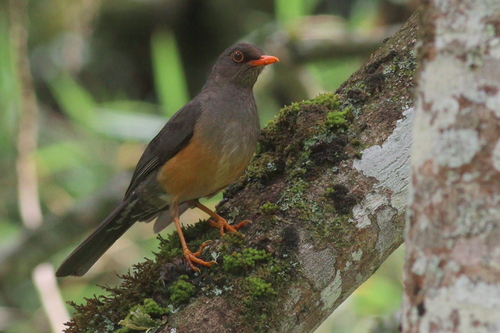
The Abyssinian ground thrush (Geokichla piaggiae) is a thrush from the family Turdidae which is native to north-east Africa where it lives at high altitude in montane forests. Its binomial nomenclature honors the 19th century Italian explorer of East Africa Carlo Piaggia.

The Abyssinian ground thrush is an attractive but rather secretive species. The adults are a deep rufous orange on the head and face with a distinct white eye ring, the orange colour becomes les rufous on the breast and flanks and the upperparts are olive brown except for the orange-brown rump and tail. On the folded wing it shows two prominent white wingbars from the tips to the coverts. Immature birds tend to be paler and duller than the adults. They measure 19–20 cm (7.5–7.9 in) in length and weigh 43–65 g (1.5–2.3 oz).

The contact call of the Abyssinian ground thrush is a high pitched "tseep", the song is a typical thrush like melodious series of whistled phrases rendered in Sinclair & Ryan as "chee-cheeleeroo-chruup". There are six currently recognised subspecies of Abyssinian ground thrush and they are listed below with their distributions:

Geokichla... Wikipedia →

Sounds

Song0:49

Kenya · 2026

© Ding Li Yong · XC1178091 · CC BY-NC-ND 4.0

Call0:57

Kenya · 2024

© Peter Boesman · XC948199 · CC BY-NC-ND 4.0

Song1:00

Kenya · 2022

© Oliver Fowler · XC768812 · CC BY-NC-SA 4.0

Global Distribution

Parks Where Found

# Park Country Daily sighting probability
1 Bale Mountains National Park 🇪🇹 Ethiopia
~10%
2 Aberdare National Park 🇰🇪 Kenya
~10%
3 Nyungwe National Park 🇷🇼 Rwanda
<5%
4 Bwindi Impenetrable National Park 🇺🇬 Uganda
<5%
5 Volcanoes National Park 🇷🇼 Rwanda
<5%
6 Virunga National Park 🇨🇩 Democratic Republic of the Congo
<5%

Before you go

What are the chances of seeing an Abyssinian Ground-Thrush in Bale Mountains National Park?

With luck

About 10% of wildlife watchers report an Abyssinian Ground-Thrush sighting in Bale Mountains National Park on a given day, based on 26 verified sightings from GBIF citizen-science data from 2019 to 2026. It is the 66th most-seen of the 117 birds we can rate there. Over three days the chance rises to about 30%, and over a week to about 60%, if each day is a fresh chance.

When is the best time to see an Abyssinian Ground-Thrush in Bale Mountains National Park?

July

In that month about 30% of wildlife watchers report an Abyssinian Ground-Thrush in Bale Mountains National Park on a given day, against under 5% in May and December, the lowest months. That is one of Bale Mountains National Park's wettest months, with about 220 mm of rain against 35 mm in December. March and September have too few records to rate.

What time of day is best to see an Abyssinian Ground-Thrush?

Between noon and 3 pm

Across all the parks we cover, that three-hour window holds the most Abyssinian Ground-Thrush sightings with a recorded time, and about 9 in 10 of them come between 6 am and 6 pm: it is a daytime animal.

Is Bale Mountains National Park the best place to see an Abyssinian Ground-Thrush?

Yes

Of the 6 parks where we can rate Abyssinian Ground-Thrush sightings, Bale Mountains National Park has the highest daily chance: about 10%. Next come Aberdare National Park (Kenya, about 10%) and Nyungwe National Park (Rwanda, under 5%).

Which relatives of the Abyssinian Ground-Thrush live in Bale Mountains National Park?

Same family: Turdidae

The closest relatives of the Abyssinian Ground-Thrush that you can see in Bale Mountains National Park (family Turdidae, Thrushes) are Groundscraper Thrush (about 60%) and Abyssinian Thrush (about 60%), with each one's daily chance of a sighting.

Where does the Abyssinian Ground-Thrush sighting chance come from?

GBIF citizen-science records

It is estimated from how often the Abyssinian Ground-Thrush is recorded against all the birds logged in Bale Mountains National Park (26 verified sightings from 2019 to 2026), calibrated against known sighting rates. Figures are rounded to the nearest 10% because citizen-science data supports honest approximations, not decimals, and months with records from fewer than five people show "—". How it works.

← Back to Bale Mountains National Park