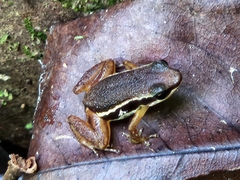
Rainforest Rocket Frog

Rainforest Rocket Frog

Silverstoneia flotator

Silhouette: Steven Traver · PhyloPic

LCLeast ConcernNTVUENCR
Daily sighting probability ~10% · With luck
at Bastimentos Island National Marine Park

In 3 days ~30% in a week ~50%

5 Verified sightings at Bastimentos Island National Marine Park From 2019 to 2026
125 In all 6 parks
September Best month
☀️ Diurnal When it's spotted

About the Rainforest Rocket Frog

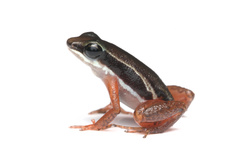
Silverstoneia flotator, the rainforest rocket frog, is a terrestrial, diurnal frog found in humid lowlands of Costa Rica and Panama. It is considered to be of least concern by the IUCN. The taxonomy is in need of a review, as it may consist of a complex of several species.

This frog has been observed between 10 and 865 meters above sea level, near rocky-bottomed streams. The frog has been observed in secondary forest, so scientists infer that it may tolerate some habitat disturbance. The female frog lays eggs in leaf litter. After the eggs hatch, the male frog carries the tadpoles to streams.

The IUCN classifies this frog as least concern of extinction because of its large range, large population, and tolerance to habitat disturbance. What threat it faces comes from deforestation associated with agriculture, logging, and urbanization.

Media related to Colostethus flotator at Wikimedia Commons Data related to Silverstoneia flotator at Wikispecies Wikipedia →

Sounds

Recording0:07

Panama · 2024

© Mabelin · iNaturalist · CC BY-NC 4.0

Recording0:32

Panama · 2025

© ibanezr · iNaturalist · CC BY-NC 4.0

Recording0:12

Panama · 2024

© Brian Gratwicke · iNaturalist · CC BY 4.0

Global Distribution

Parks Where Found

# Park Country Daily sighting probability
1 Piedras Blancas National Park 🇨🇷 Costa Rica
~30%
2 Soberanía National Park 🇵🇦 Panama
~20%
3 Corcovado National Park 🇨🇷 Costa Rica
~20%
4 Gandoca-Manzanillo Wildlife Refuge 🇨🇷 Costa Rica
~20%
5 Bastimentos Island National Marine Park 🇵🇦 Panama
~10%
6 La Amistad International Park (Panama) 🇵🇦 Panama
~10%

Zoos & Centres Where Found

# Zoo / Centre Country
1 Monteverde Theme Park 🇨🇷 Costa Rica In captivity

Before you go

What are the chances of seeing a Rainforest Rocket Frog in Bastimentos Island National Marine Park?

With luck

About 10% of wildlife watchers report a Rainforest Rocket Frog sighting in Bastimentos Island National Marine Park on a given day, based on 5 verified sightings from GBIF citizen-science data from 2019 to 2026. It is the 18th most-seen of the 18 amphibians we can rate there. Over three days the chance rises to about 30%, and over a week to about 50%, if each day is a fresh chance.

When is the best time to see a Rainforest Rocket Frog in Bastimentos Island National Marine Park?

March, May and September

In those months about 20% of wildlife watchers report a Rainforest Rocket Frog in Bastimentos Island National Marine Park on a given day, against under 5% in April, June–August and October–January, the lowest months.

What time of day is best to see a Rainforest Rocket Frog?

Between 9 am and noon

Across all the parks we cover, that three-hour window holds the most Rainforest Rocket Frog sightings with a recorded time, and about 8 in 10 of them come between 6 am and 6 pm: it is a daytime animal.

Is Bastimentos Island National Marine Park the best place to see a Rainforest Rocket Frog?

5th of 6

Of the 6 parks where we can rate Rainforest Rocket Frog sightings, Bastimentos Island National Marine Park ranks 5th at about 10%. The best odds are in Piedras Blancas National Park (Costa Rica, about 30%), Soberanía National Park (Panama, about 20%) and Corcovado National Park (Costa Rica, about 20%).

Where does the Rainforest Rocket Frog sighting chance come from?

GBIF citizen-science records

It is estimated from how often the Rainforest Rocket Frog is recorded against all the amphibians logged in Bastimentos Island National Marine Park (5 verified sightings from 2019 to 2026), calibrated against known sighting rates. Figures are rounded to the nearest 10% because citizen-science data supports honest approximations, not decimals, and months with records from fewer than five people show "—". How it works.

← Back to Bastimentos Island National Marine Park