Elephant Hawkmoth

Elephant Hawkmoth

Deilephila elpenor

Daily sighting probability ~20% · Possible
at Białowieża National Park

In 3 days ~40% in a week ~70%

12 Verified sightings at Białowieża National Park From 2019 to 2026
248 In all 8 parks
August Best month
☀️🌙 Day & Night When it's spotted

About the Elephant Hawkmoth

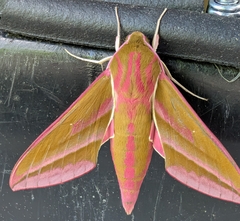
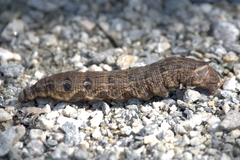
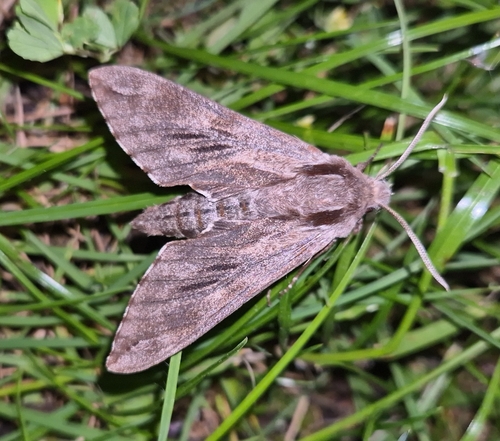
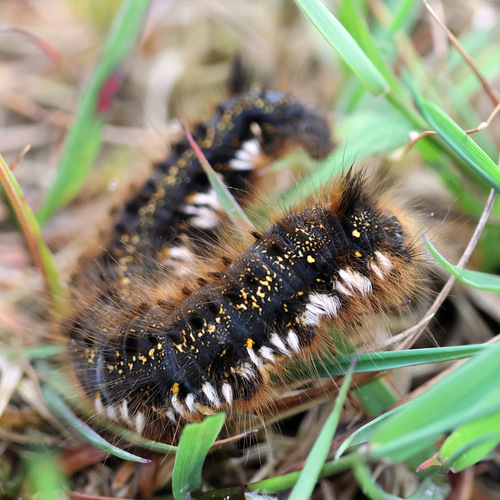
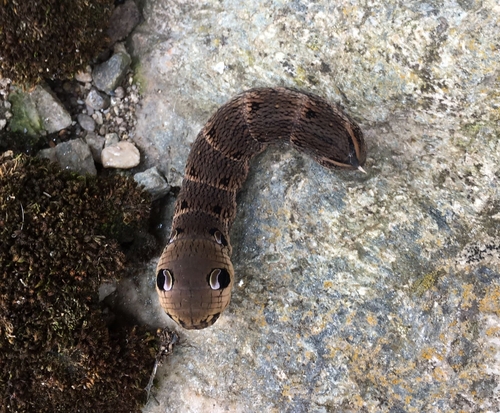
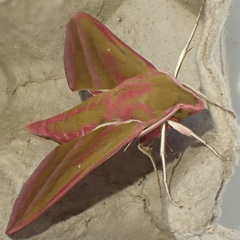
Deilephila elpenor, the elephant hawk moth or large elephant hawk moth, is a moth in the family Sphingidae. Its common name is derived from the caterpillar's resemblance to an elephant's trunk. It is most common in Central Europe and is distributed throughout the Palearctic region. It has also been introduced in British Columbia, Canada. Its distinct olive and pink colouring makes it one of the most recognisable moths in its range, but confusing the elephant hawk moth with the small elephant hawk moth, a closely related species that also shares the characteristic colours, is quite common.

These moths are nocturnal, so feed on flowers that open or produce nectar at night. The elephant hawk moth has very sensitive eyes that allow it to see colour even at low light, and it was one of the first species in which nocturnal colour vision was documented in animals. The moth is also known for its hovering capability, which it uses when feeding on nectar from flowers. This behaviour is costly in terms of energy and can help explain why the moth has evolved such enhanced visual capabilities for efficient feeding. The moths also have an important role as pollinators throughout their habitat.... Wikipedia →
Global Distribution

Parks Where Found

# Park Country Daily sighting probability
1 Snowdonia National Park 🇬🇧 United Kingdom
~20%
2 Białowieża National Park 🇵🇱 Poland
~20%
3 Bavarian Forest National Park 🇩🇪 Germany
~10%
4 Tatra National Park 🇸🇰 Slovakia
~10%
5 Wadden Sea National Park 🇩🇪 Germany
~10%
6 Cévennes National Park 🇫🇷 France
~10%
7 Pyrénées National Park 🇫🇷 France
~10%
8 Cairngorms National Park 🇬🇧 United Kingdom
~10%

Cities Where Found

# City Country Daily sighting probability
1 Liverpool 🇬🇧 United Kingdom
~30%
2 Manchester 🇬🇧 United Kingdom
~20%
3 Birmingham 🇬🇧 United Kingdom
~10%
4 Kunming 🇨🇳 China
~10%
5 Leeds 🇬🇧 United Kingdom
~10%
6 London 🇬🇧 United Kingdom
~10%
7 Helsinki 🇫🇮 Finland
~10%
8 Copenhagen 🇩🇰 Denmark
~10%
9 Hamburg 🇩🇪 Germany
~10%
10 Amsterdam 🇳🇱 Netherlands
~10%

Before you go

What are the chances of seeing an Elephant Hawkmoth in Białowieża National Park?

Possible

About 20% of wildlife watchers report an Elephant Hawkmoth sighting in Białowieża National Park on a given day, based on 12 verified sightings from GBIF citizen-science data from 2019 to 2026. It is the 56th most-seen of the 158 insects we can rate there. Over three days the chance rises to about 40%, and over a week to about 70%, if each day is a fresh chance.

When is the best time to see an Elephant Hawkmoth in Białowieża National Park?

August

In that month about 40% of wildlife watchers report an Elephant Hawkmoth in Białowieża National Park on a given day, against under 5% in May–June and October–March, the lowest months.

What time of day is best to see an Elephant Hawkmoth?

Between 11 pm and 2 am

Across all the parks we cover, that three-hour window holds the most Elephant Hawkmoth sightings with a recorded time, and about 6 in 10 of them come between 6 am and 6 pm: it is seen both by day and at night.

Is Białowieża National Park the best place to see an Elephant Hawkmoth?

Among the best

Of the 8 parks where we can rate Elephant Hawkmoth sightings, Białowieża National Park ranks 2nd at about 20%, level with the leaders once rounded. The best odds are in Snowdonia National Park (United Kingdom, about 20%).

Where does the Elephant Hawkmoth sighting chance come from?

GBIF citizen-science records

It is estimated from how often the Elephant Hawkmoth is recorded against all the insects logged in Białowieża National Park (12 verified sightings from 2019 to 2026), calibrated against known sighting rates. Figures are rounded to the nearest 10% because citizen-science data supports honest approximations, not decimals, and months with records from fewer than five people show "—". How it works.

← Back to Białowieża National Park