Marsh Warbler

Marsh Warbler

Acrocephalus palustris

Silhouette: Yves Hoebeke · PhyloPic

LCLeast ConcernNTVUENCR
Daily sighting probability ~10% · With luck
at Biebrza National Park

In 3 days ~30% in a week ~60%

215 Verified sightings at Biebrza National Park From 2019 to 2026
1,092 In all 16 parks
June Best month
☀️ Diurnal When it's spotted

About the Marsh Warbler

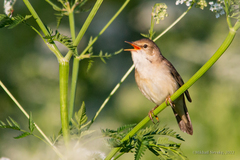
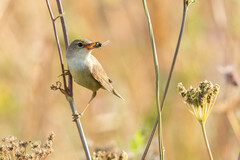
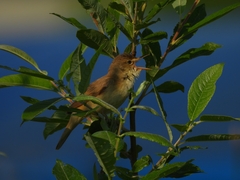
The marsh warbler (Acrocephalus palustris) is an Old World warbler currently classified in the family Acrocephalidae. It breeds in temperate Europe and the western Palearctic and winters mainly in southeast Africa. It is notable for incorporating striking imitations of a wide variety of other birds into its song.

The marsh warbler breeds in a variety of mostly damp habitats, but in Africa winters mainly in dry, well-vegetated areas. It is common over much of its breeding range and expanding its distribution in some areas. However, in Britain it is now virtually extinct as a breeding bird, though the reasons for its decline are unclear. This insectivorous warbler can be easily confused with several close relatives, but the imitative song of the male is highly distinctive.

The marsh warbler was formally described in 1798 by the German naturalist Johann Matthäus Bechstein under the scientific name Motacilla s. Sylvia palustris. The type locality is Germany. The marsh warbler is now one of around 40 species placed in the genus Acrocephalus that was introduced by Johann Andreas Naumann and his son Johann Friedrich Naumann in 1811. The genus name Acrocephalus is from Ancient... Wikipedia →

Sounds

Imitation0:33

Estonia · 2026

© FlackoWeasel · XC1162626 · CC BY-NC-SA 4.0

Song0:16

Finland · 2026

© Miika Silfverberg · XC1145922 · CC BY-NC-SA 4.0

Call0:58

Ukraine · 2025

© Taras Vykhovanets · XC1026832 · CC BY-NC-ND 4.0

Global Distribution

Parks Where Found

# Park Country Daily sighting probability
1 Fertő-Hanság National Park 🇭🇺 Hungary
~20%
2 Tsavo West National Park 🇰🇪 Kenya
~10%
3 Białowieża National Park 🇵🇱 Poland
~10%
4 Biebrza National Park 🇵🇱 Poland
~10%
5 Ecrins National Park 🇫🇷 France
~10%
6 Gauja National Park 🇱🇻 Latvia
~10%
7 Vanoise National Park 🇫🇷 France
~10%
8 Kiskunság National Park 🇭🇺 Hungary
~10%
9 Bavarian Forest National Park 🇩🇪 Germany
~10%
10 Hortobágy National Park 🇭🇺 Hungary
<5%
11 Wadden Sea National Park 🇩🇪 Germany
<5%
12 uMkhuze Game Reserve 🇿🇦 South Africa
<5%
13 Tsavo East National Park 🇰🇪 Kenya
<5%
14 Kruger National Park 🇿🇦 South Africa
<5%
15 Moremi Game Reserve 🇧🇼 Botswana
<5%
16 Chobe National Park 🇧🇼 Botswana
<5%

Cities Where Found

# City Country Daily sighting probability
1 Abu Dhabi 🇦🇪 United Arab Emirates
~10%
2 Yerevan 🇦🇲 Armenia
~10%
3 Moscow 🇷🇺 Russia
<5%
4 Minsk 🇧🇾 Belarus
<5%
5 Istanbul 🇹🇷 Turkey
<5%
6 Budapest 🇭🇺 Hungary
<5%
7 Helsinki 🇫🇮 Finland
<5%
8 Brussels 🇧🇪 Belgium
<5%
9 Turin 🇮🇹 Italy
<5%
10 Warsaw 🇵🇱 Poland
<5%

Before you go

What are the chances of seeing a Marsh Warbler in Biebrza National Park?

With luck

About 10% of wildlife watchers report a Marsh Warbler sighting in Biebrza National Park on a given day, based on 215 verified sightings from GBIF citizen-science data from 2019 to 2026. It is the 117th most-seen of the 202 birds we can rate there. Over three days the chance rises to about 30%, and over a week to about 60%, if each day is a fresh chance.

When is the best time to see a Marsh Warbler in Biebrza National Park?

June

In that month about 40% of wildlife watchers report a Marsh Warbler in Biebrza National Park on a given day, against under 5% in August to April, the lowest months.

What time of day is best to see a Marsh Warbler?

Between 6 and 9 am

Across all the parks we cover, that three-hour window holds the most Marsh Warbler sightings with a recorded time, and about 8 in 10 of them come between 6 am and 6 pm: it is a daytime animal.

Which relatives of the Marsh Warbler live in Biebrza National Park?

Same genus: Acrocephalus

The closest relatives of the Marsh Warbler that you can see in Biebrza National Park (genus Acrocephalus, Reed Warblers) are Sedge Warbler (about 50%), Aquatic Warbler (about 20%) and Great Reed-Warbler (about 20%), with each one's daily chance of a sighting.

Where does the Marsh Warbler sighting chance come from?

GBIF citizen-science records

It is estimated from how often the Marsh Warbler is recorded against all the birds logged in Biebrza National Park (215 verified sightings from 2019 to 2026), calibrated against known sighting rates. Figures are rounded to the nearest 10% because citizen-science data supports honest approximations, not decimals, and months with records from fewer than five people show "—". How it works.

← Back to Biebrza National Park