Desert Kingsnake

Desert Kingsnake

Lampropeltis splendida

Silhouette: Andy Wilson · PhyloPic

LCLeast ConcernNTVUENCR
Daily sighting probability ~10% · With luck
at Big Bend National Park

In 3 days ~20% in a week ~30%

5 Verified sightings at Big Bend National Park From 2019 to 2026
197 In all 2 parks
July Best month
🌅 Crepuscular When it's spotted

About the Desert Kingsnake

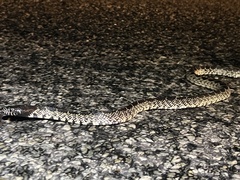
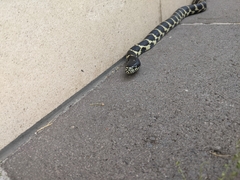
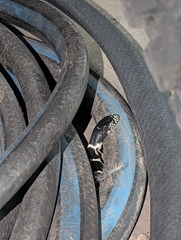
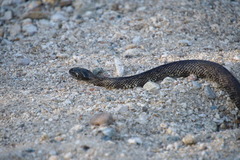
The desert kingsnake (Lampropeltis splendida) is a species of kingsnake native to Texas, Arizona, and New Mexico, United States. It is not venomous, colored yellow and black. The desert kingsnake's diet consists of rodents, lizards, and smaller snakes, including rattlesnakes. They normally grow 3–4 ft long, but have been known to grow up to 6.8 ft. They are docile creatures when confronted by humans. If they do not try to escape, often they "play dead" by flipping over onto their backs and lying motionless. Some who domesticate kingsnakes, such as ranchers, do so in the hopes that the kingsnakes will feed on other snakes, which might present more of a threat. It was previously considered a subspecies of the common kingsnake. The desert kingsnake belongs to the Colubridae family, which is the largest family of snakes in the world.

The snake's glossy dorsum is black or very dark brown colored, finely speckled with off-white or yellow. These pale flecks form dimly defined narrow vertebral crossbands, between which the intervening rectangular areas are black. Pale yellow scales may predominate along the lower sides. The abdomens of both adult and young snakes are mostly... Wikipedia →

Global Distribution

Parks Where Found

# Park Country Daily sighting probability
1 Saguaro National Park 🇺🇸 United States
~10%
2 Big Bend National Park 🇺🇸 United States
~10%

Zoos & Centres Where Found

# Zoo / Centre Country
1 Dublin Zoo 🇮🇪 Ireland In captivity
2 Beijing Wildlife Park 🇨🇳 China In captivity
3 Ecological Center of Sonora 🇲🇽 Mexico In captivity
4 Cheyenne Mountain Zoo 🇺🇸 United States In captivity
5 Phoenix Zoo 🇺🇸 United States In captivity
6 Cameron Park Zoo 🇺🇸 United States In captivity
7 Chapultepec Zoo 🇲🇽 Mexico In captivity
8 Santillana Zoo 🇪🇸 Spain In captivity
9 Siam Serpentarium 🇹🇭 Thailand In captivity
10 Snake Farm of Queen Saovabha Memorial Institute 🇹🇭 Thailand In captivity
11 Children's Aquarium at Fair Park 🇺🇸 United States In captivity
12 Lindsay Wildlife Experience 🇺🇸 United States In captivity
13 Vivarium Tablat 🇨🇭 Switzerland In captivity
14 ResQue Ranch Inc. 🇺🇸 United States In captivity
15 Snakeroom Serpentarium 🇪🇸 Spain In captivity

Before you go

What are the chances of seeing a Desert Kingsnake in Big Bend National Park?

With luck

About 10% of wildlife watchers report a Desert Kingsnake sighting in Big Bend National Park on a given day, based on 5 verified sightings from GBIF citizen-science data from 2019 to 2026. It is the 45th most-seen of the 48 reptiles we can rate there. Over three days the chance rises to about 20%, and over a week to about 30%, if each day is a fresh chance.

When is the best time to see a Desert Kingsnake in Big Bend National Park?

April–May and July

In those months about 10% of wildlife watchers report a Desert Kingsnake in Big Bend National Park on a given day, against under 5% in June and August–March, the lowest months.

What time of day is best to see a Desert Kingsnake?

Between 7 and 10 pm

Across all the parks we cover, that three-hour window holds the most Desert Kingsnake sightings with a recorded time, and about 6 in 10 of them come between 6 pm and 6 am: it is most active around dawn and dusk.

Is Big Bend National Park the best place to see a Desert Kingsnake?

Among the best

Of the 2 parks where we can rate Desert Kingsnake sightings, Big Bend National Park ranks 2nd at about 10%, level with the leaders once rounded. The best odds are in Saguaro National Park (United States, about 10%).

Which relatives of the Desert Kingsnake live in Big Bend National Park?

Same family: Colubridae

The closest relatives of the Desert Kingsnake that you can see in Big Bend National Park (family Colubridae, Colubrid Snakes) are Trans-pecos Ratsnake (about 30%), Coachwhip (about 20%) and Long-nosed Snake (about 20%), with each one's daily chance of a sighting.

Where does the Desert Kingsnake sighting chance come from?

GBIF citizen-science records

It is estimated from how often the Desert Kingsnake is recorded against all the reptiles logged in Big Bend National Park (5 verified sightings from 2019 to 2026), calibrated against known sighting rates. Figures are rounded to the nearest 10% because citizen-science data supports honest approximations, not decimals, and months with records from fewer than five people show "—". How it works.

← Back to Big Bend National Park