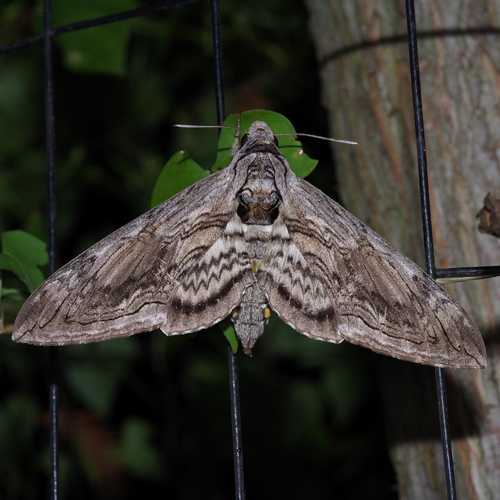
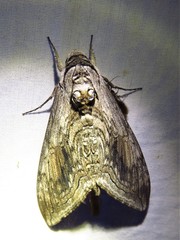
Five-Spotted Hawk Moth

Five-Spotted Hawk Moth

Manduca quinquemaculatus

Daily sighting probability ~10% · With luck
at Big Bend National Park

In 3 days ~30% in a week ~60%

24 Verified sightings at Big Bend National Park From 2019 to 2026
57 In all 4 parks
September Best month
☀️🌙 Day & Night When it's spotted

About the Five-Spotted Hawk Moth

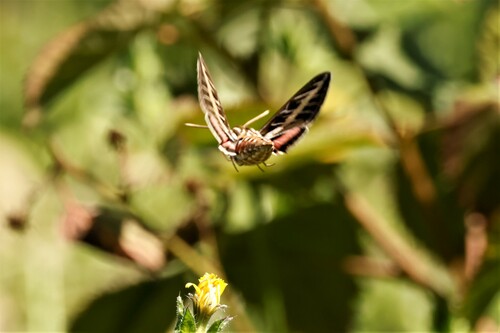
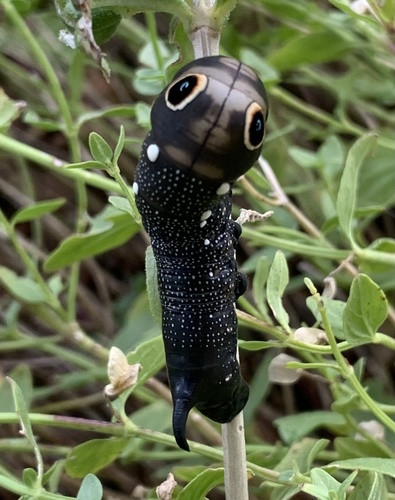
Manduca quinquemaculata, the five-spotted hawkmoth, is a brown and gray hawk moth of the family Sphingidae. The caterpillar, often referred to as the tomato hornworm, can be a major pest in gardens; they get their name from a dark projection on their posterior end and their use of tomatoes as host plants. Tomato hornworms are closely related to (and sometimes confused with) the tobacco hornworm Manduca sexta and Blackburn's sphinx moth Manduca blackburni. This confusion arises because caterpillars of both species have similar morphologies and feed on the foliage of various plants from the family Solanaceae, so either species can be found on tobacco or tomato leaves. Because of this, the plant on which the caterpillar is found does not indicate its species.

M. quinquemaculata is found across North America and Australia. The tobacco hornworm, a close relative of the tomato hornworm, tends to dominate the south while tomato hornworms are more prevalent in the northern United States.

Tomato hornworms are known to eat various plants from the family Solanaceae, commonly feeding on tomato, eggplant, pepper, tobacco, moonflowers and potato. Females... Wikipedia →
Global Distribution

Parks Where Found

# Park Country Daily sighting probability
1 Guadalupe Mountains National Park 🇺🇸 United States
~10%
2 Big Bend National Park 🇺🇸 United States
~10%
3 Grand Canyon National Park 🇺🇸 United States
~10%
4 Saguaro National Park 🇺🇸 United States
~10%

Cities Where Found

# City Country Daily sighting probability
1 Mesa 🇺🇸 United States
~10%
2 Phoenix 🇺🇸 United States
~10%
3 Austin 🇺🇸 United States
~10%
4 Dallas 🇺🇸 United States
<5%
5 San Antonio 🇺🇸 United States
<5%
6 Monterrey 🇲🇽 México
<5%
7 Salt Lake City 🇺🇸 United States
<5%
8 Denver 🇺🇸 United States
<5%
9 San Diego 🇺🇸 United States
<5%
10 Mexico City 🇲🇽 México
<5%

Before you go

What are the chances of seeing a Five-Spotted Hawk Moth in Big Bend National Park?

With luck

About 10% of wildlife watchers report a Five-Spotted Hawk Moth sighting in Big Bend National Park on a given day, based on 24 verified sightings from GBIF citizen-science data from 2019 to 2026. It is the 76th most-seen of the 329 insects we can rate there. Over three days the chance rises to about 30%, and over a week to about 60%, if each day is a fresh chance.

When is the best time to see a Five-Spotted Hawk Moth in Big Bend National Park?

September

In that month about 30% of wildlife watchers report a Five-Spotted Hawk Moth in Big Bend National Park on a given day, against under 5% in August and November–February, the lowest months. That is one of Big Bend National Park's wettest months, with about 50 mm of rain against 10 mm in April.

What time of day is best to see a Five-Spotted Hawk Moth?

Between 9 pm and midnight

Across all the parks we cover, that three-hour window holds the most Five-Spotted Hawk Moth sightings with a recorded time, and about 7 in 10 of them come between 6 pm and 6 am: it is seen both by day and at night.

Is Big Bend National Park the best place to see a Five-Spotted Hawk Moth?

Among the best

Of the 4 parks where we can rate Five-Spotted Hawk Moth sightings, Big Bend National Park ranks 2nd at about 10%, level with the leaders once rounded. The best odds are in Guadalupe Mountains National Park (United States, about 10%).

Which relatives of the Five-Spotted Hawk Moth live in Big Bend National Park?

Same family: Sphingidae

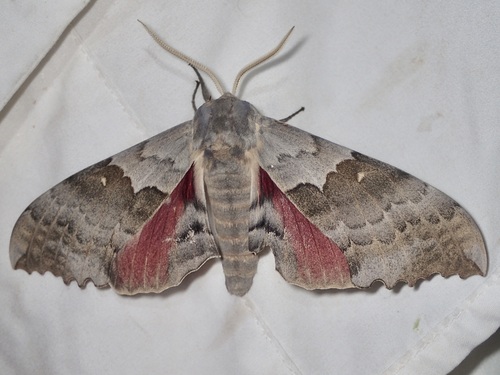
The closest relatives of the Five-Spotted Hawk Moth that you can see in Big Bend National Park (family Sphingidae, Sphinx Moths) are White-Lined Sphinx (about 30%), Falcon Sphinx (about 10%) and Western Poplar Sphinx (about 10%), with each one's daily chance of a sighting.

Where does the Five-Spotted Hawk Moth sighting chance come from?

GBIF citizen-science records

It is estimated from how often the Five-Spotted Hawk Moth is recorded against all the insects logged in Big Bend National Park (24 verified sightings from 2019 to 2026), calibrated against known sighting rates. Figures are rounded to the nearest 10% because citizen-science data supports honest approximations, not decimals, and months with records from fewer than five people show "—". How it works.

← Back to Big Bend National Park