Rough Harvester Ant

Rough Harvester Ant

Pogonomyrmex rugosus

Daily sighting probability ~20% · Possible
at Big Bend National Park

In 3 days ~50% in a week ~80%

56 Verified sightings at Big Bend National Park From 2019 to 2026
185 In all 5 parks
December Best month
☀️ Diurnal When it's spotted

About the Rough Harvester Ant

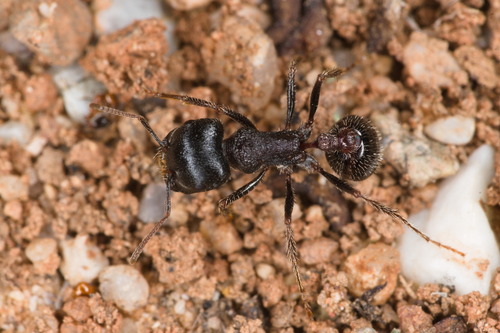
Pogonomyrmex rugosus, the desert harvester ant or rough harvester ant, is a species of harvester ant in the subfamily Myrmicinae which is found in the southwestern United States,and Northern Mexico. Pogonomyrmex rugosus can be found in open, sandy, and hot areas. They will typically forage during the day, bringing seeds back to the colony and scavenging dead insects they may find. Nests will often have a small circle around the entrance which has been cleared of foliage, making them easily recognizable.

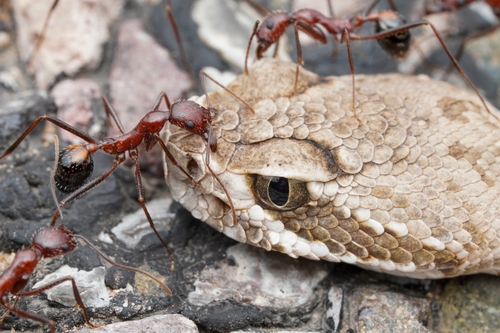
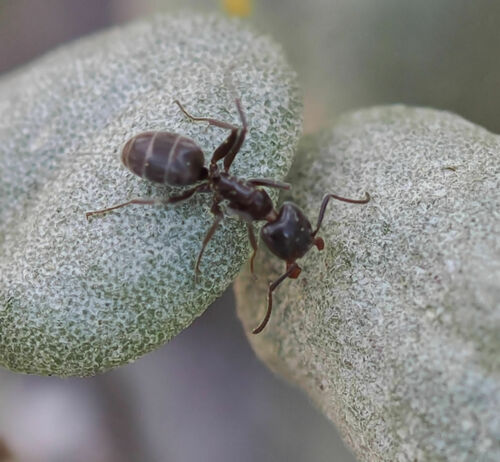
P. Rugosus has two distinct color variants. P. Rugosus found in southwestern deserts such as in California and Arizona, will feature a red and black color scheme, where as those found in more central parts of the United States and Mexico will be fully black.

Pogonomyrmex Rugosus will typically perform their nuptial flights from July–September, during hot daytime conditions of 80–95°F and during elevated humidity, usually after rain the previous day. P. rugosus colonies can grow to have up to 15,000 workers.

P. rugosus workers use group foraging tactics that involve the creation of... Wikipedia →
Global Distribution

Parks Where Found

# Park Country Daily sighting probability
1 Joshua Tree National Park 🇺🇸 United States
~20%
2 Big Bend National Park 🇺🇸 United States
~20%
3 Zion National Park 🇺🇸 United States
~10%
4 Death Valley National Park 🇺🇸 United States
~10%
5 Saguaro National Park 🇺🇸 United States
~10%

Cities Where Found

# City Country Daily sighting probability
1 Ciudad Juárez 🇲🇽 México
~20%
2 Las Vegas 🇺🇸 United States
~10%
3 Mesa 🇺🇸 United States
~10%
4 Phoenix 🇺🇸 United States
~10%
5 San Diego 🇺🇸 United States
<5%
6 Los Angeles 🇺🇸 United States
<5%

Before you go

What are the chances of seeing a Rough Harvester Ant in Big Bend National Park?

Possible

About 20% of wildlife watchers report a Rough Harvester Ant sighting in Big Bend National Park on a given day, based on 56 verified sightings from GBIF citizen-science data from 2019 to 2026. It is the 31st most-seen of the 329 insects we can rate there. Over three days the chance rises to about 50%, and over a week to about 80%, if each day is a fresh chance.

When is the best time to see a Rough Harvester Ant in Big Bend National Park?

December

In that month about 40% of wildlife watchers report a Rough Harvester Ant in Big Bend National Park on a given day, against under 5% in February, the lowest month.

What time of day is best to see a Rough Harvester Ant?

Between 10 am and 1 pm

Across all the parks we cover, that three-hour window holds the most Rough Harvester Ant sightings with a recorded time, and about 8 in 10 of them come between 6 am and 6 pm: it is a daytime animal.

Is Big Bend National Park the best place to see a Rough Harvester Ant?

Among the best

Of the 5 parks where we can rate Rough Harvester Ant sightings, Big Bend National Park ranks 2nd at about 20%, level with the leaders once rounded. The best odds are in Joshua Tree National Park (United States, about 20%).

Which relatives of the Rough Harvester Ant live in Big Bend National Park?

Same family: Formicidae

The closest relatives of the Rough Harvester Ant that you can see in Big Bend National Park (family Formicidae, Ants) are Novomessor cockerelli (about 10%), Camponotus festinatus (about 10%) and Liometopum luctuosum (about 10%), with each one's daily chance of a sighting.

Where does the Rough Harvester Ant sighting chance come from?

GBIF citizen-science records

It is estimated from how often the Rough Harvester Ant is recorded against all the insects logged in Big Bend National Park (56 verified sightings from 2019 to 2026), calibrated against known sighting rates. Figures are rounded to the nearest 10% because citizen-science data supports honest approximations, not decimals, and months with records from fewer than five people show "—". How it works.

← Back to Big Bend National Park