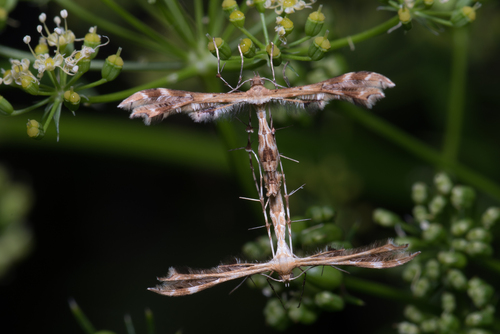
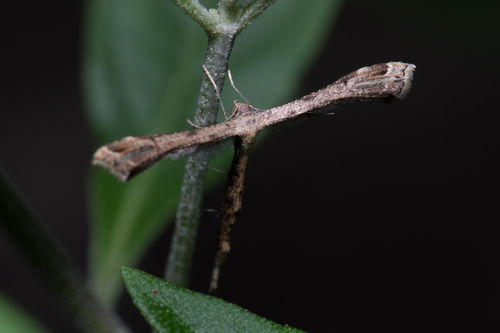
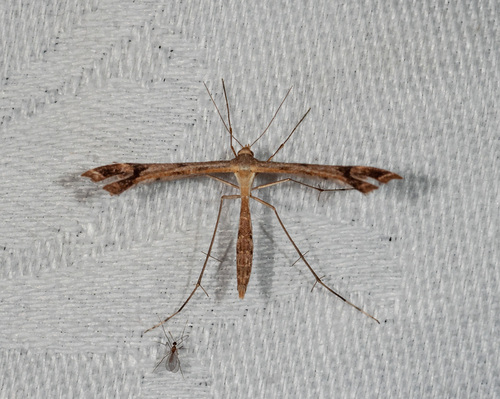
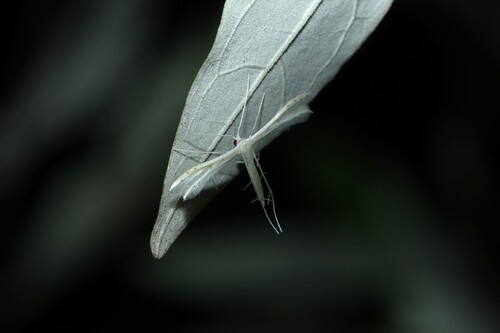
Dowdy Plume Moth

Dowdy Plume Moth

Stenoptilia zophodactylus

Daily sighting probability <5% · Rare
at Blue Mountains National Park

In 3 days ~10% in a week ~30%

7 Verified sightings at Blue Mountains National Park From 2019 to 2026
37 In all 3 parks
February Best month
☀️🌙 Day & Night When it's spotted

About the Dowdy Plume Moth

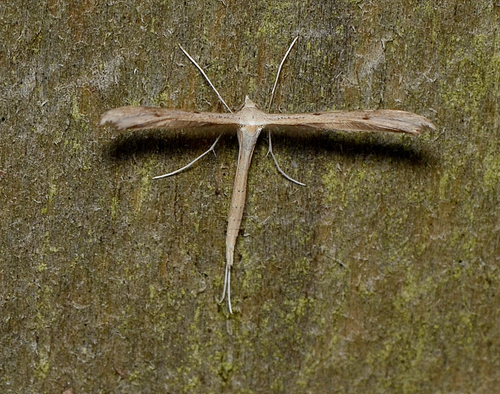
Stenoptilia zophodactylus, also known as the dowdy plume, is a species of moth of the family Pterophoridae found worldwide. It was first described by Philogène Auguste Joseph Duponchel in 1840. The wingspan is 16–23 mm. Gielis, C., 1996 provides a description.

The moth can be found from July to September in two or more overlapping broods. Larvae can be found from March to September, initially in an irregular, full depth blotch which may occupy the entire leaf. The frass is in numerous, dispersed brown grains. Some larvae leave the mine during an early instar and feed externally on flower buds and developing fruits while others remain in the mine until shortly before pupation. The larvae feed on common centaury (Centaurium erythraea), Centaurium venusta and Centaurium littoralis, yellow-wort (Blackstonia perfoliata), great yellow gentian (Gentiana lutea), German gentian (Gentianella germanica), Gentianella diemensis, Sopubia trifida and Ngai camphor (Blumea balsamifera).

It is found in Europe, North America (including Mexico), South America (Ecuador and Paraguay), Australia, New Zealand, South Africa, India and Iran. Wikipedia →
Global Distribution

Parks Where Found

# Park Country Daily sighting probability
1 Booderee National Park 🇦🇺 Australia
~20%
2 Great Otway National Park 🇦🇺 Australia
~10%
3 Blue Mountains National Park 🇦🇺 Australia
<5%

Cities Where Found

# City Country Daily sighting probability
1 Auckland 🇳🇿 New Zealand
<5%
2 Melbourne 🇦🇺 Australia
<5%
3 Sydney 🇦🇺 Australia
<5%

Before you go

What are the chances of seeing a Dowdy Plume Moth in Blue Mountains National Park?

Rare

Under 5% of wildlife watchers report a Dowdy Plume Moth sighting in Blue Mountains National Park on a given day, based on 7 verified sightings from GBIF citizen-science data from 2019 to 2026. It is the 554th most-seen of the 789 insects we can rate there. Over three days the chance rises to about 10%, and over a week to about 30%, if each day is a fresh chance.

When is the best time to see a Dowdy Plume Moth in Blue Mountains National Park?

February, September and November

In those months about 10% of wildlife watchers report a Dowdy Plume Moth in Blue Mountains National Park on a given day, against under 5% in March–August, October and December–January, the lowest months.

What time of day is best to see a Dowdy Plume Moth?

Between 8 and 11 am

Across all the parks we cover, that three-hour window holds the most Dowdy Plume Moth sightings with a recorded time, and about 6 in 10 of them come between 6 am and 6 pm: it is seen both by day and at night.

Is Blue Mountains National Park the best place to see a Dowdy Plume Moth?

3rd of 3

Of the 3 parks where we can rate Dowdy Plume Moth sightings, Blue Mountains National Park ranks 3rd at under 5%. The best odds are in Booderee National Park (Australia, about 20%) and Great Otway National Park (Australia, about 10%).

Where does the Dowdy Plume Moth sighting chance come from?

GBIF citizen-science records

It is estimated from how often the Dowdy Plume Moth is recorded against all the insects logged in Blue Mountains National Park (7 verified sightings from 2019 to 2026), calibrated against known sighting rates. Figures are rounded to the nearest 10% because citizen-science data supports honest approximations, not decimals, and months with records from fewer than five people show "—". How it works.

← Back to Blue Mountains National Park