
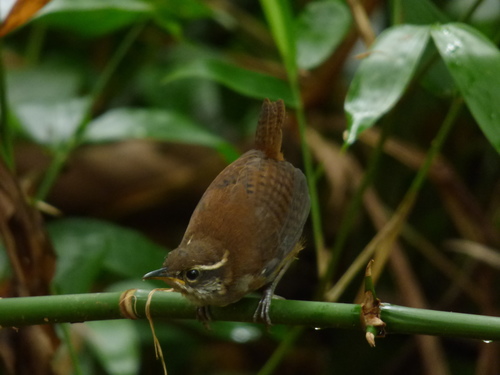
Nightingale Wren

Nightingale Wren

Microcerculus philomela

Silhouette: Matt Wilkins · PhyloPic

LCNTNear ThreatenedVUENCR
Daily sighting probability <5% · Rare
at Braulio Carrillo National Park

In 3 days ~10%

101 Verified sightings at Braulio Carrillo National Park From 2019 to 2026
3,991 In all 10 parks
December Best month
☀️ Diurnal When it's spotted

About the Nightingale Wren

The northern nightingale-wren (Microcerculus philomela), or nightingale wren, is a species of passerine bird in the family Troglodytidae. It is found in Belize, Costa Rica, Guatemala, Honduras, Mexico, and Nicaragua. The northern nightingale-wren forms a species pair with the southern nightingale-wren (Microcerculus marginatus) and was in the past considered conspecific with it. It is currently treated as a species in its own right by the International Ornithological Committee (IOC) and the Clements taxonomy, though under different English names. It is monotypic.

The northern nightingale-wren is 10 to 11.5 cm (3.9 to 4.5 in) long; seven males weighed 17.4 to 21.5 g (0.61 to 0.76 oz) and four females 16.4 to 17.4 g (0.58 to 0.61 oz). Adults are almost entirely dark brown, but with a dark gray throat and breast. Black tips on feathers of both the upper- and undersides give a scalloped appearance. Juveniles are similar though the scaling on their upperparts is darker and that on the underparts is whitish to pale gray.

The northern nightingale-wren is found from Chiapas in Mexico through Guatemala, southern... Wikipedia →

Sounds

Song0:42

Honduras · 2025

© Alfonso Auerbach · XC1003818 · CC BY-NC-SA 4.0

Uncertain0:35

Honduras · 2021

© Mario Reyes Jr · XC654608 · CC BY-NC-SA 4.0

Call1:10

Costa Rica · 2019

© Hans Matheve · XC518333 · CC BY-NC-ND 4.0

Global Distribution

Parks Where Found

# Park Country Daily sighting probability
1 Arenal Volcano National Park 🇨🇷 Costa Rica
~20%
2 Tenorio Volcano National Park 🇨🇷 Costa Rica
~20%
3 Rincón de la Vieja National Park 🇨🇷 Costa Rica
~10%
4 Cusuco National Park 🇭🇳 Honduras
~10%
5 Braulio Carrillo National Park 🇨🇷 Costa Rica
<5%
6 Cockscomb Basin Wildlife Sanctuary 🇧🇿 Belize
<5%
7 Cerro Azul Meámbar National Park 🇭🇳 Honduras
<5%
8 Monteverde Cloud Forest Reserve 🇨🇷 Costa Rica
<5%
9 Poás Volcano National Park 🇨🇷 Costa Rica
<5%
10 Tapantí-Macizo de la Muerte National Park 🇨🇷 Costa Rica
<5%

Before you go

What are the chances of seeing a Nightingale Wren in Braulio Carrillo National Park?

Rare

Under 5% of wildlife watchers report a Nightingale Wren sighting in Braulio Carrillo National Park on a given day, based on 101 verified sightings from GBIF citizen-science data from 2019 to 2026. It is the 330th most-seen of the 505 birds we can rate there. Over three days the chance rises to about 10%, if each day is a fresh chance.

When is the best time to see a Nightingale Wren in Braulio Carrillo National Park?

December

In that month about 10% of wildlife watchers report a Nightingale Wren in Braulio Carrillo National Park on a given day, against under 5% in January to November, the lowest months.

What time of day is best to see a Nightingale Wren?

Between 7 and 10 am

Across all the parks we cover, that three-hour window holds the most Nightingale Wren sightings with a recorded time, and about 9 in 10 of them come between 6 am and 6 pm: it is a daytime animal.

Which relatives of the Nightingale Wren live in Braulio Carrillo National Park?

Same family: Troglodytidae

The closest relatives of the Nightingale Wren that you can see in Braulio Carrillo National Park (family Troglodytidae, Wrens) are Southern House Wren (about 30%), White-breasted Wood-Wren (about 30%) and Bay Wren (about 20%), with each one's daily chance of a sighting.

Where does the Nightingale Wren sighting chance come from?

GBIF citizen-science records

It is estimated from how often the Nightingale Wren is recorded against all the birds logged in Braulio Carrillo National Park (101 verified sightings from 2019 to 2026), calibrated against known sighting rates. Figures are rounded to the nearest 10% because citizen-science data supports honest approximations, not decimals, and months with records from fewer than five people show "—". How it works.

← Back to Braulio Carrillo National Park