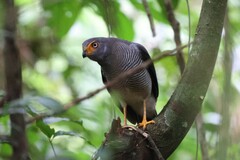
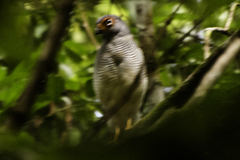
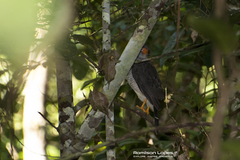
Lined Forest Falcon

Lined Forest Falcon

Micrastur gilvicollis

Silhouette: Unknown (photo), John E. McCormack, Michael G. Harvey, Brant C. Faircloth, Nicholas G. Crawford, Travis C. Glenn, Robb T. Brumfield & T. Michael Keesey · PhyloPic

LCLeast ConcernNTVUENCR
Daily sighting probability ~40% · Likely
at Brownsberg Nature Park

In 3 days ~80% in a week >90%

103 Verified sightings at Brownsberg Nature Park From 2019 to 2026
322 In all 6 parks
January Best month
☀️ Diurnal When it's spotted

About the Lined Forest Falcon

The lined forest falcon (Micrastur gilvicollis) is a species of bird of prey in subfamily Herpetotherinae of family Falconidae, the falcons and caracaras. It is found in Bolivia, Brazil, Colombia, Ecuador, French Guiana, Guyana, Peru, Suriname, and Venezuela.

Until 1972 what is now the lined forest falcon was considered a subspecies of the barred forest falcon (M. ruficollis); the treatment as a full species was confirmed in 2019. (In the mid-20th century some previous authors had treated it as a species.) What is now the cryptic forest falcon (M. mintoni) was a population of the lined forest falcon until 2002 when vocal studies and specimen analyses determined it was a separate species. The plumbeous forest falcon (M. plumbeus) has sometimes been considered a subspecies of the lined forest falcon.

The lined forest falcon is monotypic. The lined forest falcon is 33 to 38 cm (13 to 15 in) long and weighs 170 to 262 g (6.0 to 9.2 oz). It has pale gray upperparts. Its white underparts have highly variable gray barring, from light gray only on the breast to heavy bars on the entire underparts. Its tail is dark gray with a white tip and two... Wikipedia →

Sounds

Song0:10

Ecuador · 2025

© Marc Anderson · XC998169 · CC BY-NC-ND 4.0

Uncertain0:42

Colombia · 2021

© AwakeBio · XC698106 · CC BY-NC-SA 4.0

Call0:18

Bolivia · 2004

© Rosendo Manuel Fraga · XC605877 · CC BY-NC-SA 4.0

Global Distribution

Parks Where Found

# Park Country Daily sighting probability
1 Brownsberg Nature Park 🇸🇷 Suriname
~40%
2 Tambopata National Reserve 🇵🇪 Peru
<5%
3 Yasuní National Park 🇪🇨 Ecuador
<5%
4 Amacayacu National Natural Park 🇨🇴 Colombia
<5%
5 Manu National Park 🇵🇪 Peru
<5%
6 Sierra de la Macarena National Park 🇨🇴 Colombia
<5%

Before you go

What are the chances of seeing a Lined Forest Falcon in Brownsberg Nature Park?

Likely

About 40% of wildlife watchers report a Lined Forest Falcon sighting in Brownsberg Nature Park on a given day, based on 103 verified sightings from GBIF citizen-science data from 2019 to 2026. It is the 30th most-seen of the 221 birds we can rate there. Over three days the chance rises to about 80%, and over a week to over 90%, if each day is a fresh chance.

When is the best time to see a Lined Forest Falcon in Brownsberg Nature Park?

January

In that month about 60% of wildlife watchers report a Lined Forest Falcon in Brownsberg Nature Park on a given day, against about 30% in February–April, August and October, the lowest months. May to July have too few records to rate.

What time of day is best to see a Lined Forest Falcon?

Between 5 and 8 am

Across all the parks we cover, that three-hour window holds the most Lined Forest Falcon sightings with a recorded time, and about 8 in 10 of them come between 6 am and 6 pm: it is a daytime animal.

Is Brownsberg Nature Park the best place to see a Lined Forest Falcon?

Yes

Of the 6 parks where we can rate Lined Forest Falcon sightings, Brownsberg Nature Park has the highest daily chance: about 40%. Next come Tambopata National Reserve (Peru, under 5%) and Yasuní National Park (Ecuador, under 5%).

Where does the Lined Forest Falcon sighting chance come from?

GBIF citizen-science records

It is estimated from how often the Lined Forest Falcon is recorded against all the birds logged in Brownsberg Nature Park (103 verified sightings from 2019 to 2026), calibrated against known sighting rates. Figures are rounded to the nearest 10% because citizen-science data supports honest approximations, not decimals, and months with records from fewer than five people show "—". How it works.

← Back to Brownsberg Nature Park