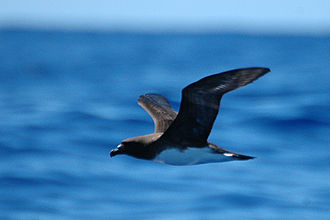
Band-rumped Storm-Petrel

Band-rumped Storm-Petrel

Oceanodroma castro

Silhouette: Richard Crossley · PhyloPic

Daily sighting probability <5% · Rare
at Cabo Blanco Absolute Nature Reserve

In 3 days <5% in a week ~10%

11 Verified sightings at Cabo Blanco Absolute Nature Reserve From 2019 to 2026
982 In all 3 parks
May Best month
☀️ Diurnal When it's spotted

About the Band-rumped Storm-Petrel

The band-rumped storm petrel, Madeiran storm petrel, or Harcourt's storm petrel (Hydrobates castro) is a species of storm petrel in the family Hydrobatidae. The band-rumped storm petrel is 19–21 cm (7.5–8.3 in) in length with a 43–46 cm (17–18 in) wingspan, and weighs 44–49 g (1.6–1.7 oz). It is mainly brownish black with an extensive white rump. Similar to Leach's storm petrel with the forked tail, long wings, but Leach's has a more deeply forked tail, a differently shaped (V-shaped or triangular) white rump, and a 'tern-like' flight, whereas the band-rumped storm-petrel has a more 'shearwater-like' flight.

The species breeds on islands in the warmer parts of the Atlantic and Pacific Oceans. These include the Berlengas (a few tens of kilometres off mainland Portugal), the Azores, Madeira, Canary Islands and Saint Helena in the Atlantic, and in the Pacific off eastern Japan, on Kauai, Hawaii, and on the Galápagos Islands. In 2016, the species was reported to have also started breeding on the Mauna Loa volcano on the island of Hawaii.

Birds nest in colonies close to the sea in rock crevices and females lay a single... Wikipedia →

Sounds

Recording0:35

Spain · 2024

© Adrián Pina · iNaturalist · CC BY-NC 4.0

Global Distribution

Parks Where Found

# Park Country Daily sighting probability
1 Galápagos Islands 🇪🇨 Ecuador
~10%
2 Isla del Coco National Park 🇨🇷 Costa Rica
<5%
3 Cabo Blanco Absolute Nature Reserve 🇨🇷 Costa Rica
<5%

Before you go

What are the chances of seeing a Band-rumped Storm-Petrel in Cabo Blanco Absolute Nature Reserve?

Rare

Under 5% of wildlife watchers report a Band-rumped Storm-Petrel sighting in Cabo Blanco Absolute Nature Reserve on a given day, based on 11 verified sightings from GBIF citizen-science data from 2019 to 2026. It is the 205th most-seen of the 241 birds we can rate there. Over three days the chance rises to under 5%, and over a week to about 10%, if each day is a fresh chance.

When is the best time to see a Band-rumped Storm-Petrel in Cabo Blanco Absolute Nature Reserve?

May

In that month about 10% of wildlife watchers report a Band-rumped Storm-Petrel in Cabo Blanco Absolute Nature Reserve on a given day, against under 5% in June to April, the lowest months.

What time of day is best to see a Band-rumped Storm-Petrel?

Between 10 am and 1 pm

Across all the parks we cover, that three-hour window holds the most Band-rumped Storm-Petrel sightings with a recorded time, and about 9 in 10 of them come between 6 am and 6 pm: it is a daytime animal.

Is Cabo Blanco Absolute Nature Reserve the best place to see a Band-rumped Storm-Petrel?

3rd of 3

Of the 3 parks where we can rate Band-rumped Storm-Petrel sightings, Cabo Blanco Absolute Nature Reserve ranks 3rd at under 5%. The best odds are in Galápagos Islands (Ecuador, about 10%) and Isla del Coco National Park (Costa Rica, under 5%).

Which relatives of the Band-rumped Storm-Petrel live in Cabo Blanco Absolute Nature Reserve?

Same genus: Oceanodroma

The closest relatives of the Band-rumped Storm-Petrel that you can see in Cabo Blanco Absolute Nature Reserve (genus Oceanodroma) are Wedge-rumped Storm-Petrel (about 10%) and Least Storm-Petrel (about 10%), with each one's daily chance of a sighting.

Where does the Band-rumped Storm-Petrel sighting chance come from?

GBIF citizen-science records

It is estimated from how often the Band-rumped Storm-Petrel is recorded against all the birds logged in Cabo Blanco Absolute Nature Reserve (11 verified sightings from 2019 to 2026), calibrated against known sighting rates. Figures are rounded to the nearest 10% because citizen-science data supports honest approximations, not decimals, and months with records from fewer than five people show "—". How it works.

← Back to Cabo Blanco Absolute Nature Reserve