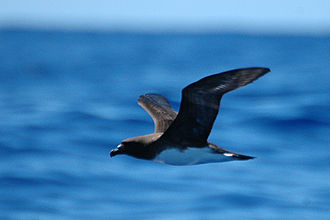
Least Storm-Petrel

Least Storm-Petrel

Oceanodroma microsoma

Silhouette: Richard Crossley · PhyloPic

Daily sighting probability ~10% · With luck
at Cabo Blanco Absolute Nature Reserve

In 3 days ~20% in a week ~40%

94 Verified sightings at Cabo Blanco Absolute Nature Reserve From 2019 to 2026
115 In all 3 parks
May Best month
☀️ Diurnal When it's spotted

About the Least Storm-Petrel

The least storm petrel (Hydrobates microsoma) is a small seabird of the storm petrel family Hydrobatidae. It is 13–15 cm in length, with a wingspan of 32 cm. It is the smallest member of the order Procellariiformes. It was formerly defined in the genus Oceanodroma before that genus was synonymized with Hydrobates.

It breeds on islands off the Baja Peninsula and Gulf of California of Mexico in rock crevices or small burrows in soft earth and lays a single white egg.The single egg that this bird lays is white with a wreath of fine black specks around one and sometimes both ends. Like most petrels, its walking ability is limited to a short shuffle to the burrow. It is a colonial nester.

It spends the rest of the year at sea, reaching as far south as the tropical Pacific South America. It frequently can be seen well offshore of southern California in late summer and autumn. It feeds on mainly planktonic crustaceans, with a preference of larvae of spiny lobsters. It feeds similarly to other storm petrels, picking food off the surface of the water while in flight.

The least storm petrel suffers losses on some of the breeding islands, particularly from feral cats and rats. Wikipedia →

Global Distribution

Parks Where Found

# Park Country Daily sighting probability
1 Coiba National Park 🇵🇦 Panama
~10%
2 Cabo Blanco Absolute Nature Reserve 🇨🇷 Costa Rica
~10%
3 Cabo Pulmo National Park 🇲🇽 Mexico
<5%

Cities Where Found

# City Country Daily sighting probability
1 San Diego 🇺🇸 United States
<5%
2 Los Angeles 🇺🇸 United States
<5%

Before you go

What are the chances of seeing a Least Storm-Petrel in Cabo Blanco Absolute Nature Reserve?

With luck

About 10% of wildlife watchers report a Least Storm-Petrel sighting in Cabo Blanco Absolute Nature Reserve on a given day, based on 94 verified sightings from GBIF citizen-science data from 2019 to 2026. It is the 106th most-seen of the 241 birds we can rate there. Over three days the chance rises to about 20%, and over a week to about 40%, if each day is a fresh chance.

When is the best time to see a Least Storm-Petrel in Cabo Blanco Absolute Nature Reserve?

May

In that month about 30% of wildlife watchers report a Least Storm-Petrel in Cabo Blanco Absolute Nature Reserve on a given day, against under 5% in February–March and July–November, the lowest months.

What time of day is best to see a Least Storm-Petrel?

Between 8 and 11 am

Across all the parks we cover, that three-hour window holds the most Least Storm-Petrel sightings with a recorded time, and nearly all of them come between 6 am and 6 pm: it is a daytime animal.

Is Cabo Blanco Absolute Nature Reserve the best place to see a Least Storm-Petrel?

Among the best

Of the 3 parks where we can rate Least Storm-Petrel sightings, Cabo Blanco Absolute Nature Reserve ranks 2nd at about 10%, level with the leaders once rounded. The best odds are in Coiba National Park (Panama, about 10%).

Where does the Least Storm-Petrel sighting chance come from?

GBIF citizen-science records

It is estimated from how often the Least Storm-Petrel is recorded against all the birds logged in Cabo Blanco Absolute Nature Reserve (94 verified sightings from 2019 to 2026), calibrated against known sighting rates. Figures are rounded to the nearest 10% because citizen-science data supports honest approximations, not decimals, and months with records from fewer than five people show "—". How it works.

← Back to Cabo Blanco Absolute Nature Reserve