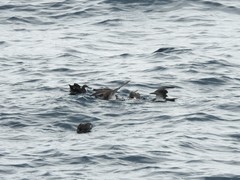
Galápagos Shearwater

Galápagos Shearwater

Puffinus subalaris

Silhouette: Juan Carlos Jerí · PhyloPic

LCLeast ConcernNTVUENCR
Daily sighting probability ~10% · With luck
at Cabo Blanco Absolute Nature Reserve

In 3 days ~30% in a week ~50%

131 Verified sightings at Cabo Blanco Absolute Nature Reserve From 2019 to 2026
7,866 In all 4 parks
August Best month
☀️ Diurnal When it's spotted

About the Galápagos Shearwater

The Galápagos shearwater (Puffinus subalaris) is a small shearwater. Until recently it was considered to be a subspecies of Audubon's shearwater, but it is actually one of two members of a very ancient lineage of the small Puffinus species, the other being, as indicated by mtDNA cytochrome b sequence data, the Christmas shearwater.

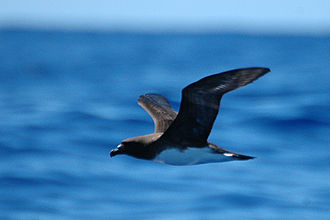
It is an endemic breeder of the Galápagos Islands, and is largely sedentary, although individuals are commonly seen as far as the Oaxacan coast of Mexico. The Galápagos shearwater has dark brown upperparts, undertail and underwing flight feathers, the rest of the underparts plumage being white. It sometimes has a dark collar. Both sexes are alike, as are the young after fledging.

It is a slender-bodied shearwater, about 29–31 cm long, with a wingspan of around 63 cm and weighs 123-225 g. The species closely resembles the tropical shearwater, although the latter is typically blacker and has a longer tail.

The Galápagos shearwater is a gregarious species and will feed at sea with other shearwaters and boobies. It flies low over the water and feeds on squid, fish and offal. It intersperses 4-10 stiff wing beats with shallow... Wikipedia →

Sounds

Call0:30

Ecuador · 2016

© Richard Hoyer · XC326283 · CC BY-NC-SA 4.0

Global Distribution

Parks Where Found

# Park Country Daily sighting probability
1 Galápagos Islands 🇪🇨 Ecuador
~50%
2 Cabo Blanco Absolute Nature Reserve 🇨🇷 Costa Rica
~10%
3 Marino Ballena National Park 🇨🇷 Costa Rica
<5%
4 Manuel Antonio National Park 🇨🇷 Costa Rica
<5%

Before you go

What are the chances of seeing a Galápagos Shearwater in Cabo Blanco Absolute Nature Reserve?

With luck

About 10% of wildlife watchers report a Galápagos Shearwater sighting in Cabo Blanco Absolute Nature Reserve on a given day, based on 131 verified sightings from GBIF citizen-science data from 2019 to 2026. It is the 83rd most-seen of the 241 birds we can rate there. Over three days the chance rises to about 30%, and over a week to about 50%, if each day is a fresh chance.

When is the best time to see a Galápagos Shearwater in Cabo Blanco Absolute Nature Reserve?

August

In that month about 30% of wildlife watchers report a Galápagos Shearwater in Cabo Blanco Absolute Nature Reserve on a given day, against under 5% in February–March and September–October, the lowest months. That is one of Cabo Blanco Absolute Nature Reserve's wettest months, with about 510 mm of rain against 15 mm in February.

What time of day is best to see a Galápagos Shearwater?

Between 2 and 5 pm

Across all the parks we cover, that three-hour window holds the most Galápagos Shearwater sightings with a recorded time, and about 9 in 10 of them come between 6 am and 6 pm: it is a daytime animal.

Is Cabo Blanco Absolute Nature Reserve the best place to see a Galápagos Shearwater?

2nd of 4

Of the 4 parks where we can rate Galápagos Shearwater sightings, Cabo Blanco Absolute Nature Reserve ranks 2nd at about 10%. The best odds are in Galápagos Islands (Ecuador, about 50%).

Where does the Galápagos Shearwater sighting chance come from?

GBIF citizen-science records

It is estimated from how often the Galápagos Shearwater is recorded against all the birds logged in Cabo Blanco Absolute Nature Reserve (131 verified sightings from 2019 to 2026), calibrated against known sighting rates. Figures are rounded to the nearest 10% because citizen-science data supports honest approximations, not decimals, and months with records from fewer than five people show "—". How it works.

← Back to Cabo Blanco Absolute Nature Reserve