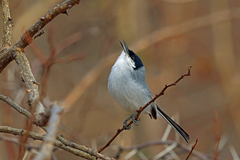

White-lored Gnatcatcher

White-lored Gnatcatcher

Polioptila albiloris

Silhouette: Sheatherius · PhyloPic

LCLeast ConcernNTVUENCR
Daily sighting probability ~10% · With luck
at Cabo Blanco Absolute Nature Reserve

In 3 days ~20% in a week ~40%

75 Verified sightings at Cabo Blanco Absolute Nature Reserve From 2019 to 2026
1,649 In all 9 parks
October Best month
☀️ Diurnal When it's spotted

About the White-lored Gnatcatcher

The white-lored gnatcatcher (Polioptila albiloris) is a species of bird in the family Polioptilidae. It is found in Costa Rica, El Salvador, Guatemala, Honduras, Mexico, and Nicaragua. The white-lored gnatcatcher was previously considered conspecific with the black-capped gnatcatcher (Polioptila nigriceps). The Yucatan gnatcatcher (P. albiventris) was previously a treated as a subspecies of the white-lored. The white-lored gnatcatcher has two subspecies, the nominate Polioptila albiloris albiloris and P. a. vanrossemi.

The white-lored gnatcatcher is 11 to 12 cm (4.3 to 4.7 in) long and weighs 6 to 9 g (0.21 to 0.32 oz). The nominate male in breeding plumage has a black cap down to the eyes and including the nape. The rest of the upperparts are bluish gray. The tail is black with white outermost feathers. The throat is white becoming pale bluish gray on the breast and flanks. The female has a dark gray cap and the eponymous white lores and supercilium. The juvenile is similar to the female but has browner upperparts. The male P. a. vanrossemi has a larger black cap and longer wings and tail than the nominate. Wikipedia →

Sounds

Call0:17

Costa Rica · 2013

© Albert Lastukhin · XC1101679 · CC BY-NC-ND 4.0

Alarm call0:23

Costa Rica · 2022

© Johan Chaves · XC749769 · CC BY-NC-SA 4.0

Song0:21

Mexico · 2016

© Manuel Grosselet · XC317985 · CC BY-NC-SA 4.0

Global Distribution

Parks Where Found

# Park Country Daily sighting probability
1 Santa Rosa National Park 🇨🇷 Costa Rica
~50%
2 Las Baulas Marine National Park 🇨🇷 Costa Rica
~30%
3 Cañón del Sumidero National Park 🇲🇽 Mexico
~20%
4 Rincón de la Vieja National Park 🇨🇷 Costa Rica
~20%
5 Palo Verde National Park 🇨🇷 Costa Rica
~10%
6 Ostional Wildlife Refuge 🇨🇷 Costa Rica
~10%
7 Cabo Blanco Absolute Nature Reserve 🇨🇷 Costa Rica
~10%
8 Carara National Park 🇨🇷 Costa Rica
<5%
9 Tenorio Volcano National Park 🇨🇷 Costa Rica
<5%

Cities Where Found

# City Country Daily sighting probability
1 Managua 🇳🇮 Nicaragua
<5%
2 San José 🇨🇷 Costa Rica
<5%

Before you go

What are the chances of seeing a White-lored Gnatcatcher in Cabo Blanco Absolute Nature Reserve?

With luck

About 10% of wildlife watchers report a White-lored Gnatcatcher sighting in Cabo Blanco Absolute Nature Reserve on a given day, based on 75 verified sightings from GBIF citizen-science data from 2019 to 2026. It is the 98th most-seen of the 241 birds we can rate there. Over three days the chance rises to about 20%, and over a week to about 40%, if each day is a fresh chance.

When is the best time to see a White-lored Gnatcatcher in Cabo Blanco Absolute Nature Reserve?

January, April and June–November

In those months about 10% of wildlife watchers report a White-lored Gnatcatcher in Cabo Blanco Absolute Nature Reserve on a given day, against under 5% in February–March, May and December, the lowest months.

What time of day is best to see a White-lored Gnatcatcher?

Between 7 and 10 am

Across all the parks we cover, that three-hour window holds the most White-lored Gnatcatcher sightings with a recorded time, and about 9 in 10 of them come between 6 am and 6 pm: it is a daytime animal.

Where does the White-lored Gnatcatcher sighting chance come from?

GBIF citizen-science records

It is estimated from how often the White-lored Gnatcatcher is recorded against all the birds logged in Cabo Blanco Absolute Nature Reserve (75 verified sightings from 2019 to 2026), calibrated against known sighting rates. Figures are rounded to the nearest 10% because citizen-science data supports honest approximations, not decimals, and months with records from fewer than five people show "—". How it works.

← Back to Cabo Blanco Absolute Nature Reserve