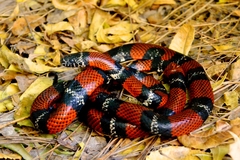
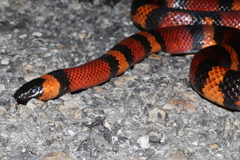

Central American Milksnake

Central American Milksnake

Lampropeltis abnorma

Silhouette: Andy Wilson · PhyloPic

LCLeast ConcernNTVUENCR
Daily sighting probability ~10% · With luck
at Calakmul Biosphere Reserve

In 3 days ~20% in a week ~50%

6 Verified sightings at Calakmul Biosphere Reserve From 2019 to 2026
17 In all 3 parks
March Best month
☀️🌙 Day & Night When it's spotted

About the Central American Milksnake

Lampropeltis abnorma, commonly known as the Guatemalan milk snake, is a species of milk snake. Species Lampropeltis abnorma at The Reptile Database Wikipedia →

Global Distribution

Parks Where Found

# Park Country Daily sighting probability
1 Santa Rosa National Park 🇨🇷 Costa Rica
~10%
2 Calakmul Biosphere Reserve 🇲🇽 Mexico
~10%
3 Monteverde Cloud Forest Reserve 🇨🇷 Costa Rica
~10%

Zoos & Centres Where Found

# Zoo / Centre Country
1 San Diego Zoo 🇺🇸 United States In captivity
2 Cincinnati Zoo and Botanical Garden 🇺🇸 United States In captivity
3 Yumka' 🇲🇽 Mexico In captivity
4 Yaroslavl Zoo 🇷🇺 Russia In captivity
5 Kyiv Zoo 🇺🇦 Ukraine In captivity
6 Berlin Zoological Garden 🇩🇪 Germany In captivity
7 Indianapolis Zoo 🇺🇸 United States In captivity
8 Nikolaev Zoo 🇺🇦 Ukraine In captivity
9 Attica Zoological Park 🇬🇷 Greece In captivity
10 Budapest Zoo & Botanical Garden 🇭🇺 Hungary In captivity
11 Pittsburgh Zoo & Aquarium 🇺🇸 United States In captivity
12 La Paz Waterfall Gardens 🇨🇷 Costa Rica In captivity
13 Reserva Zoológica Oasys MiniHollywood 🇪🇸 Spain In captivity
14 Paphos Zoo 🇨🇾 Cyprus In captivity
15 Zagreb Zoo 🇭🇷 Croatia In captivity
16 Reptile Gardens 🇺🇸 United States In captivity
17 Santillana Zoo 🇪🇸 Spain In captivity
18 Parque museo La Venta 🇲🇽 Mexico In captivity
19 Aquarium Berlin 🇩🇪 Germany In captivity
20 Acuario Inbursa 🇲🇽 Mexico In captivity
21 Tula Exotarium 🇷🇺 Russia In captivity
22 Seattle Marine Aquarium 🇺🇸 United States In captivity
23 Zoológico Miguél Álvarez del Toro 🇲🇽 Mexico In captivity

Before you go

What are the chances of seeing a Central American Milksnake in Calakmul Biosphere Reserve?

With luck

About 10% of wildlife watchers report a Central American Milksnake sighting in Calakmul Biosphere Reserve on a given day, based on 6 verified sightings from GBIF citizen-science data from 2019 to 2026. It is the 39th most-seen of the 46 reptiles we can rate there. Over three days the chance rises to about 20%, and over a week to about 50%, if each day is a fresh chance.

When is the best time to see a Central American Milksnake in Calakmul Biosphere Reserve?

March

In that month about 30% of wildlife watchers report a Central American Milksnake in Calakmul Biosphere Reserve on a given day, against under 5% in April to February, the lowest months. That is one of Calakmul Biosphere Reserve's driest months, with about 20 mm of rain against 130 mm in June.

What time of day is best to see a Central American Milksnake?

Between 7 and 10 am

Across all the parks we cover, that three-hour window holds the most Central American Milksnake sightings with a recorded time, and about 6 in 10 of them come between 6 am and 6 pm: it is seen both by day and at night.

Is Calakmul Biosphere Reserve the best place to see a Central American Milksnake?

Among the best

Of the 3 parks where we can rate Central American Milksnake sightings, Calakmul Biosphere Reserve ranks 2nd at about 10%, level with the leaders once rounded. The best odds are in Santa Rosa National Park (Costa Rica, about 10%).

Which relatives of the Central American Milksnake live in Calakmul Biosphere Reserve?

Same family: Colubridae

The closest relatives of the Central American Milksnake that you can see in Calakmul Biosphere Reserve (family Colubridae, Colubrid Snakes) are Speckled Racer (about 30%), Black-striped Snake (about 20%) and Faded Black-striped Snake (about 20%), with each one's daily chance of a sighting.

Where does the Central American Milksnake sighting chance come from?

GBIF citizen-science records

It is estimated from how often the Central American Milksnake is recorded against all the reptiles logged in Calakmul Biosphere Reserve (6 verified sightings from 2019 to 2026), calibrated against known sighting rates. Figures are rounded to the nearest 10% because citizen-science data supports honest approximations, not decimals, and months with records from fewer than five people show "—". How it works.

← Back to Calakmul Biosphere Reserve