Puffing Snake

Puffing Snake

Phrynonax poecilonotus

Silhouette: Alex Slavenko · PhyloPic

LCLeast ConcernNTVUENCR
Daily sighting probability ~10% · With luck
at Calakmul Biosphere Reserve

In 3 days ~30% in a week ~60%

9 Verified sightings at Calakmul Biosphere Reserve From 2019 to 2026
273 In all 15 parks
July Best month
☀️ Diurnal When it's spotted

About the Puffing Snake

Phrynonax poecilonotus is a species of nonvenomous snake in the family Colubridae. The species is endemic to the New World. P. poecilonotus is commonly known in Trinidad and Tobago as dos cocorite, in Brazil as papa-ovo, and in English as the puffing snake or the bird snake.

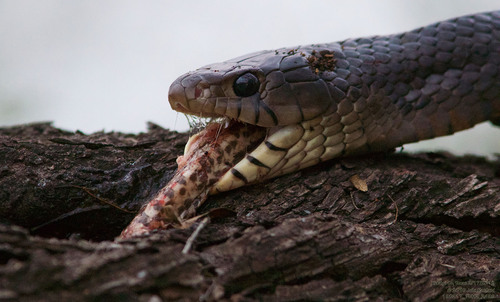
P. poecilonotus is found from Mexico through Central America to northern and central South America and Trinidad and Tobago. P. poecilonotus apparently eats any terrestrial vertebrate small enough to handle and is well known as a predator of bird eggs (hence some of the common names). In captivity, they are known to enjoy scrambled eggs.

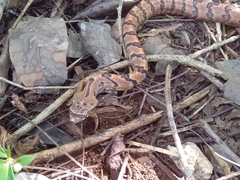
P. poecilonotus is one of the most variable snakes in the world. For about the first year of their life, they look very dull in color, and look all the same upon hatching. During the first four years, the snake's appearance will change rapidly, from slate grey and yellow, to slate and orange, etc. Past the first four years of life, changes will be very slow, but they will still change in appearance. The snakes can be combinations of black with red, orange, yellow, and/or lavender, or slate and red, yellow, orange... Wikipedia →

Global Distribution

Parks Where Found

# Park Country Daily sighting probability
1 Piedras Blancas National Park 🇨🇷 Costa Rica
~30%
2 Corcovado National Park 🇨🇷 Costa Rica
~20%
3 Rincón de la Vieja National Park 🇨🇷 Costa Rica
~20%
4 Braulio Carrillo National Park 🇨🇷 Costa Rica
~20%
5 Chagres National Park 🇵🇦 Panama
~20%
6 Bastimentos Island National Marine Park 🇵🇦 Panama
~20%
7 Tenorio Volcano National Park 🇨🇷 Costa Rica
~20%
8 Marino Ballena National Park 🇨🇷 Costa Rica
~20%
9 Arenal Volcano National Park 🇨🇷 Costa Rica
~20%
10 Carara National Park 🇨🇷 Costa Rica
~10%
11 Manuel Antonio National Park 🇨🇷 Costa Rica
~10%
12 Monteverde Cloud Forest Reserve 🇨🇷 Costa Rica
~10%
13 Calakmul Biosphere Reserve 🇲🇽 Mexico
~10%
14 La Amistad International Park (Panama) 🇵🇦 Panama
~10%
15 Soberanía National Park 🇵🇦 Panama
~10%

Zoos & Centres Where Found

# Zoo / Centre Country
1 Zoo Miami 🇺🇸 United States In captivity
2 Brookfield Zoo 🇺🇸 United States In captivity
3 Jacksonville Zoo and Gardens 🇺🇸 United States In captivity
4 Zoo Atlanta 🇺🇸 United States In captivity
5 La Paz Waterfall Gardens 🇨🇷 Costa Rica In captivity
6 International Animal Rescue – Costa Rica 🇨🇷 Costa Rica In captivity
7 La Aurora Zoo 🇬🇹 Guatemala In captivity
8 Zoológico Miguél Álvarez del Toro 🇲🇽 Mexico In captivity

Before you go

What are the chances of seeing a Puffing Snake in Calakmul Biosphere Reserve?

With luck

About 10% of wildlife watchers report a Puffing Snake sighting in Calakmul Biosphere Reserve on a given day, based on 9 verified sightings from GBIF citizen-science data from 2019 to 2026. It is the 26th most-seen of the 46 reptiles we can rate there. Over three days the chance rises to about 30%, and over a week to about 60%, if each day is a fresh chance.

When is the best time to see a Puffing Snake in Calakmul Biosphere Reserve?

July

In that month about 30% of wildlife watchers report a Puffing Snake in Calakmul Biosphere Reserve on a given day, against under 5% in May–June and August–March, the lowest months.

What time of day is best to see a Puffing Snake?

Between 10 am and 1 pm

Across all the parks we cover, that three-hour window holds the most Puffing Snake sightings with a recorded time, and about 8 in 10 of them come between 6 am and 6 pm: it is a daytime animal.

Which relatives of the Puffing Snake live in Calakmul Biosphere Reserve?

Same family: Colubridae

The closest relatives of the Puffing Snake that you can see in Calakmul Biosphere Reserve (family Colubridae, Colubrid Snakes) are Speckled Racer (about 30%), Black-striped Snake (about 20%) and Faded Black-striped Snake (about 20%), with each one's daily chance of a sighting.

Where does the Puffing Snake sighting chance come from?

GBIF citizen-science records

It is estimated from how often the Puffing Snake is recorded against all the reptiles logged in Calakmul Biosphere Reserve (9 verified sightings from 2019 to 2026), calibrated against known sighting rates. Figures are rounded to the nearest 10% because citizen-science data supports honest approximations, not decimals, and months with records from fewer than five people show "—". How it works.

← Back to Calakmul Biosphere Reserve