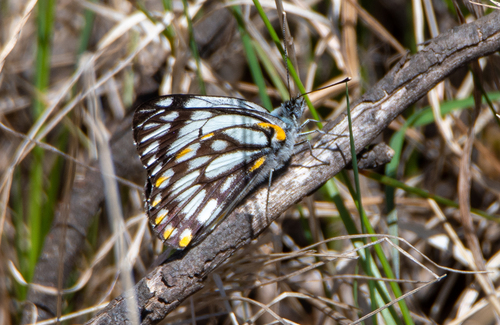

Bag-Shelter Moth

Bag-Shelter Moth

Ochrogaster lunifer

Endemic
Daily sighting probability ~20% · Possible
at Cape Range

In 3 days ~50% in a week ~80%

5 Verified sightings at Cape Range From 2019 to 2026
50 In all 6 parks
May Best month
☀️ Diurnal When it's spotted

About the Bag-Shelter Moth

Ochrogaster lunifer, the bag-shelter moth or processionary caterpillar, is a member of the family Notodontidae. The species was first described by Gottlieb August Wilhelm Herrich-Schäffer in 1855. Both the larval and adult forms have hairs that cause irritation of the skin (urticaria). The adult moth has a woolly appearance and its wings can grow to be about 5.5 cm across. The larvae feed on Grevillea striata at night and reside in brown silken bag nests during the day.

Ochrogaster lunifer has a one-year lifecycle, living communally with siblings and conspecifics from egg to pre-pupa. In October to November (Spring), adult moths emerge from the pupae underground, mate and the females lay an egg mass containing 150–550 eggs on the trunk or in the canopy of a host tree. Host trees include species of wattles and eucalypts. The eggs hatch after approximately 3–4 weeks. The caterpillars moult 7 times giving 8 instars which develop from December to May (Summer-Autumn). First instars do not feed and stay within the protection of the egg mass, other early instars feed on leaves in their host tree during the day and later instars feed at night. Throughout their development, the... Wikipedia →

Global Distribution

Parks Where Found

# Park Country Daily sighting probability
1 Uluru-Kata Tjuta National Park 🇦🇺 Australia
~20%
2 Cape Range 🇦🇺 Australia
~20%
3 Hattah-Kulkyne National Park 🇦🇺 Australia
~20%
4 Ningaloo Marine Park 🇦🇺 Australia
~10%
5 Grampians National Park 🇦🇺 Australia
~10%
6 Blue Mountains National Park 🇦🇺 Australia
~10%

Cities Where Found

# City Country Daily sighting probability
1 Brisbane 🇦🇺 Australia
~10%

Before you go

What are the chances of seeing a Bag-Shelter Moth in Cape Range?

Possible

About 20% of wildlife watchers report a Bag-Shelter Moth sighting in Cape Range on a given day, based on 5 verified sightings from GBIF citizen-science data from 2019 to 2026. It is the 2nd most-seen of the 6 insects we can rate there. Over three days the chance rises to about 50%, and over a week to about 80%, if each day is a fresh chance.

When is the best time to see a Bag-Shelter Moth in Cape Range?

May and October

In those months about 40% of wildlife watchers report a Bag-Shelter Moth in Cape Range on a given day, against under 5% in January–April, July–September and November, the lowest months.

What time of day is best to see a Bag-Shelter Moth?

Between 8 and 11 am

Across all the parks we cover, that three-hour window holds the most Bag-Shelter Moth sightings with a recorded time, and about 8 in 10 of them come between 6 am and 6 pm: it is a daytime animal.

Is Cape Range the best place to see a Bag-Shelter Moth?

Among the best

Of the 6 parks where we can rate Bag-Shelter Moth sightings, Cape Range ranks 2nd at about 20%, level with the leaders once rounded. The best odds are in Uluru-Kata Tjuta National Park (Australia, about 20%).

Which relatives of the Bag-Shelter Moth live in Cape Range?

Same order: Lepidoptera

The closest relatives of the Bag-Shelter Moth that you can see in Cape Range (order Lepidoptera, Butterflies and Moths) are Caper White (about 20%), Lime Swallowtail (about 20%) and Meadow Argus (about 20%), with each one's daily chance of a sighting.

Where does the Bag-Shelter Moth sighting chance come from?

GBIF citizen-science records

It is estimated from how often the Bag-Shelter Moth is recorded against all the insects logged in Cape Range (5 verified sightings from 2019 to 2026), calibrated against known sighting rates. Figures are rounded to the nearest 10% because citizen-science data supports honest approximations, not decimals, and months with records from fewer than five people show "—". How it works.

← Back to Cape Range