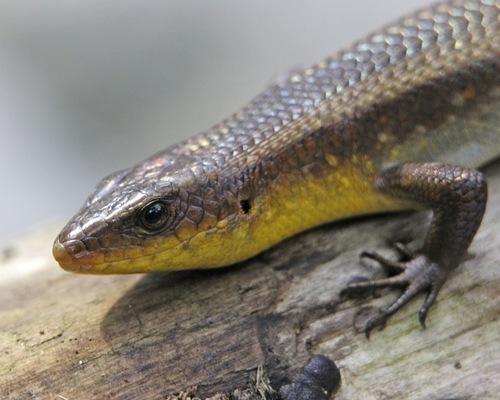
Oriental Long-tailed Grass Lizard

Oriental Long-tailed Grass Lizard

Takydromus sexlineatus

Silhouette: Gustav Mützel · PhyloPic

LCLeast ConcernNTVUENCR
Daily sighting probability ~20% · Possible
at Cat Tien National Park

In 3 days ~50% in a week ~80%

15 Verified sightings at Cat Tien National Park From 2019 to 2026
15 In 1 park
November Best month
🌅 Crepuscular When it's spotted

About the Oriental Long-tailed Grass Lizard

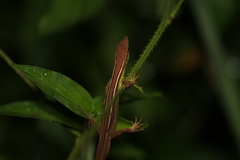
Takydromus sexlineatus, the Asian grass lizard, six-striped long-tailed grass lizard, or long-tailed grass lizard, is an arboreal, diurnal species of lizard. The tail length is usually over three times the body (snout to vent) length in this species.

Males and females are similar, males being distinguishable by the presence of pre-anal pores. On average they grow to around 12 cm (4.7 in) snout-to-vent length, with the addition of a distinctive, prehensile long tail. Some individuals may have small circular spots on the sides of the bodies. This species of lizard is often kept as a pet.

Like many lizards, they can drop their tail and grow a new one when attacked. The long-tailed grass lizard is easily identifiable by its long tail, and has a white to cream coloured underbelly with a brown, green or beige back, often adorned with brown stripes of different shades. It typically has a small head with a sharply pointed snout and a black or pink tongue. Its body is slightly elongated and thin, with small, pointy scales beneath the chin, resembling a beard. Males have white spots on their sides, while females do not. Males have tails that thicken past the vent and are generally... Wikipedia →

Global Distribution

Parks Where Found

# Park Country Daily sighting probability
1 Cat Tien National Park 🇻🇳 Vietnam
~20%

More parks will be added in future updates.

Cities Where Found

# City Country Daily sighting probability
1 Surakarta 🇮🇩 Indonesia
~40%
2 Jakarta 🇮🇩 Indonesia
~40%
3 Tasikmalaya 🇮🇩 Indonesia
~40%
4 Ho Chi Minh City 🇻🇳 Vietnam
~40%
5 Denpasar 🇮🇩 Indonesia
~40%
6 Yogyakarta 🇮🇩 Indonesia
~20%
7 Bandung 🇮🇩 Indonesia
~10%
8 Tuen Mun 🇨🇳 China
~10%

Zoos & Centres Where Found

# Zoo / Centre Country
1 Reptile Gardens 🇺🇸 United States In captivity

Closest Relatives at Cat Tien National Park

No species of the same family or order lives in Cat Tien National Park, so these are its closest relatives here: other reptiles.

Before you go

What are the chances of seeing an Oriental Long-tailed Grass Lizard in Cat Tien National Park?

Possible

About 20% of wildlife watchers report an Oriental Long-tailed Grass Lizard sighting in Cat Tien National Park on a given day, based on 15 verified sightings from GBIF citizen-science data from 2019 to 2026. It is the 22nd most-seen of the 45 reptiles we can rate there. Over three days the chance rises to about 50%, and over a week to about 80%, if each day is a fresh chance.

When is the best time to see an Oriental Long-tailed Grass Lizard in Cat Tien National Park?

June and November

In those months about 40% of wildlife watchers report an Oriental Long-tailed Grass Lizard in Cat Tien National Park on a given day, against under 5% in March–April and August–October, the lowest months.

What time of day is best to see an Oriental Long-tailed Grass Lizard?

Between 1 and 4 pm

Across all the parks we cover, that three-hour window holds the most Oriental Long-tailed Grass Lizard sightings with a recorded time, and about 6 in 10 of them come between 6 am and 6 pm: it is most active around dawn and dusk.

Where else can you see an Oriental Long-tailed Grass Lizard?

Only Cat Tien National Park, in our data

Cat Tien National Park is the only park on Wallace's Line with enough records to rate Oriental Long-tailed Grass Lizard sightings: about 20% of wildlife watchers there report one on a given day.

Where does the Oriental Long-tailed Grass Lizard sighting chance come from?

GBIF citizen-science records

It is estimated from how often the Oriental Long-tailed Grass Lizard is recorded against all the reptiles logged in Cat Tien National Park (15 verified sightings from 2019 to 2026), calibrated against known sighting rates. Figures are rounded to the nearest 10% because citizen-science data supports honest approximations, not decimals, and months with records from fewer than five people show "—". How it works.

← Back to Cat Tien National Park