Buffy-crowned Wood Partridge

Buffy-crowned Wood Partridge

Dendrortyx leucophrys

Silhouette: Sheatherius · PhyloPic

LCLeast ConcernNTVUENCR
Daily sighting probability ~10% · With luck
at Celaque National Park

In 3 days ~30% in a week ~60%

22 Verified sightings at Celaque National Park From 2019 to 2026
552 In all 7 parks
September Best month
☀️ Diurnal When it's spotted

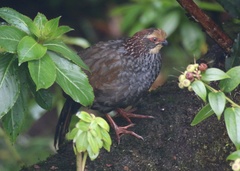
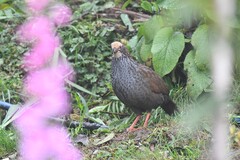
About the Buffy-crowned Wood Partridge

The buffy-crowned wood partridge (Dendrortyx leucophrys) is a bird species in the family Odontophoridae, the New World quail. It is found in Mexico, Guatemala, Honduras, El Salvador, Costa Rica and Nicaragua. The holotype of the buffy-crowned wood partridge was collected in Cobán, Guatemala, in June 1843 by Adolphe Delattre and given the binomial Ortyx leucophrys. It was originally in the collection of the 13th Earl of Derby who bequeathed it to the people of Liverpool in 1851. It is housed in the World Museum of the National Museums Liverpool with accession number D1496.

The buffy-crowned wood partridge shares the genus Dendrortyx with two other species, all of which appear to be quite distinct from each other. It has two subspecies, the nominate Dendrortyx leucophrys leucophrys and D. l. hypospodius. The latter has sometimes been considered a separate species. The members of D. l. leucophrys in Honduras and Nicaragua were previously treated as another subspecies.

The buffy-crowned wood partridge is 28 to 35.5 cm (11.0 to 14.0 in) long. Males weigh an estimated 397 g (14.0 oz) and females an estimated 340 g (12 oz). The nominate subspecies... Wikipedia →

Sounds

Song0:23

Guatemala · 2024

© Peter Boesman · XC880082 · CC BY-NC-ND 4.0

Chorus0:17

Costa Rica · 2003

© Richard Garrigues · XC5796 · CC BY-NC-ND 2.5

Song0:22

Costa Rica · 2019

© MiriamEaglemon · XC499851 · CC BY-NC-SA 4.0

Global Distribution

Parks Where Found

# Park Country Daily sighting probability
1 Irazú Volcano National Park 🇨🇷 Costa Rica
~20%
2 Celaque National Park 🇭🇳 Honduras
~10%
3 Cusuco National Park 🇭🇳 Honduras
<5%
4 Tapantí-Macizo de la Muerte National Park 🇨🇷 Costa Rica
<5%
5 Los Quetzales National Park 🇨🇷 Costa Rica
<5%
6 Chirripó National Park 🇨🇷 Costa Rica
<5%
7 Braulio Carrillo National Park 🇨🇷 Costa Rica
<5%

Cities Where Found

# City Country Daily sighting probability
1 Guatemala City 🇬🇹 Guatemala
<5%
2 San José 🇨🇷 Costa Rica
<5%

Before you go

What are the chances of seeing a Buffy-crowned Wood Partridge in Celaque National Park?

With luck

About 10% of wildlife watchers report a Buffy-crowned Wood Partridge sighting in Celaque National Park on a given day, based on 22 verified sightings from GBIF citizen-science data from 2019 to 2026. It is the 78th most-seen of the 193 birds we can rate there. Over three days the chance rises to about 30%, and over a week to about 60%, if each day is a fresh chance.

When is the best time to see a Buffy-crowned Wood Partridge in Celaque National Park?

January, May and August–September

In those months about 20% of wildlife watchers report a Buffy-crowned Wood Partridge in Celaque National Park on a given day, against under 5% in October, the lowest month.

What time of day is best to see a Buffy-crowned Wood Partridge?

Between 8 and 11 am

Across all the parks we cover, that three-hour window holds the most Buffy-crowned Wood Partridge sightings with a recorded time, and about 9 in 10 of them come between 6 am and 6 pm: it is a daytime animal.

Is Celaque National Park the best place to see a Buffy-crowned Wood Partridge?

2nd of 7

Of the 7 parks where we can rate Buffy-crowned Wood Partridge sightings, Celaque National Park ranks 2nd at about 10%. The best odds are in Irazú Volcano National Park (Costa Rica, about 20%).

Where does the Buffy-crowned Wood Partridge sighting chance come from?

GBIF citizen-science records

It is estimated from how often the Buffy-crowned Wood Partridge is recorded against all the birds logged in Celaque National Park (22 verified sightings from 2019 to 2026), calibrated against known sighting rates. Figures are rounded to the nearest 10% because citizen-science data supports honest approximations, not decimals, and months with records from fewer than five people show "—". How it works.

← Back to Celaque National Park