Central American Gulf Coast Toad

Central American Gulf Coast Toad

Incilius valliceps

Silhouette: Jose Carlos Arenas-Monroy · PhyloPic

LCLeast ConcernNTVUENCR
Daily sighting probability ~30% · Possible
at Celaque National Park

In 3 days ~60% in a week ~90%

5 Verified sightings at Celaque National Park From 2019 to 2026
253 In all 12 parks
September Best month
🌅 Crepuscular When it's spotted

About the Central American Gulf Coast Toad

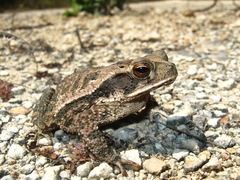
The Gulf Coast toad (Incilius valliceps) is a species of toad native to eastern and southeastern Mexico and Central America as far south as Costa Rica. The Gulf Coast toad is a medium-sized toad species, ranging from 2.5 to 10.2 cm (1 to 4 in) in length. Their back varies in color from nearly black, to shades of brown and grey with a distinctive white or yellowish colored stripe down the center, and sometimes lighter colored patches on the sides. Their underside is yellow or cream colored. Their back is covered in small tubercles, while their underside is normally devoid of them.

I. valliceps has the most extensive ridging of any toad in its geographic range. The ridges extend from the nose, to the back of the head, and with a branch that wraps around the back side of the eye. The Gulf Coast toad is found in a wide range of habitats, including open grassland, semi-arid regions, light forest, and even suburban backyards. They are typically found not far from a permanent water source, which they use for breeding in the spring, but they are capable of travelling long distances while foraging for food.

Like most toads, the Gulf Coast toad is an... Wikipedia →

Sounds

Advertisement call0:19

Costa Rica · 2014

© Chris Harrison · XC893982 · CC BY-NC-SA 4.0

Recording0:08

Mexico · 2026

© Juan Cruzado Cortés · iNaturalist · CC BY 4.0

Recording0:16

Mexico · 2025

© noirbirdie · iNaturalist · CC BY-NC 4.0

Global Distribution

Parks Where Found

# Park Country Daily sighting probability
1 Pico Bonito National Park 🇭🇳 Honduras
~40%
2 Cockscomb Basin Wildlife Sanctuary 🇧🇿 Belize
~40%
3 Biotopo Cerro Cahuí 🇬🇹 Guatemala
~40%
4 Calakmul Biosphere Reserve 🇲🇽 Mexico
~40%
5 Lago de Yojoa 🇭🇳 Honduras
~30%
6 Cerro Azul Meámbar National Park 🇭🇳 Honduras
~30%
7 Tikal National Park 🇬🇹 Guatemala
~30%
8 Celaque National Park 🇭🇳 Honduras
~30%
9 Sian Ka'an Biosphere Reserve 🇲🇽 Mexico
~20%
10 Arrecifes de Cozumel National Park 🇲🇽 Mexico
~20%
11 Tenorio Volcano National Park 🇨🇷 Costa Rica
~10%
12 Ría Lagartos Biosphere Reserve 🇲🇽 Mexico
~10%

Cities Where Found

# City Country Daily sighting probability
1 San Pedro Sula 🇭🇳 Honduras
~30%

Before you go

What are the chances of seeing a Central American Gulf Coast Toad in Celaque National Park?

Possible

About 30% of wildlife watchers report a Central American Gulf Coast Toad sighting in Celaque National Park on a given day, based on 5 verified sightings from GBIF citizen-science data from 2019 to 2026. Over three days the chance rises to about 60%, and over a week to about 90%, if each day is a fresh chance.

When is the best time to see a Central American Gulf Coast Toad in Celaque National Park?

September

In that month about 50% of wildlife watchers report a Central American Gulf Coast Toad in Celaque National Park on a given day, against under 5% in July and December–May, the lowest months. That is one of Celaque National Park's wettest months, with about 370 mm of rain against 60 mm in February.

What time of day is best to see a Central American Gulf Coast Toad?

Between 6 and 9 pm

Across all the parks we cover, that three-hour window holds the most Central American Gulf Coast Toad sightings with a recorded time, and about half of them come between 6 am and 6 pm: it is most active around dawn and dusk.

Where does the Central American Gulf Coast Toad sighting chance come from?

GBIF citizen-science records

It is estimated from how often the Central American Gulf Coast Toad is recorded against all the amphibians logged in Celaque National Park (5 verified sightings from 2019 to 2026), calibrated against known sighting rates. Figures are rounded to the nearest 10% because citizen-science data supports honest approximations, not decimals, and months with records from fewer than five people show "—". How it works.

← Back to Celaque National Park