
Yucatán Wren

Yucatán Wren

Campylorhynchus yucatanicus

Silhouette: Andy Wilson · PhyloPic

LCNTNear ThreatenedVUENCR Endemic
Daily sighting probability ~40% · Likely
at Celestún Biosphere Reserve

In 3 days ~80% in a week >90%

715 Verified sightings at Celestún Biosphere Reserve From 2019 to 2026
808 In all 2 parks
June Best month
☀️ Diurnal When it's spotted

About the Yucatán Wren

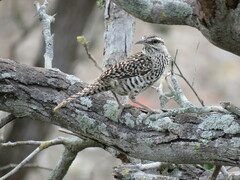
The Yucatan wren (Campylorhynchus yucatanicus) is a species of bird in the family Troglodytidae. It is endemic to Mexico. Its natural habitat is subtropical or tropical dry shrubland, only found on the narrow coastal strip of the northern Yucatán Peninsula. One of the critical habitats of this species is the Petenes mangroves ecoregion of the Yucatan coast. It is threatened by habitat destruction.

The adult Yucatan wren is a small species about 18 centimetres (7 in) long. The face is whitish with a dark eye-stripe, and the crown is greyish brown. The upper parts are brown streaked with black and white, and the wings are brown and barred with dark brown and white. The tail is black barred with grey, with white tips to some of the outer feathers. The underparts are whitish with a dark cheek stripe and blackish spotting and barring. The juvenile is similar in appearance to the adult but with less contrast between the upper and underparts.

The Yucatan wren is endemic to a coastal strip of the Yucatan peninsula. It can be found in arid areas with scrub, large cacti, and pastureland edges. Its breeding range is even more restricted to a strip... Wikipedia →

Sounds

Call0:28

Mexico · 2016

© Ross Gallardy · XC332790 · CC BY-NC-SA 4.0

Alarm call0:44

Mexico · 2005

© meena haribal · XC5507 · CC BY-NC-ND 2.5

Song0:04

Mexico · 2010

© Jon King · XC58806 · CC BY-NC-ND 2.5

Global Distribution

Parks Where Found

# Park Country Daily sighting probability
1 Celestún Biosphere Reserve 🇲🇽 Mexico
~40%
2 Ría Lagartos Biosphere Reserve 🇲🇽 Mexico
<5%

Before you go

What are the chances of seeing a Yucatán Wren in Celestún Biosphere Reserve?

Likely

About 40% of wildlife watchers report a Yucatán Wren sighting in Celestún Biosphere Reserve on a given day, based on 715 verified sightings from GBIF citizen-science data from 2019 to 2026. It is the 34th most-seen of the 297 birds we can rate there. Over three days the chance rises to about 80%, and over a week to over 90%, if each day is a fresh chance.

When is the best time to see a Yucatán Wren in Celestún Biosphere Reserve?

June

In that month about 60% of wildlife watchers report a Yucatán Wren in Celestún Biosphere Reserve on a given day, against about 30% in February, April and July, the lowest months. That is one of Celestún Biosphere Reserve's wettest months, with about 160 mm of rain against 10 mm in February.

What time of day is best to see a Yucatán Wren?

Between 7 and 10 am

Across all the parks we cover, that three-hour window holds the most Yucatán Wren sightings with a recorded time, and about 9 in 10 of them come between 6 am and 6 pm: it is a daytime animal.

Is Celestún Biosphere Reserve the best place to see a Yucatán Wren?

Yes

Of the 2 parks where we can rate Yucatán Wren sightings, Celestún Biosphere Reserve has the highest daily chance: about 40%. Next come Ría Lagartos Biosphere Reserve (Mexico, under 5%).

Where does the Yucatán Wren sighting chance come from?

GBIF citizen-science records

It is estimated from how often the Yucatán Wren is recorded against all the birds logged in Celestún Biosphere Reserve (715 verified sightings from 2019 to 2026), calibrated against known sighting rates. Figures are rounded to the nearest 10% because citizen-science data supports honest approximations, not decimals, and months with records from fewer than five people show "—". How it works.

← Back to Celestún Biosphere Reserve