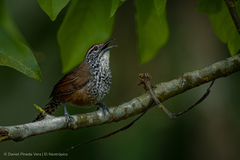
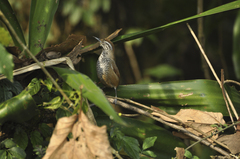
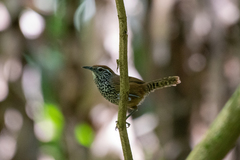

Spot-breasted Wren

Spot-breasted Wren

Pheugopedius maculipectus

Silhouette: Matt Wilkins · PhyloPic

LCLeast ConcernNTVUENCR
Daily sighting probability <5% · Rare
at Celestún Biosphere Reserve

In 3 days <5%

10 Verified sightings at Celestún Biosphere Reserve From 2019 to 2026
5,648 In all 15 parks
May Best month
☀️ Diurnal When it's spotted

About the Spot-breasted Wren

The spot-breasted wren (Pheugopedius maculipectus) is a species of bird in the family Troglodytidae. It is found in Belize, Costa Rica, El Salvador, Guatemala, Honduras, Mexico, and Nicaragua. The spot-breasted wren has at times been treated as conspecific with rufous-breasted wren (P. rutilus) and speckle-breasted wren (P. sclateri). They do form a superspecies.

The International Ornithological Committee (IOC) recognizes five subspecies: BirdLife International (BLI) does not recognize either petersi or varians, considering them "indistinguishable from umbrinus". The spot-breasted wren is 12.5 to 14 cm (4.9 to 5.5 in) long; males weigh 14.3 to 16.8 g (0.50 to 0.59 oz) and females 12.4 to 16.2 g (0.44 to 0.57 oz). Adults of the nominate subspecies have a reddish brown crown and upperparts; the rump is more chestnut. Their tail is dull brown with narrow dark bars. They have a white supercilium... Wikipedia →

Sounds

Song0:38

Belize · 2023

© Paul Driver · XC998037 · CC BY-NC-SA 4.0

Call0:09

Mexico · 2023

© Leonardo Guzman Hernandez · XC858728 · CC BY-NC-SA 4.0

Uncertain0:19

Mexico · 2020

© Alfredo Dorantes Euan · XC580750 · CC BY-NC-SA 4.0

Global Distribution

Parks Where Found

# Park Country Daily sighting probability
1 Cockscomb Basin Wildlife Sanctuary 🇧🇿 Belize
~70%
2 Pico Bonito National Park 🇭🇳 Honduras
~60%
3 Tikal National Park 🇬🇹 Guatemala
~50%
4 Cusuco National Park 🇭🇳 Honduras
~50%
5 Calakmul Biosphere Reserve 🇲🇽 Mexico
~40%
6 Montes Azules Biosphere Reserve 🇲🇽 Mexico
~40%
7 Lago de Yojoa 🇭🇳 Honduras
~40%
8 Cerro Azul Meámbar National Park 🇭🇳 Honduras
~30%
9 Cañón del Sumidero National Park 🇲🇽 Mexico
~30%
10 El Triunfo 🇲🇽 Mexico
~30%
11 Biotopo Cerro Cahuí 🇬🇹 Guatemala
~20%
12 Sian Ka'an Biosphere Reserve 🇲🇽 Mexico
~20%
13 Cumbres de Monterrey National Park 🇲🇽 Mexico
~20%
14 Ría Lagartos Biosphere Reserve 🇲🇽 Mexico
<5%
15 Celestún Biosphere Reserve 🇲🇽 Mexico
<5%

Cities Where Found

# City Country Daily sighting probability
1 San Salvador 🇸🇻 El Salvador
~10%
2 San Pedro Sula 🇭🇳 Honduras
<5%
3 Guatemala City 🇬🇹 Guatemala
<5%

Before you go

What are the chances of seeing a Spot-breasted Wren in Celestún Biosphere Reserve?

Rare

Under 5% of wildlife watchers report a Spot-breasted Wren sighting in Celestún Biosphere Reserve on a given day, based on 10 verified sightings from GBIF citizen-science data from 2019 to 2026. It is the 254th most-seen of the 297 birds we can rate there. Over three days the chance rises to under 5%, if each day is a fresh chance.

When is the best time to see a Spot-breasted Wren in Celestún Biosphere Reserve?

Any time of year

In every month with enough records, under 5% of wildlife watchers report a Spot-breasted Wren in Celestún Biosphere Reserve on a given day, so our monthly data shows no clear season.

What time of day is best to see a Spot-breasted Wren?

Between 7 and 10 am

Across all the parks we cover, that three-hour window holds the most Spot-breasted Wren sightings with a recorded time, and about 9 in 10 of them come between 6 am and 6 pm: it is a daytime animal.

Which relatives of the Spot-breasted Wren live in Celestún Biosphere Reserve?

Same family: Troglodytidae

The closest relatives of the Spot-breasted Wren that you can see in Celestún Biosphere Reserve (family Troglodytidae, Wrens) are Yucatán Wren (about 40%) and Southern House Wren (about 10%), with each one's daily chance of a sighting.

Where does the Spot-breasted Wren sighting chance come from?

GBIF citizen-science records

It is estimated from how often the Spot-breasted Wren is recorded against all the birds logged in Celestún Biosphere Reserve (10 verified sightings from 2019 to 2026), calibrated against known sighting rates. Figures are rounded to the nearest 10% because citizen-science data supports honest approximations, not decimals, and months with records from fewer than five people show "—". How it works.

← Back to Celestún Biosphere Reserve