Ant Bug

Ant Bug

Alydus calcaratus

Daily sighting probability <5% · Rare
at Cévennes National Park

In 3 days ~10% in a week ~30%

5 Verified sightings at Cévennes National Park From 2019 to 2026
53 In all 5 parks
August Best month
☀️ Diurnal When it's spotted

About the Ant Bug

Alydus calcaratus is a bug species with a Holarctic distribution ranging from the British Isles almost all over Europe to eastern Siberia and China. Moreover, the species also in northern North America from Alaska and Québec across the United States to Wyoming. It is the only species in the family in northern Central Europe outside of the Alps.

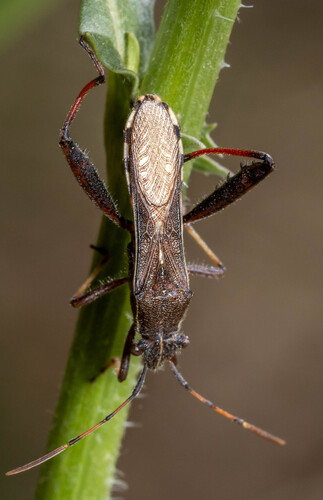
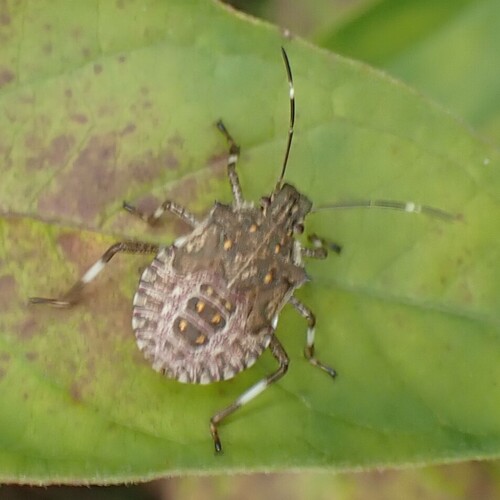
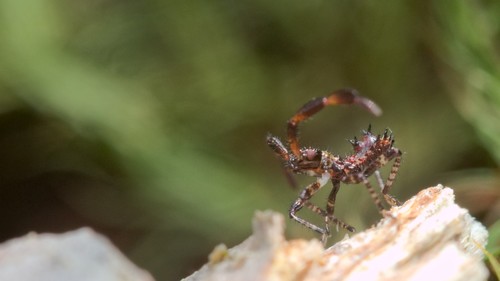
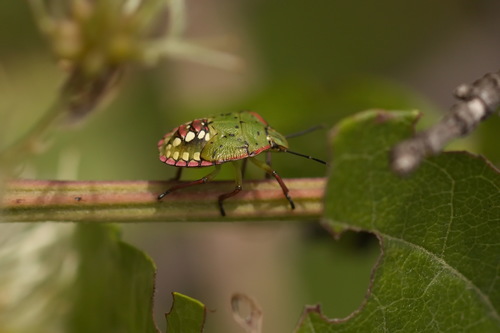
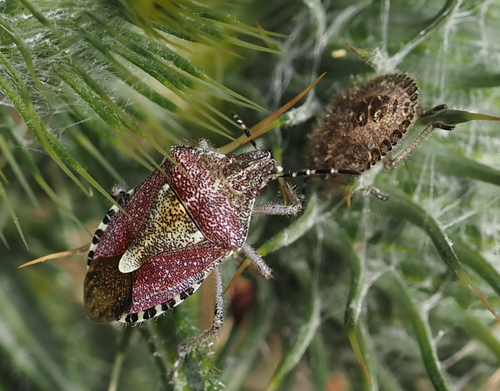
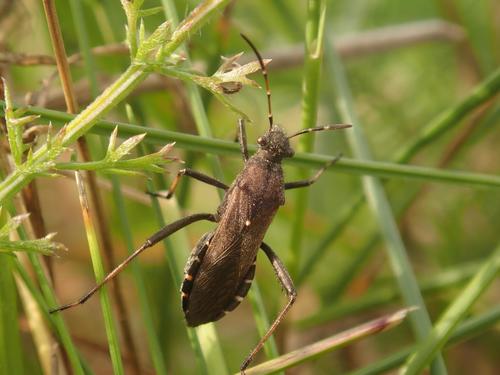
Alydus calcaratus is a large (10.0 to 12.0 mm), oblong and mainly blackish-coloured bug. The head is as wide as the pronotum, the rear corners of the pronotum are rounded. The hind leg (femora) of the males are thickened and have several strong spines on the underside. As with all the other species of the family (Alydidae), the antennae have four segments, of which the fourth is curved. The body is blackish, the dorsum of the abdomen has a bright orange patch, which is visible only in flight. They resemble spider-hunting wasps such as Arachnospila.

Alydus calcaratus is phytophagous, the imagines and the nymphs feeding mostly on fallen seeds of various legumes (Fabaceae) especially species of the genera Sarothamnus, Cytisus, Genista and Ulex. Feeding on vertebrate carrion and faeces has also been observed. In Germany, imagines can be observed from the middle or end of June at the earliest, most occur in early August to mid-September, and the last observations are in October. The animals mate from July to September, nymphs were found from May to August. Information on the way of life of the nymphs is contradictory. The nymphs are said to live in ant nests but the nature of the relationship of the nymphs to ants is still unclear.

The habitat is heaths, dry grassland, dry places with light soils and sand dunes. Wikipedia →
Global Distribution

Parks Where Found

# Park Country Daily sighting probability
1 Vanoise National Park 🇫🇷 France
~10%
2 Mercantour National Park 🇫🇷 France
~10%
3 Ecrins National Park 🇫🇷 France
~10%
4 Pyrénées National Park 🇫🇷 France
~10%
5 Cévennes National Park 🇫🇷 France
<5%

Cities Where Found

# City Country Daily sighting probability
1 Helsinki 🇫🇮 Finland
~10%
2 Warsaw 🇵🇱 Poland
~10%
3 Berlin 🇩🇪 Germany
<5%
4 Munich 🇩🇪 Germany
<5%
5 Vienna 🇦🇹 Austria
<5%
6 Kyiv 🇺🇦 Ukraine
<5%
7 Prague 🇨🇿 Czechia
<5%

Before you go

What are the chances of seeing an Ant Bug in Cévennes National Park?

Rare

Under 5% of wildlife watchers report an Ant Bug sighting in Cévennes National Park on a given day, based on 5 verified sightings from GBIF citizen-science data from 2019 to 2026. It is the 896th most-seen of the 996 insects we can rate there. Over three days the chance rises to about 10%, and over a week to about 30%, if each day is a fresh chance.

When is the best time to see an Ant Bug in Cévennes National Park?

August and September

In those months about 10% of wildlife watchers report an Ant Bug in Cévennes National Park on a given day, against under 5% in October to July, the lowest months.

What time of day is best to see an Ant Bug?

Between 1 and 4 pm

Across all the parks we cover, that three-hour window holds the most Ant Bug sightings with a recorded time, and nearly all of them come between 6 am and 6 pm: it is a daytime animal.

Where does the Ant Bug sighting chance come from?

GBIF citizen-science records

It is estimated from how often the Ant Bug is recorded against all the insects logged in Cévennes National Park (5 verified sightings from 2019 to 2026), calibrated against known sighting rates. Figures are rounded to the nearest 10% because citizen-science data supports honest approximations, not decimals, and months with records from fewer than five people show "—". How it works.

← Back to Cévennes National Park