
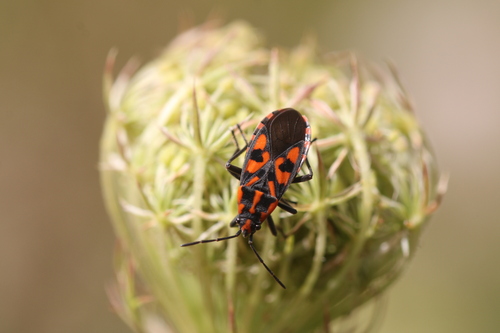
European Firebug

European Firebug

Pyrrhocoris apterus

Daily sighting probability ~30% · Possible
at Cévennes National Park

In 3 days ~70% in a week ~90%

202 Verified sightings at Cévennes National Park From 2019 to 2026
656 In all 14 parks
December Best month
☀️ Diurnal When it's spotted

About the European Firebug

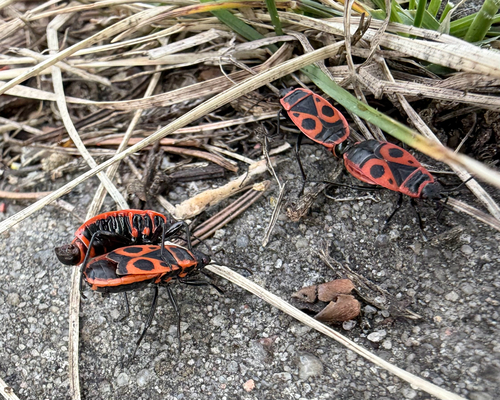
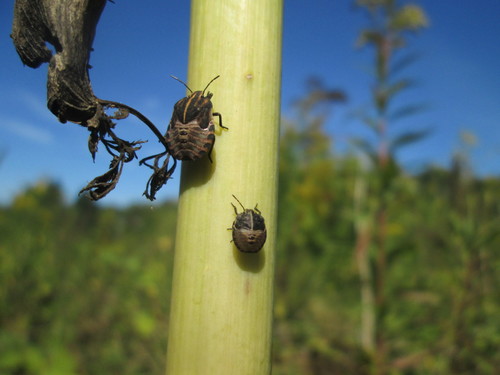
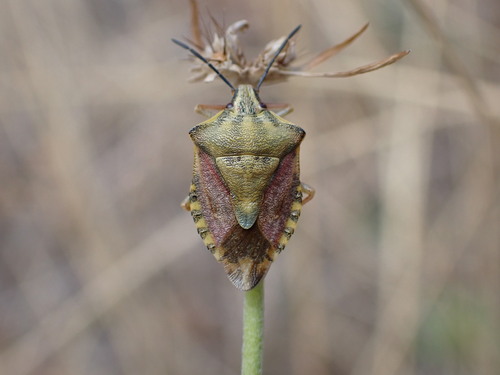
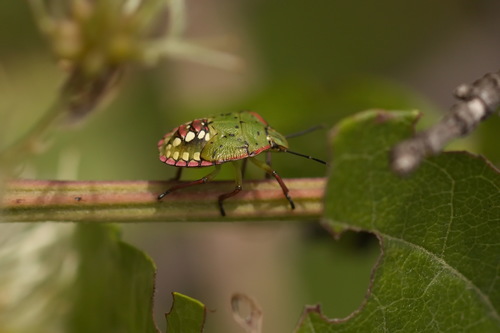
The firebug, Pyrrhocoris apterus, is a common insect of the family Pyrrhocoridae. Easily recognisable due to its striking red and black coloration, it may be confused with the similarly coloured though unrelated Corizus hyoscyami (cinnamon bug or squash bug). Pyrrhocoris apterus is distributed throughout the Palaearctic from the Atlantic coast of Europe to northwest China. Beyond its native Palaearctic range, it has been recorded in the United States, Central America, Southern Ontario (As an invasive species), India, and Australia. It has been reported as recently expanding its distribution northwards into mainland United Kingdom and eastward on to the coast of the Mediterranean Sea. It is frequently observed to form aggregations, especially in immature forms, containing tens to perhaps a hundred individuals.

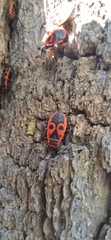
The firebug generally mates in April and May. Its diet consists primarily of seeds from lime trees and mallows (see below). It can often be found in groups near the base of lime tree trunks, on the sunny side. The firebug can be seen in tandem formation when mating, which can last from 12 hours up to 7 days. It has been proposed that this long copulation duration... Wikipedia →

Global Distribution

Parks Where Found

# Park Country Daily sighting probability
1 Gauja National Park 🇱🇻 Latvia
~40%
2 Triglav National Park 🇸🇮 Slovenia
~40%
3 Białowieża National Park 🇵🇱 Poland
~30%
4 Biebrza National Park 🇵🇱 Poland
~30%
5 Cévennes National Park 🇫🇷 France
~30%
6 Fertő-Hanság National Park 🇭🇺 Hungary
~20%
7 Bavarian Forest National Park 🇩🇪 Germany
~20%
8 Plitvice Lakes National Park 🇭🇷 Croatia
~20%
9 Picos de Europa National Park 🇪🇸 Spain
~20%
10 Sierra Nevada National Park 🇪🇸 Spain
~20%
11 Doñana National Park 🇪🇸 Spain
~10%
12 Pyrénées National Park 🇫🇷 France
~10%
13 Sierra de Guadarrama National Park 🇪🇸 Spain
~10%
14 Wadden Sea National Park 🇩🇪 Germany
<5%

Cities Where Found

# City Country Daily sighting probability
1 Dushanbe 🇹🇯 Tajikistan
~60%
2 Bishkek 🇰🇬 Kyrgyzstan
~50%
3 Kyiv 🇺🇦 Ukraine
~50%
4 Ankara 🇹🇷 Turkey
~40%
5 Berlin 🇩🇪 Germany
~40%
6 Kharkiv 🇺🇦 Ukraine
~40%
7 Budapest 🇭🇺 Hungary
~40%
8 Prague 🇨🇿 Czechia
~40%
9 Paris 🇫🇷 France
~40%
10 Turin 🇮🇹 Italy
~40%

Before you go

What are the chances of seeing a European Firebug in Cévennes National Park?

Possible

About 30% of wildlife watchers report a European Firebug sighting in Cévennes National Park on a given day, based on 202 verified sightings from GBIF citizen-science data from 2019 to 2026. It is the 8th most-seen of the 996 insects we can rate there. Over three days the chance rises to about 70%, and over a week to about 90%, if each day is a fresh chance.

When is the best time to see a European Firebug in Cévennes National Park?

March–June, September and December

In those months about 40% of wildlife watchers report a European Firebug in Cévennes National Park on a given day, against about 20% in January, July–August and October–November, the lowest months.

What time of day is best to see a European Firebug?

Between 1 and 4 pm

Across all the parks we cover, that three-hour window holds the most European Firebug sightings with a recorded time, and about 9 in 10 of them come between 6 am and 6 pm: it is a daytime animal.

Is Cévennes National Park the best place to see a European Firebug?

5th of 14

Of the 14 parks where we can rate European Firebug sightings, Cévennes National Park ranks 5th at about 30%. The best odds are in Gauja National Park (Latvia, about 40%), Triglav National Park (Slovenia, about 40%) and Białowieża National Park (Poland, about 30%).

Where does the European Firebug sighting chance come from?

GBIF citizen-science records

It is estimated from how often the European Firebug is recorded against all the insects logged in Cévennes National Park (202 verified sightings from 2019 to 2026), calibrated against known sighting rates. Figures are rounded to the nearest 10% because citizen-science data supports honest approximations, not decimals, and months with records from fewer than five people show "—". How it works.

← Back to Cévennes National Park