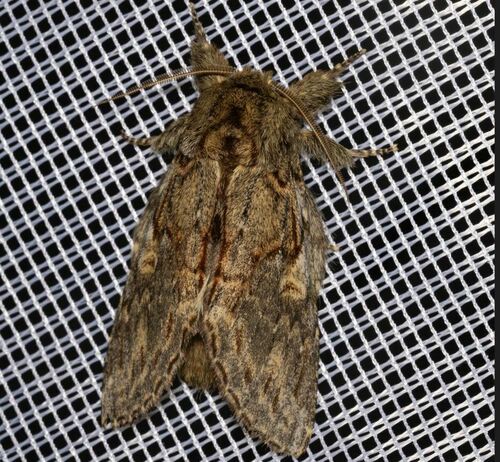
Great Prominent

Great Prominent

Peridea anceps

Daily sighting probability ~10% · With luck
at Cévennes National Park

In 3 days ~20% in a week ~40%

49 Verified sightings at Cévennes National Park From 2019 to 2026
130 In all 6 parks
May Best month
☀️🌙 Day & Night When it's spotted

About the Great Prominent

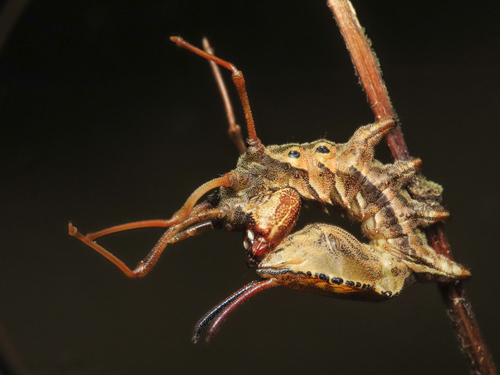
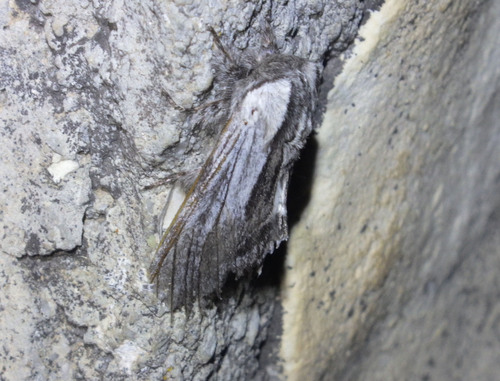
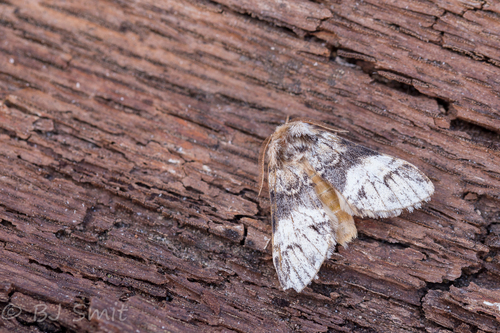
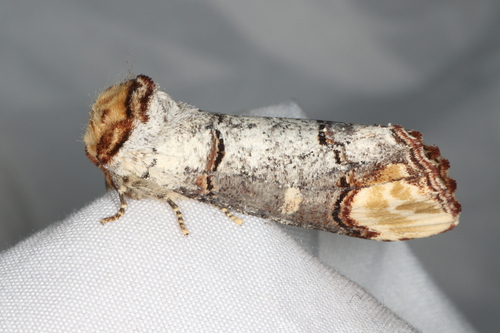
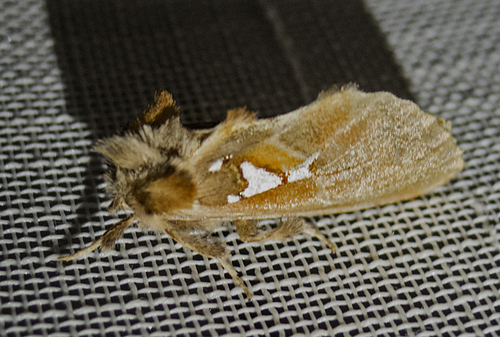
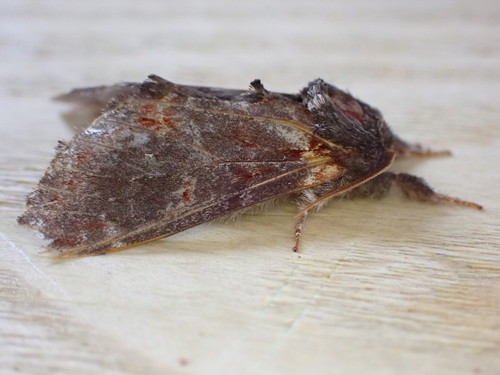
Peridea anceps, the great prominent, is a moth of the family Notodontidae first described by Johann August Ephraim Goeze in 1781. It is found in central and southern Europe and North Africa. The wingspan is 50–65 mm. The antennae are almost half as long as the forewing, narrowly feathered in the male and wire-shaped in the female. The body is cylindrical, and covered with dark brownish hairs. The thorax may have slightly different drawings but the middle part is slightly darker and warmer brown than the rest. The forewing is oblong and narrow, almost oval, with a wide "tooth" of backward-pointing hairs approximately in the middle of the back edge. It is yellowish grey with four more or less distinct narrow transverse bands, the two innermost ones being dark and the two outermost light. The hindwing is yellowish-white, darker at the front edge and at the base. The larva is naked without any body outgrowths, green with short, bright oblique stripes on the side of each body joint and some, partially broken, lighter longitudinal stripes along the back. The head capsule is green with four light stripes.

The moth flies from April to July depending on the location. The larvae feed on oak. If the larva is disturbed, it bends the front and hind end upwards until the front body is over the space, and cracks with the legs while shaking the front body. This surprising behavior may be enough to scare predators. Wikipedia →
Global Distribution

Parks Where Found

# Park Country Daily sighting probability
1 Snowdonia National Park 🇬🇧 United Kingdom
~20%
2 Cévennes National Park 🇫🇷 France
~10%
3 Bavarian Forest National Park 🇩🇪 Germany
~10%
4 Pyrénées National Park 🇫🇷 France
~10%
5 Sierra de Guadarrama National Park 🇪🇸 Spain
<5%
6 Wadden Sea National Park 🇩🇪 Germany
<5%

Cities Where Found

# City Country Daily sighting probability
1 Hamburg 🇩🇪 Germany
<5%
2 Prague 🇨🇿 Czechia
<5%
3 Vienna 🇦🇹 Austria
<5%

Before you go

What are the chances of seeing a Great Prominent in Cévennes National Park?

With luck

About 10% of wildlife watchers report a Great Prominent sighting in Cévennes National Park on a given day, based on 49 verified sightings from GBIF citizen-science data from 2019 to 2026. It is the 382nd most-seen of the 996 insects we can rate there. Over three days the chance rises to about 20%, and over a week to about 40%, if each day is a fresh chance.

When is the best time to see a Great Prominent in Cévennes National Park?

March and May

In those months about 20% of wildlife watchers report a Great Prominent in Cévennes National Park on a given day, against under 5% in June to February, the lowest months.

What time of day is best to see a Great Prominent?

Between 9 pm and midnight

Across all the parks we cover, that three-hour window holds the most Great Prominent sightings with a recorded time, and about half of them come between 6 pm and 6 am: it is seen both by day and at night.

Is Cévennes National Park the best place to see a Great Prominent?

2nd of 6

Of the 6 parks where we can rate Great Prominent sightings, Cévennes National Park ranks 2nd at about 10%. The best odds are in Snowdonia National Park (United Kingdom, about 20%).

Which relatives of the Great Prominent live in Cévennes National Park?

Same family: Notodontidae

The closest relatives of the Great Prominent that you can see in Cévennes National Park (family Notodontidae, Prominent Moths) are Pine Processionary-Moth (about 20%), Lobster Moth (about 10%) and Tawny Prominent (about 10%), with each one's daily chance of a sighting.

Where does the Great Prominent sighting chance come from?

GBIF citizen-science records

It is estimated from how often the Great Prominent is recorded against all the insects logged in Cévennes National Park (49 verified sightings from 2019 to 2026), calibrated against known sighting rates. Figures are rounded to the nearest 10% because citizen-science data supports honest approximations, not decimals, and months with records from fewer than five people show "—". How it works.

← Back to Cévennes National Park