Snowy Plover

Snowy Plover

Charadrius nivosus

LCNTNear ThreatenedVUENCR
Daily sighting probability ~20% · Possible
at Channel Islands National Park

In 3 days ~50% in a week ~80%

345 Verified sightings at Channel Islands National Park From 2019 to 2026
1,609 In all 10 parks
December Best month
☀️ Diurnal When it's spotted

About the Snowy Plover

The snowy plover (Anarhynchus nivosus, formerly Charadrius nivosus) is a small shorebird found in the Americas. It is a member of the bird family Charadriidae, which includes the plovers, dotterels, and lapwings. The snowy plover was originally described by John Cassin in 1858, but was classified as a subspecies of the Kentish plover in 1922. Since 2011, the snowy plover has been recognized as a distinct species based on genetic and anatomical differences from the Kentish plover. Two or three subspecies are recognized, distributed along the Pacific coast of North America, Ecuador, Peru, and Chile, in several inland areas of the US and Mexico, along the Gulf Coast, and on Caribbean islands. The coastal populations consist of both residential and migratory birds, whereas the inland populations are mostly migratory. It is one of the best studied endemic shorebirds of the Americas, and one of the rarest.

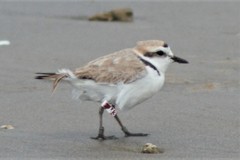
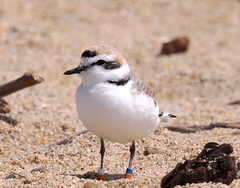
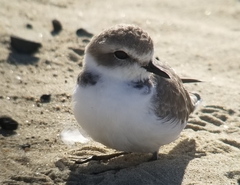
Snowy plovers are pale brown above and white below, with a white band on the hind neck. During the breeding season, males have black patches behind the eye and on the side of the neck; the neck patches are separated from each other and do not form a continuous breast band as in many other plovers. Snowy plovers can also be distinguished from other plovers in having an all-black and slender bill, and gray to black legs. The typical call is a repeated "tu-wheet".

This plover inhabits open areas in which vegetation is absent or sparse, in particular coastal sand beaches and shores of salt or soda lakes, where it feeds on invertebrates such as crustaceans, worms, beetles, and flies. At the beginning of the breeding season, males excavate multiple nest scrapes that are advertised to females; one of these scrapes is later selected for breeding. Some females will desert their brood soon after the chicks hatch to re-mate with another male, while their first mate will continue to rear the chicks. Such polygamy is uncommon in birds, and is possibly a strategy to maximize breeding success. There are more males than females – 1.4 times as many in California – and the more pronounced this sex ratio imbalance is, the more females engage in polyandrous behavior.

The snowy plover is listed as near threatened by the International Union for Conservation of Nature. The main threats are habitat destruction due to invasive beach grasses, urban development, as well as frequent disturbance due to recreational uses of beaches.

Wikipedia →

Sounds

Alarm call0:40

Mexico · 2020

© Isain Contreras Rodríguez · XC566601 · CC BY-NC-SA 4.0

Call1:08

United States · 2015

© Paul Marvin · XC286814 · CC BY-NC-SA 4.0

Flight call0:18

Ecuador · 2003

© John V. Moore · XC257558 · CC BY-NC-SA 4.0

Global Distribution

Parks Where Found

# Park Country Daily sighting probability
1 Pan de Azúcar National Park 🇨🇱 Chile
~50%
2 Ría Lagartos Biosphere Reserve 🇲🇽 Mexico
~40%
3 Padre Island National Seashore 🇺🇸 United States
~30%
4 Celestún Biosphere Reserve 🇲🇽 Mexico
~20%
5 Paracas National Reserve 🇵🇪 Peru
~20%
6 Bahía de Loreto National Park 🇲🇽 Mexico
~20%
7 Channel Islands National Park 🇺🇸 United States
~20%
8 Pacific Rim National Park Reserve 🇨🇦 Canada
~10%
9 El Vizcaíno Biosphere Reserve 🇲🇽 Mexico
~10%
10 Redwood National Park 🇺🇸 United States
~10%

Cities Where Found

# City Country Daily sighting probability
1 San Diego 🇺🇸 United States
<5%
2 Los Angeles 🇺🇸 United States
<5%
3 San Francisco 🇺🇸 United States
<5%
4 Mexico City 🇲🇽 México
<5%
5 Denver 🇺🇸 United States
<5%
6 Chicago 🇺🇸 United States
<5%

Zoos & Centres Where Found

# Zoo / Centre Country
1 Monterey Bay Aquarium 🇺🇸 United States In captivity
2 Seattle Aquarium 🇺🇸 United States In captivity
3 Seattle Marine Aquarium 🇺🇸 United States In captivity

Before you go

What are the chances of seeing a Snowy Plover in Channel Islands National Park?

Possible

About 20% of wildlife watchers report a Snowy Plover sighting in Channel Islands National Park on a given day, based on 345 verified sightings from GBIF citizen-science data from 2019 to 2026. It is the 63rd most-seen of the 278 birds we can rate there. Over three days the chance rises to about 50%, and over a week to about 80%, if each day is a fresh chance.

When is the best time to see a Snowy Plover in Channel Islands National Park?

December and January

In those months about 30% of wildlife watchers report a Snowy Plover in Channel Islands National Park on a given day, against under 5% in October, the lowest month. Those are among Channel Islands National Park's wettest months, with about 60 mm of rain a month against almost none in July.

What time of day is best to see a Snowy Plover?

Between 11 am and 2 pm

Across all the parks we cover, that three-hour window holds the most Snowy Plover sightings with a recorded time, and about 9 in 10 of them come between 6 am and 6 pm: it is a daytime animal.

Which relatives of the Snowy Plover live in Channel Islands National Park?

Same genus: Charadrius

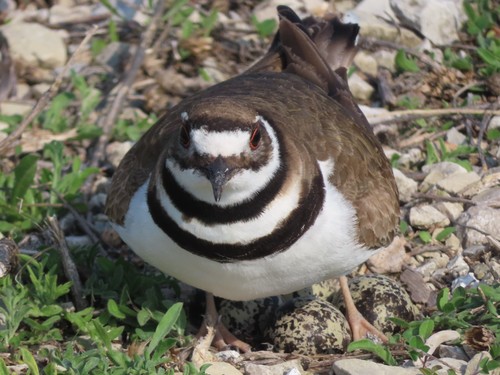
The closest relatives of the Snowy Plover that you can see in Channel Islands National Park (genus Charadrius, Holarctic Ringed Plovers and Allies) are Killdeer (about 10%) and Semipalmated Plover (about 10%), with each one's daily chance of a sighting.

Where does the Snowy Plover sighting chance come from?

GBIF citizen-science records

It is estimated from how often the Snowy Plover is recorded against all the birds logged in Channel Islands National Park (345 verified sightings from 2019 to 2026), calibrated against known sighting rates. Figures are rounded to the nearest 10% because citizen-science data supports honest approximations, not decimals, and months with records from fewer than five people show "—". How it works.

← Back to Channel Islands National Park