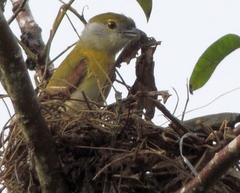
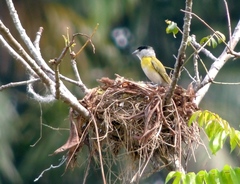
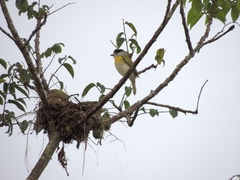
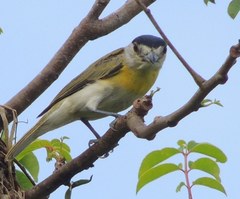

Green-backed Becard

Green-backed Becard

Pachyramphus viridis

Silhouette: Sheatherius · PhyloPic

LCLeast ConcernNTVUENCR
Daily sighting probability <5% · Rare
at Chapada Diamantina National Park

In 3 days ~10%

12 Verified sightings at Chapada Diamantina National Park From 2019 to 2026
189 In all 10 parks
January Best month
☀️ Diurnal When it's spotted

About the Green-backed Becard

The green-backed becard (Pachyramphus viridis) is a species of passerine bird in the family Tityridae, the tityras, becards, and allies. It is found in Argentina, Bolivia, Brazil, Guyana, Paraguay, Uruguay, and Venezuela. The green-backed becard includes the yellow-cheeked becard as a subspecies.

The green-backed becard was formally described in 1816 by the French ornithologist Louis Vieillot under the binomial name Tityra viridis. He based his account on the "Caracterizados verde y corona negra" from Paraguay that had been described in 1805 by the Spanish naturalist Félix de Azara in his Apuntamientos para la historia natural de los páxaros del Paragüay y Rio de la Plata. The specific epithet viridis is Latin meaning "green". The green-backed becard is now one of 17 species placed in the genus Pachyramphus that was introduced in 1839 by the English zoologist George Robert Gray.

The genus has variously been assigned to the tyrant flycatcher family Tyrannidae, and the cotinga family Cotingidae. Several early twenty-first century studies confirmed the placement of Pachyramphus in Tityridae and taxonomic systems made the reassignment.

Four subspecies are recognised: P.... Wikipedia →

Sounds

Song0:28

Brazil · 2026

© JAYRSON ARAUJO DE OLIVEIRA · XC1150315 · CC BY-NC-SA 4.0

Call0:39

Brazil · 2018

© Fernando Igor de Godoy · XC705200 · CC BY-NC-SA 4.0

Song0:16

Brazil · 2026

© Fabrício Grigolin · XC1071818 · CC BY-NC-SA 4.0

Global Distribution

Parks Where Found

# Park Country Daily sighting probability
1 El Impenetrable National Park 🇦🇷 Argentina
~10%
2 El Palmar National Park 🇦🇷 Argentina
~10%
3 Serra dos Órgãos National Park 🇧🇷 Brazil
<5%
4 Chapada Diamantina National Park 🇧🇷 Brazil
<5%
5 Iberá National Park 🇦🇷 Argentina
<5%
6 Itatiaia National Park 🇧🇷 Brazil
<5%
7 Parque Estadual Encontro das Águas 🇧🇷 Brazil
<5%
8 Amboró National Park 🇧🇴 Bolivia
<5%
9 Iguazú National Park 🇦🇷 Argentina
<5%
10 Iguaçu National Park 🇧🇷 Brazil
<5%

Cities Where Found

# City Country Daily sighting probability
1 Asuncion 🇵🇾 Paraguay
<5%
2 São Paulo 🇧🇷 Brazil
<5%

Before you go

What are the chances of seeing a Green-backed Becard in Chapada Diamantina National Park?

Rare

Under 5% of wildlife watchers report a Green-backed Becard sighting in Chapada Diamantina National Park on a given day, based on 12 verified sightings from GBIF citizen-science data from 2019 to 2026. It is the 221st most-seen of the 271 birds we can rate there. Over three days the chance rises to about 10%, if each day is a fresh chance.

When is the best time to see a Green-backed Becard in Chapada Diamantina National Park?

January and April

In those months about 10% of wildlife watchers report a Green-backed Becard in Chapada Diamantina National Park on a given day, against under 5% in February–March and May–December, the lowest months.

What time of day is best to see a Green-backed Becard?

Between 7 and 10 am

Across all the parks we cover, that three-hour window holds the most Green-backed Becard sightings with a recorded time, and about 9 in 10 of them come between 6 am and 6 pm: it is a daytime animal.

Which relatives of the Green-backed Becard live in Chapada Diamantina National Park?

Same genus: Pachyramphus

The closest relatives of the Green-backed Becard that you can see in Chapada Diamantina National Park (genus Pachyramphus, Becards) are White-winged Becard (about 10%) and Crested Becard (about 10%), with each one's daily chance of a sighting.

Where does the Green-backed Becard sighting chance come from?

GBIF citizen-science records

It is estimated from how often the Green-backed Becard is recorded against all the birds logged in Chapada Diamantina National Park (12 verified sightings from 2019 to 2026), calibrated against known sighting rates. Figures are rounded to the nearest 10% because citizen-science data supports honest approximations, not decimals, and months with records from fewer than five people show "—". How it works.

← Back to Chapada Diamantina National Park