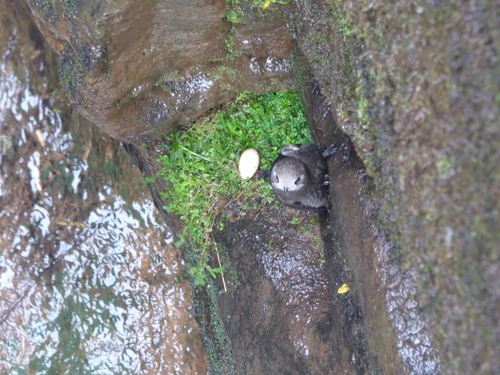

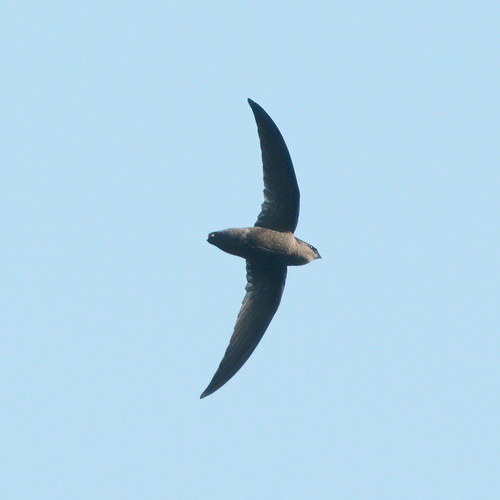
Great Dusky Swift

Great Dusky Swift

Cypseloides senex

Silhouette: vectorized by Rob Sparks · PhyloPic

LCLeast ConcernNTVUENCR
Daily sighting probability <5% · Rare
at Chapada dos Guimarães National Park

In 3 days ~10% in a week ~30%

37 Verified sightings at Chapada dos Guimarães National Park From 2019 to 2026
5,124 In all 5 parks
October Best month
☀️ Diurnal When it's spotted

About the Great Dusky Swift

The great dusky swift (Cypseloides senex) is a species of bird in subfamily Cypseloidinae of the swift family Apodidae. It is found in Argentina, Brazil, Paraguay, and possibly Bolivia. The great dusky swift is monotypic.

The great dusky swift is the largest member of genus Cypseloides. It is 18 cm (7.1 in) long and weighs 56 to 110 g (2.0 to 3.9 oz). The sexes have the same plumage. Adults have a chocolate brown crown and throat with pale gray edges to the feathers, giving a frosted appearance to the face. Their back is a darker brown, their rump a brown intermediate between the head and back, and their tail blackish brown. Their undersides are a paler brown than the back. The upper side of the wing is mostly brown and the underside somewhat lighter. Juveniles are very similar to adults with the addition on pale fringes to the wing feathers.

The great dusky swift is found in Brazil from southern Pará and much of Mato Grosso east into Bahia and south to Rio Grande do Sul, in eastern Paraguay, and in northeastern Argentina's Misiones Province. Undocumented sight records in Bolivia lead the South American... Wikipedia →

Sounds

Call0:05

Brazil · 2002

© Dante Buzzetti · XC500223 · CC BY-NC-SA 4.0

Global Distribution

Parks Where Found

# Park Country Daily sighting probability
1 Iguaçu National Park 🇧🇷 Brazil
~40%
2 Iguazú National Park 🇦🇷 Argentina
~40%
3 Serra da Canastra National Park 🇧🇷 Brazil
~20%
4 Chapada dos Guimarães National Park 🇧🇷 Brazil
<5%
5 Emas National Park 🇧🇷 Brazil
<5%

Before you go

What are the chances of seeing a Great Dusky Swift in Chapada dos Guimarães National Park?

Rare

Under 5% of wildlife watchers report a Great Dusky Swift sighting in Chapada dos Guimarães National Park on a given day, based on 37 verified sightings from GBIF citizen-science data from 2019 to 2026. It is the 165th most-seen of the 273 birds we can rate there. Over three days the chance rises to about 10%, and over a week to about 30%, if each day is a fresh chance.

When is the best time to see a Great Dusky Swift in Chapada dos Guimarães National Park?

October to December

In those months about 10% of wildlife watchers report a Great Dusky Swift in Chapada dos Guimarães National Park on a given day, against under 5% in January and May–September, the lowest months. February to April have too few records to rate.

What time of day is best to see a Great Dusky Swift?

Between 9 am and noon

Across all the parks we cover, that three-hour window holds the most Great Dusky Swift sightings with a recorded time, and about 9 in 10 of them come between 6 am and 6 pm: it is a daytime animal.

Is Chapada dos Guimarães National Park the best place to see a Great Dusky Swift?

4th of 5

Of the 5 parks where we can rate Great Dusky Swift sightings, Chapada dos Guimarães National Park ranks 4th at under 5%. The best odds are in Iguaçu National Park (Brazil, about 40%), Iguazú National Park (Argentina, about 40%) and Serra da Canastra National Park (Brazil, about 20%).

Which relatives of the Great Dusky Swift live in Chapada dos Guimarães National Park?

Same family: Apodidae

The closest relatives of the Great Dusky Swift that you can see in Chapada dos Guimarães National Park (family Apodidae, Swifts) are White-collared Swift (about 10%) and Biscutate Swift (about 10%), with each one's daily chance of a sighting.

Where does the Great Dusky Swift sighting chance come from?

GBIF citizen-science records

It is estimated from how often the Great Dusky Swift is recorded against all the birds logged in Chapada dos Guimarães National Park (37 verified sightings from 2019 to 2026), calibrated against known sighting rates. Figures are rounded to the nearest 10% because citizen-science data supports honest approximations, not decimals, and months with records from fewer than five people show "—". How it works.

← Back to Chapada dos Guimarães National Park