Pavonine Cuckoo

Pavonine Cuckoo

Dromococcyx pavoninus

Silhouette: Nicolas Huet le Jeune and Jean-Gabriel Prêtre (vectorized by T. Michael Keesey) · PhyloPic

LCLeast ConcernNTVUENCR
Daily sighting probability <5% · Rare
at Chapada dos Guimarães National Park

In 3 days <5% in a week ~10%

7 Verified sightings at Chapada dos Guimarães National Park From 2019 to 2026
459 In all 6 parks
July Best month
☀️ Diurnal When it's spotted

About the Pavonine Cuckoo

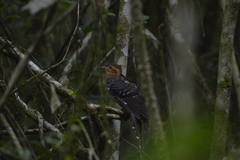
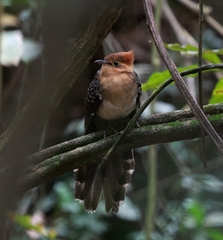
The pavonine cuckoo (Dromococcyx pavoninus) is a Neotropical cuckoo with a long graduated tail and a short crest. It is one of three species of Neotropical cuckoo which are known to be brood parasites. The head and crest of this bird is rusty brown and the remaining plumage is mainly dark brown above and paler below, with a rich buff coloured supercilium, throat and breast. It is similar in appearance to the pheasant cuckoo but has a slightly different call and is larger overall. Additionally, the buff supercilium, throat and breast of the pheasant cuckoo is paler than in the pavonine cuckoo and the throat and breast of the pheasant cuckoo are heavily marked while those areas of the pavonine cuckoo have no dark spots or streaks.

The pavonine cuckoo inhabits the understorey of subtropical or tropical moist lowland forests and subtropical or tropical moist montane forests in South America, where it is found in Argentina, Bolivia, Brazil, Colombia, Ecuador, French Guiana, Guyana, Paraguay, Peru, and Venezuela. It has a wide range but a patchy distribution, being absent from some areas where it might have been expected to be present.

��2... Wikipedia →

Sounds

Dawn song0:59

Colombia · 2026

© Andrea Morales Rozo · XC1088602 · CC BY-NC-SA 4.0

Subsong0:17

Brazil · 2025

© Fabrício Grigolin · XC1064441 · CC BY-NC-SA 4.0

Song0:24

Peru · 2015

© David Gibson · XC1011721 · CC BY-NC-SA 4.0

Global Distribution

Parks Where Found

# Park Country Daily sighting probability
1 Iguazú National Park 🇦🇷 Argentina
<5%
2 Iguaçu National Park 🇧🇷 Brazil
<5%
3 Henri Pittier National Park 🇻🇪 Venezuela
<5%
4 Tambopata National Reserve 🇵🇪 Peru
<5%
5 Manu National Park 🇵🇪 Peru
<5%
6 Chapada dos Guimarães National Park 🇧🇷 Brazil
<5%

Before you go

What are the chances of seeing a Pavonine Cuckoo in Chapada dos Guimarães National Park?

Rare

Under 5% of wildlife watchers report a Pavonine Cuckoo sighting in Chapada dos Guimarães National Park on a given day, based on 7 verified sightings from GBIF citizen-science data from 2019 to 2026. It is the 248th most-seen of the 273 birds we can rate there. Over three days the chance rises to under 5%, and over a week to about 10%, if each day is a fresh chance.

When is the best time to see a Pavonine Cuckoo in Chapada dos Guimarães National Park?

Any time of year

In every month with enough records, under 5% of wildlife watchers report a Pavonine Cuckoo in Chapada dos Guimarães National Park on a given day, so our monthly data shows no clear season. February to April have too few records to rate.

What time of day is best to see a Pavonine Cuckoo?

Between 9 am and noon

Across all the parks we cover, that three-hour window holds the most Pavonine Cuckoo sightings with a recorded time, and about 8 in 10 of them come between 6 am and 6 pm: it is a daytime animal.

Is Chapada dos Guimarães National Park the best place to see a Pavonine Cuckoo?

Among the best

Of the 6 parks where we can rate Pavonine Cuckoo sightings, Chapada dos Guimarães National Park ranks 6th at under 5%, level with the leaders once rounded. The best odds are in Iguazú National Park (Argentina, under 5%), Iguaçu National Park (Brazil, under 5%) and Henri Pittier National Park (Venezuela, under 5%).

Where does the Pavonine Cuckoo sighting chance come from?

GBIF citizen-science records

It is estimated from how often the Pavonine Cuckoo is recorded against all the birds logged in Chapada dos Guimarães National Park (7 verified sightings from 2019 to 2026), calibrated against known sighting rates. Figures are rounded to the nearest 10% because citizen-science data supports honest approximations, not decimals, and months with records from fewer than five people show "—". How it works.

← Back to Chapada dos Guimarães National Park