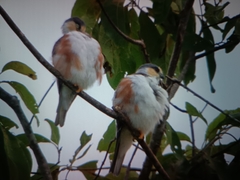
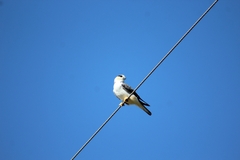
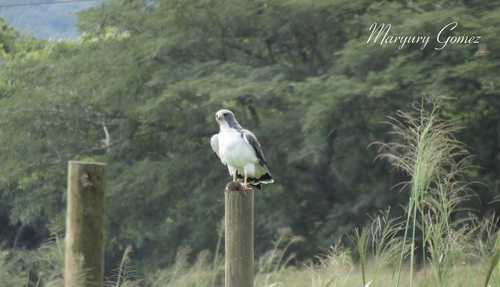
Pearl Kite

Pearl Kite

Gampsonyx swainsonii

Silhouette: Sheatherius · PhyloPic

LCLeast ConcernNTVUENCR
Daily sighting probability <5% · Rare
at Chapada dos Guimarães National Park

In 3 days <5% in a week ~10%

14 Verified sightings at Chapada dos Guimarães National Park From 2019 to 2026
193 In all 8 parks
August Best month
☀️ Diurnal When it's spotted

About the Pearl Kite

The pearl kite (Gampsonyx swainsonii) is a very small raptor found in open savanna habitat adjacent to deciduous woodland in Central and South America. It is the only member of the genus Gampsonyx. The scientific name commemorates the English naturalist William Swainson.

The type specimen was collected from Brazil by English naturalist William Swainson, and described by Nicholas Aylward Vigors in 1825. Vigors noted the similarity to both hawks and falcons, but placed Gampsonyx within the "Accipitrine subfamily" because it lacks the notched beak of the falcons. He also noted its striking resemblance to the coloration of the falconets.

Later, the pearl kite was classified with the falcons. For example, Peters placed it with the forest falcons in subfamily Polyhieracinae. In the mid-20th century it was found to be related to Elanus based on morphology and its molt schedule.

This tiny kite breeds from Panama, Colombia and Venezuela south to Bolivia and northern Argentina, with an isolated sedentary population in Nicaragua. It is expanding its range and was proved to breed on Trinidad in 1970. It was first reported in Costa Rica... Wikipedia →

Sounds

Call0:14

Brazil · 2026

© JAYRSON ARAUJO DE OLIVEIRA · XC1155542 · CC BY-NC-SA 4.0

Song0:13

Venezuela · 2023

© Francisco contreras · XC844094 · CC BY-NC-SA 4.0

Song0:12

Brazil · 2021

© Fernando Igor de Godoy · XC707614 · CC BY-NC-SA 4.0

Global Distribution

Parks Where Found

# Park Country Daily sighting probability
1 Tayrona National Natural Park 🇨🇴 Colombia
<5%
2 Henri Pittier National Park 🇻🇪 Venezuela
<5%
3 Parque Natural Metropolitano 🇵🇦 Panama
<5%
4 Santa Rosa National Park 🇨🇷 Costa Rica
<5%
5 Chapada dos Guimarães National Park 🇧🇷 Brazil
<5%
6 Caroni Swamp 🇹🇹 Trinidad and Tobago
<5%
7 Sierra de la Macarena National Park 🇨🇴 Colombia
<5%
8 Masaya Volcano National Park 🇳🇮 Nicaragua
<5%

Cities Where Found

# City Country Daily sighting probability
1 Maracaibo 🇻🇪 Venezuela
~10%
2 Panama City 🇵🇦 Panama
<5%
3 Fortaleza 🇧🇷 Brazil
<5%
4 Barranquilla 🇨🇴 Colombia
<5%
5 Campo Grande 🇧🇷 Brazil
<5%
6 Valencia 🇻🇪 Venezuela
<5%
7 Cali 🇨🇴 Colombia
<5%
8 Asuncion 🇵🇾 Paraguay
<5%
9 Managua 🇳🇮 Nicaragua
<5%
10 Caracas 🇻🇪 Venezuela
<5%

Zoos & Centres Where Found

# Zoo / Centre Country
1 Mangal das Garças 🇧🇷 Brazil In captivity
2 Parque Zoológico Nacional Simón Bolívar 🇨🇷 Costa Rica In captivity

Before you go

What are the chances of seeing a Pearl Kite in Chapada dos Guimarães National Park?

Rare

Under 5% of wildlife watchers report a Pearl Kite sighting in Chapada dos Guimarães National Park on a given day, based on 14 verified sightings from GBIF citizen-science data from 2019 to 2026. It is the 225th most-seen of the 273 birds we can rate there. Over three days the chance rises to under 5%, and over a week to about 10%, if each day is a fresh chance.

When is the best time to see a Pearl Kite in Chapada dos Guimarães National Park?

Any time of year

In every month with enough records, under 5% of wildlife watchers report a Pearl Kite in Chapada dos Guimarães National Park on a given day, so our monthly data shows no clear season. February to April have too few records to rate.

What time of day is best to see a Pearl Kite?

Between 8 and 11 am

Across all the parks we cover, that three-hour window holds the most Pearl Kite sightings with a recorded time, and nearly all of them come between 6 am and 6 pm: it is a daytime animal.

Which relatives of the Pearl Kite live in Chapada dos Guimarães National Park?

Same family: Accipitridae

The closest relatives of the Pearl Kite that you can see in Chapada dos Guimarães National Park (family Accipitridae, Hawks, Eagles, and Kites) are Roadside Hawk (about 20%), American Swallow-tailed Kite (about 10%) and Plumbeous Kite (about 10%), with each one's daily chance of a sighting.

Where does the Pearl Kite sighting chance come from?

GBIF citizen-science records

It is estimated from how often the Pearl Kite is recorded against all the birds logged in Chapada dos Guimarães National Park (14 verified sightings from 2019 to 2026), calibrated against known sighting rates. Figures are rounded to the nearest 10% because citizen-science data supports honest approximations, not decimals, and months with records from fewer than five people show "—". How it works.

← Back to Chapada dos Guimarães National Park