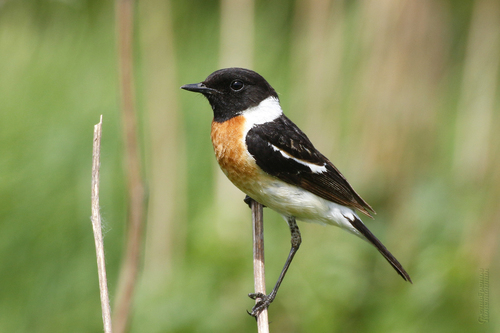
White-tailed Stonechat

White-tailed Stonechat

Saxicola leucurus

Silhouette: PhyloPic

LCLeast ConcernNTVUENCR
Daily sighting probability ~20% · Possible
at Chitwan National Park

In 3 days ~50% in a week ~80%

278 Verified sightings at Chitwan National Park From 2019 to 2026
311 In all 3 parks
January Best month
🌅 Crepuscular When it's spotted

About the White-tailed Stonechat

The white-tailed stonechat (Saxicola leucurus) is a species of bird in the family Muscicapidae. Very similar in plumage to european stonechat (Saxicola rubicola). The male has black head, white collar and bright rufous chest patch. The back and wings are dark, with white on wing coverts and rump. The key differentiating feature from male common stonechat is the white inner webs of outer tail feathers which is visible when the bird spreads the tail in flight or while landing. Note that this may not be visible when the tail is folded. The female is very similar to female european stonechat, but is overall paler with duller rump, tail and wings.

Considered monotypic though there are slight variations in plumage for birds from South Assam Hills (where the birds are darker and large billed) and Pakistan (where chest patch is more reddish). Though sympatric with Asian stonechat in its range, they do not intergrade.

White-tailed stonechats are resident in suitable marshy habitats in the Indus River valley, southern Himalayan foothills, the Terai–Duar savanna and grasslands, Bangladesh, South Assam Hills, Manipur... Wikipedia →

Sounds

Call0:24

Myanmar · 2018

© Thet Zaw Naing · XC686239 · CC BY-NC-SA 4.0

Song0:07

India · 2021

© Dibyendu Ash · XC622258 · CC BY-NC-SA 4.0

Song0:07

Myanmar · 2014

© Frank Lambert · XC207525 · CC BY-NC-ND 4.0

Global Distribution

Parks Where Found

# Park Country Daily sighting probability
1 Chitwan National Park 🇳🇵 Nepal
~20%
2 Royal Bardia National Park 🇳🇵 Nepal
~10%
3 Kaziranga National Park 🇮🇳 India
<5%

Cities Where Found

# City Country Daily sighting probability
1 New Delhi 🇮🇳 India
<5%

Before you go

What are the chances of seeing a White-tailed Stonechat in Chitwan National Park?

Possible

About 20% of wildlife watchers report a White-tailed Stonechat sighting in Chitwan National Park on a given day, based on 278 verified sightings from GBIF citizen-science data from 2019 to 2026. It is the 91st most-seen of the 367 birds we can rate there. Over three days the chance rises to about 50%, and over a week to about 80%, if each day is a fresh chance.

When is the best time to see a White-tailed Stonechat in Chitwan National Park?

January

In that month about 40% of wildlife watchers report a White-tailed Stonechat in Chitwan National Park on a given day, against about 10% in April to October, the lowest months. That is one of Chitwan National Park's driest months, with about 20 mm of rain against 660 mm in July.

What time of day is best to see a White-tailed Stonechat?

Between 10 am and 1 pm

Across all the parks we cover, that three-hour window holds the most White-tailed Stonechat sightings with a recorded time, and about 6 in 10 of them come between 6 am and 6 pm: it is most active around dawn and dusk.

Is Chitwan National Park the best place to see a White-tailed Stonechat?

Yes

Of the 3 parks where we can rate White-tailed Stonechat sightings, Chitwan National Park has the highest daily chance: about 20%. Next come Royal Bardia National Park (Nepal, about 10%) and Kaziranga National Park (India, under 5%).

Which relatives of the White-tailed Stonechat live in Chitwan National Park?

Same genus: Saxicola

The closest relatives of the White-tailed Stonechat that you can see in Chitwan National Park (genus Saxicola, Stonechats and Bushchats) are Pied Bushchat (about 40%) and Siberian Stonechat (about 40%), with each one's daily chance of a sighting.

Where does the White-tailed Stonechat sighting chance come from?

GBIF citizen-science records

It is estimated from how often the White-tailed Stonechat is recorded against all the birds logged in Chitwan National Park (278 verified sightings from 2019 to 2026), calibrated against known sighting rates. Figures are rounded to the nearest 10% because citizen-science data supports honest approximations, not decimals, and months with records from fewer than five people show "—". How it works.

← Back to Chitwan National Park