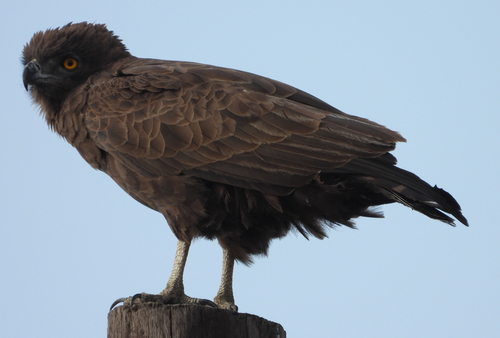
Pale Chanting Goshawk

Pale Chanting Goshawk

Melierax canorus

Silhouette: Sheatherius · PhyloPic

LCLeast ConcernNTVUENCR
Daily sighting probability <5% · Rare
at Chobe National Park

In 3 days ~10%

32 Verified sightings at Chobe National Park From 2019 to 2026
2,763 In all 11 parks
September Best month
☀️ Diurnal When it's spotted

About the Pale Chanting Goshawk

The pale chanting goshawk (Melierax canorus) is a bird of prey in the family Accipitridae. This hawk breeds in southern Africa and is a resident species of dry, open semi-desert with 75 cm or less annual rainfall. It is commonly seen perched on roadside telephone poles.

This species is approximately 55 cm in length with a wingspan of 110 cm. The adult has grey upperparts with a white rump. The central tail feathers are black tipped with white and the outer tail feathers are barred grey and white. The head and upper breast are pale grey while the rest of the underparts are finely barred in dark grey and white. The eyes are dark brown in the adult and pale yellow in the immature. The bill is red at the base and dark grey at the tip. The cere, facial skin and long legs are also red. In flight, the adult has black primary flight feathers, very pale grey (white from a distance) secondaries, and grey forewings. Immatures have brown upperparts, with a white rump and black bars on the tail. From below, the flight feathers and tail are white with black barring, the throat is dark-streaked white, and the rest of the underparts are rufous. It is larger and paler than the barred... Wikipedia →

Sounds

Call0:05

South Africa · 2020

© Tony Archer · XC611171 · CC BY-NC-SA 4.0

Flight call0:20

South Africa · 2018

© Raphaël Nussbaumer · XC459455 · CC BY-NC-SA 4.0

Call0:20

South Africa · 2006

© Franck BRUNELIERE, Grandeur Nature Safaris · XC18911 · CC BY-NC-ND 2.5

Global Distribution

Parks Where Found

# Park Country Daily sighting probability
1 Kgalagadi Transfrontier Park 🇿🇦 South Africa
~70%
2 Etosha National Park 🇳🇦 Namibia
~50%
3 Namib-Naukluft National Park 🇳🇦 Namibia
~40%
4 Addo Elephant National Park 🇿🇦 South Africa
~30%
5 Waterberg Plateau Park 🇳🇦 Namibia
~20%
6 De Hoop Nature Reserve 🇿🇦 South Africa
~10%
7 Chobe National Park 🇧🇼 Botswana
<5%
8 Pilanesberg National Park 🇿🇦 South Africa
<5%
9 Moremi Game Reserve 🇧🇼 Botswana
<5%
10 West Coast National Park 🇿🇦 South Africa
<5%
11 Hwange National Park 🇿🇼 Zimbabwe
<5%

Zoos & Centres Where Found

# Zoo / Centre Country
1 Pairi Daiza 🇧🇪 Belgium In captivity
2 Dullstroom Bird Of Prey & Rehabilitation Centre 🇿🇦 South Africa In captivity
3 World of Birds Wildlife Sanctuary and Monkey Park 🇿🇦 South Africa In captivity

Before you go

What are the chances of seeing a Pale Chanting Goshawk in Chobe National Park?

Rare

Under 5% of wildlife watchers report a Pale Chanting Goshawk sighting in Chobe National Park on a given day, based on 32 verified sightings from GBIF citizen-science data from 2019 to 2026. It is the 248th most-seen of the 373 birds we can rate there. Over three days the chance rises to about 10%, if each day is a fresh chance.

When is the best time to see a Pale Chanting Goshawk in Chobe National Park?

Any time of year

In every month with enough records, under 5% of wildlife watchers report a Pale Chanting Goshawk in Chobe National Park on a given day, so our monthly data shows no clear season.

What time of day is best to see a Pale Chanting Goshawk?

Between 10 am and 1 pm

Across all the parks we cover, that three-hour window holds the most Pale Chanting Goshawk sightings with a recorded time, and nearly all of them come between 6 am and 6 pm: it is a daytime animal.

Where does the Pale Chanting Goshawk sighting chance come from?

GBIF citizen-science records

It is estimated from how often the Pale Chanting Goshawk is recorded against all the birds logged in Chobe National Park (32 verified sightings from 2019 to 2026), calibrated against known sighting rates. Figures are rounded to the nearest 10% because citizen-science data supports honest approximations, not decimals, and months with records from fewer than five people show "—". How it works.

← Back to Chobe National Park