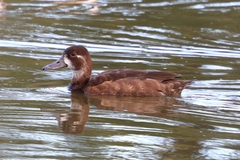
Southern Pochard

Southern Pochard

Netta erythrophthalma

Silhouette: Sheatherius · PhyloPic

LCLeast ConcernNTVUENCR
Daily sighting probability <5% · Rare
at Chobe National Park

In 3 days <5% in a week ~10%

11 Verified sightings at Chobe National Park From 2019 to 2026
705 In all 11 parks
March Best month
☀️ Diurnal When it's spotted

About the Southern Pochard

The southern pochard (Netta erythrophthalma) is a species of duck, and a member of the genus Netta. The South American pochard has a fragmented range and is found from Colombia, Venezuela, Brazil, Ecuador, Peru, Bolivia and Argentina to Chile. Here it occurs in a wide variety of shallow fresh waters with submerged vegetation, from the lowlands up to 3,700 metres.

The African pochard occurs from the Cape to the Ethiopian highlands on water bodies with or without emergent vegetation. They are suspected to have been strong migrants in the past but the construction of numerous farm dams seems to allow them a more sedentary lifestyle. They reach highest concentrations in Africa's central plateaus and in the south-western winter rainfall region.

Two syntype specimens of Nyroca brunnea Eyton (Monogr. Anat., 1838, p.161., pl.23.), the African Southern Pochard, are held in the vertebrate zoology collections of National Museums Liverpool at World Museum, with accession numbers NML-VZ D832 (male adult) and NML... Wikipedia →

Sounds

Song0:13

South Africa · 2001

© Nature sounds by Simply Birding · XC649360 · CC BY-NC-ND 4.0

Call0:13

Tanzania · 2017

© Frank Lambert · XC430123 · CC BY-NC-ND 4.0

Song0:13

Brazil · 2009

© Helberth Peixoto · XC44784 · CC BY-NC-ND 2.5

Global Distribution

Parks Where Found

# Park Country Daily sighting probability
1 Arusha National Park 🇹🇿 Tanzania
~40%
2 Ngorongoro Conservation Area 🇹🇿 Tanzania
~10%
3 Garden Route National Park 🇿🇦 South Africa
~10%
4 Hwange National Park 🇿🇼 Zimbabwe
<5%
5 De Hoop Nature Reserve 🇿🇦 South Africa
<5%
6 Amboseli National Park 🇰🇪 Kenya
<5%
7 Moremi Game Reserve 🇧🇼 Botswana
<5%
8 Chobe National Park 🇧🇼 Botswana
<5%
9 Table Mountain National Park 🇿🇦 South Africa
<5%
10 iSimangaliso Wetland Park 🇿🇦 South Africa
<5%
11 Kruger National Park 🇿🇦 South Africa
<5%

Cities Where Found

# City Country Daily sighting probability
1 Cape Town 🇿🇦 South Africa
<5%
2 Belo Horizonte 🇧🇷 Brazil
<5%
3 Johannesburg 🇿🇦 South Africa
<5%
4 Harare 🇿🇼 Zimbabwe
<5%
5 São Paulo 🇧🇷 Brazil
<5%

Zoos & Centres Where Found

# Zoo / Centre Country
1 Parc des oiseaux 🇫🇷 France In captivity
2 Slimbridge Wetland Centre 🇬🇧 United Kingdom In captivity
3 Berlin Zoological Garden 🇩🇪 Germany In captivity
4 Cologne Zoological Garden 🇩🇪 Germany In captivity
5 Duisburg Zoo 🇩🇪 Germany In captivity
6 Aquarium Berlin 🇩🇪 Germany In captivity
7 Cologne Zoo Aquarium 🇩🇪 Germany In captivity

Before you go

What are the chances of seeing a Southern Pochard in Chobe National Park?

Rare

Under 5% of wildlife watchers report a Southern Pochard sighting in Chobe National Park on a given day, based on 11 verified sightings from GBIF citizen-science data from 2019 to 2026. It is the 311th most-seen of the 373 birds we can rate there. Over three days the chance rises to under 5%, and over a week to about 10%, if each day is a fresh chance.

When is the best time to see a Southern Pochard in Chobe National Park?

Any time of year

In every month with enough records, under 5% of wildlife watchers report a Southern Pochard in Chobe National Park on a given day, so our monthly data shows no clear season.

What time of day is best to see a Southern Pochard?

Between 9 am and noon

Across all the parks we cover, that three-hour window holds the most Southern Pochard sightings with a recorded time, and about 9 in 10 of them come between 6 am and 6 pm: it is a daytime animal.

Which relatives of the Southern Pochard live in Chobe National Park?

Same family: Anatidae

The closest relatives of the Southern Pochard that you can see in Chobe National Park (family Anatidae, Ducks, Geese, and Swans) are Egyptian Goose (about 60%), Spur-winged Goose (about 50%) and White-faced Whistling Duck (about 40%), with each one's daily chance of a sighting.

Where does the Southern Pochard sighting chance come from?

GBIF citizen-science records

It is estimated from how often the Southern Pochard is recorded against all the birds logged in Chobe National Park (11 verified sightings from 2019 to 2026), calibrated against known sighting rates. Figures are rounded to the nearest 10% because citizen-science data supports honest approximations, not decimals, and months with records from fewer than five people show "—". How it works.

← Back to Chobe National Park