



Completed


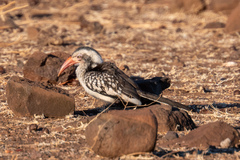


Southern Red-billed Hornbill
Tockus rufirostris
Silhouette: Andy Wilson · PhyloPic
- KingdomAnimalia (Animals)
- PhylumChordata (Chordates)
- ClassAves (Birds)
- OrderBucerotiformes (Hornbills and Hoopoes)
- FamilyBucerotidae (Hornbills)
- GenusTockus (Red-billed and Yellow-billed Hornbills)
- SpeciesTockus rufirostris (Southern Red-billed Hornbill)
In 3 days ~90% in a week >90%
909 Verified sightings at Chobe National Park From 2019 to 2026
8,972 In all 13 parks
September Best month
☀️ Diurnal When it's spotted
About the Southern Red-billed Hornbill
The southern red-billed hornbill (Tockus rufirostris) is a species of hornbill in the family Bucerotidae, which is native to the savannas and dryer bushlands of southern Africa. It is replaced by a near-relative, the Damara red-billed hornbill, in the arid woodlands of western Namibia. All five red-billed hornbills were formerly considered conspecific.
It is usually treated as a monotypic taxon, but two additional subspecies have been proposed: Tockus rufirostris rufirostris Sundevall, 1850 — bushveld regions of Transvaal, southern Botswana and southern Zimbabwe Tockus rufirostris degens Clancey, 1964 — eastern lowveld
Tockus rufirostris ngamiensis Roberts, 1932 — northern Namibia to northern Zimbabwe The differences are clinal. The sexes are similar, but males are larger and heavier. Males also have somewhat longer bills, with the lower mandible coloured black to a variable extent. It is distinguishable from other red-billed hornbills by the combination of yellow iris and pale orbital skin (pink to greyish), and the ample blackish plumage... Wikipedia →
Recent sightings of Southern Red-billed Hornbill in Chobe National Park
LIVEiNaturalistGlobal Distribution
Parks Where Found
| # | Park | Country | Daily sighting probability |
|---|---|---|---|
| 1 | Mana Pools National Park | 🇿🇼 Zimbabwe | |
| 2 | Lower Zambezi National Park | 🇿🇲 Zambia | |
| 3 | Liwonde National Park | 🇲🇼 Malawi | |
| 4 | Gonarezhou National Park | 🇿🇼 Zimbabwe | |
| 5 | Moremi Game Reserve | 🇧🇼 Botswana | |
| 6 | Chobe National Park | 🇧🇼 Botswana | |
| 7 | Hwange National Park | 🇿🇼 Zimbabwe | |
| 8 | Kruger National Park | 🇿🇦 South Africa | |
| 9 | South Luangwa National Park | 🇿🇲 Zambia | |
| 10 | Etosha National Park | 🇳🇦 Namibia | |
| 11 | Pilanesberg National Park | 🇿🇦 South Africa | |
| 12 | Kafue National Park | 🇿🇲 Zambia | |
| 13 | Waterberg Plateau Park | 🇳🇦 Namibia |
Zoos & Centres Where Found
| # | Zoo / Centre | Country | |
|---|---|---|---|
| 1 | Omaha’s Henry Doorly Zoo and Aquarium | 🇺🇸 United States | |
| 2 | Milwaukee County Zoo | 🇺🇸 United States | |
| 3 | ZooTampa | 🇺🇸 United States | |
| 4 | Chapultepec Zoo | 🇲🇽 Mexico | |
| 5 | Monkeyland | 🇿🇦 South Africa | |
| 6 | African Dawn Bird and Wildlife Sanctuary | 🇿🇦 South Africa | |
| 7 | Birds of Eden | 🇿🇦 South Africa | |
| 8 | Tropicarium | 🇭🇺 Hungary |
Closest Relatives at Chobe National Park


Before you go
What are the chances of seeing a Southern Red-billed Hornbill in Chobe National Park?
Likely
About 50% of wildlife watchers report a Southern Red-billed Hornbill sighting in Chobe National Park on a given day, based on 909 verified sightings from GBIF citizen-science data from 2019 to 2026. It is the 16th most-seen of the 373 birds we can rate there. Over three days the chance rises to about 90%, and over a week to over 90%, if each day is a fresh chance.
When is the best time to see a Southern Red-billed Hornbill in Chobe National Park?
September
In that month about 60% of wildlife watchers report a Southern Red-billed Hornbill in Chobe National Park on a given day, against about 30% in November, the lowest month. That is one of Chobe National Park's driest months, with almost no rain against 150 mm in January.
What time of day is best to see a Southern Red-billed Hornbill?
Between 8 and 11 am
Across all the parks we cover, that three-hour window holds the most Southern Red-billed Hornbill sightings with a recorded time, and about 9 in 10 of them come between 6 am and 6 pm: it is a daytime animal.
Is Chobe National Park the best place to see a Southern Red-billed Hornbill?
6th of 13
Of the 13 parks where we can rate Southern Red-billed Hornbill sightings, Chobe National Park ranks 6th at about 50%. The best odds are in Mana Pools National Park (Zimbabwe, about 70%), Lower Zambezi National Park (Zambia, about 60%) and Liwonde National Park (Malawi, about 60%). All parks ranked.
Where does the Southern Red-billed Hornbill sighting chance come from?
GBIF citizen-science records
It is estimated from how often the Southern Red-billed Hornbill is recorded against all the birds logged in Chobe National Park (909 verified sightings from 2019 to 2026), calibrated against known sighting rates. Figures are rounded to the nearest 10% because citizen-science data supports honest approximations, not decimals, and months with records from fewer than five people show "—". How it works.
