Stygian Owl

Stygian Owl

Asio stygius

Silhouette: Ferran Sayol · PhyloPic

LCLeast ConcernNTVUENCR
Daily sighting probability <5% · Rare
at Ciénaga de Zapata

In 3 days ~10% in a week ~30%

72 Verified sightings at Ciénaga de Zapata From 2019 to 2026
89 In all 2 parks
April Best month
☀️🌙 Day & Night When it's spotted

About the Stygian Owl

The Stygian owl (Asio stygius) is a medium-sized "typical owl" in subfamily Striginae. It is found in Mexico, parts of Central America, Cuba, Hispaniola, and 10 countries in South America. The Stygian owl has these six recognized subspecies:

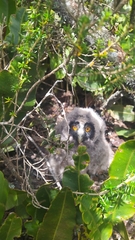
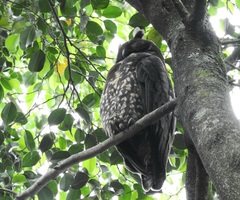
The sexes have similar very dark plumage. (The adjective "Stygian" means "of, or relating to, the River Styx", but is more widely applied to anything that is dark or dismal.) The face is blackish with a pale border and a whitish forehead, and the head has long dark feathers that project upward as "ears". The dark upperparts have buff streaks and bars; the underparts are a dingy buff with dark brown or blackish barring and streaks. The eye is shades of yellow, the bill blue-black to blackish, and the feet dark grayish or brownish pink. Its eyes may appear to be a shade of crimson under certain lighting... Wikipedia →

Sounds

Call1:21

Brazil · 2025

© Marcelo J Feliti · XC1119996 · CC BY-NC-SA 4.0

Song0:46

Colombia · 2021

© Iván Lau · XC667604 · CC BY-NC-SA 4.0

Song0:10

Brazil · 2020

© JAYRSON ARAUJO DE OLIVEIRA · XC577102 · CC BY-NC-SA 4.0

Global Distribution

Parks Where Found

# Park Country Daily sighting probability
1 Ciénaga de Zapata 🇨🇺 Cuba
<5%
2 Cusuco National Park 🇭🇳 Honduras
<5%

Cities Where Found

# City Country Daily sighting probability
1 Guatemala City 🇬🇹 Guatemala
~10%
2 Bogota 🇨🇴 Colombia
<5%
3 Curitiba 🇧🇷 Brazil
<5%
4 Porto Alegre 🇧🇷 Brazil
<5%
5 Brasilia 🇧🇷 Brazil
<5%
6 São Paulo 🇧🇷 Brazil
<5%
7 Medellín 🇨🇴 Colombia
<5%

Zoos & Centres Where Found

# Zoo / Centre Country
1 Parque Zoologico Guátika 🇨🇴 Colombia In captivity
2 Amaru 🇪🇨 Ecuador In captivity
3 Bioparque Wakatá 🇨🇴 Colombia In captivity
4 Dantas 🇨🇴 Colombia In captivity
5 Parque Cóndor 🇪🇨 Ecuador In captivity
6 Wiwa Quito 🇪🇨 Ecuador In captivity

Before you go

What are the chances of seeing a Stygian Owl in Ciénaga de Zapata?

Rare

Under 5% of wildlife watchers report a Stygian Owl sighting in Ciénaga de Zapata on a given day, based on 72 verified sightings from GBIF citizen-science data from 2019 to 2026. It is the 124th most-seen of the 177 birds we can rate there. Over three days the chance rises to about 10%, and over a week to about 30%, if each day is a fresh chance.

When is the best time to see a Stygian Owl in Ciénaga de Zapata?

April, July, October and December

In those months about 10% of wildlife watchers report a Stygian Owl in Ciénaga de Zapata on a given day, against under 5% in January–March, May–June, August and November, the lowest months. September has too few records to rate.

What time of day is best to see a Stygian Owl?

Between 9 am and noon

Across all the parks we cover, that three-hour window holds the most Stygian Owl sightings with a recorded time, and about 6 in 10 of them come between 6 am and 6 pm: it is seen both by day and at night.

Is Ciénaga de Zapata the best place to see a Stygian Owl?

Yes

Of the 2 parks where we can rate Stygian Owl sightings, Ciénaga de Zapata has the highest daily chance: under 5%. Next come Cusuco National Park (Honduras, under 5%).

Which relatives of the Stygian Owl live in Ciénaga de Zapata?

Same family: Strigidae

The closest relatives of the Stygian Owl that you can see in Ciénaga de Zapata (family Strigidae, Typical Owls) are Cuban Pygmy-Owl (about 30%) and Bare-legged Owl (about 10%), with each one's daily chance of a sighting.

Where does the Stygian Owl sighting chance come from?

GBIF citizen-science records

It is estimated from how often the Stygian Owl is recorded against all the birds logged in Ciénaga de Zapata (72 verified sightings from 2019 to 2026), calibrated against known sighting rates. Figures are rounded to the nearest 10% because citizen-science data supports honest approximations, not decimals, and months with records from fewer than five people show "—". How it works.

← Back to Ciénaga de Zapata