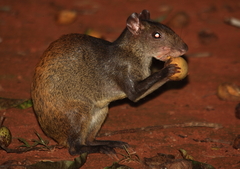
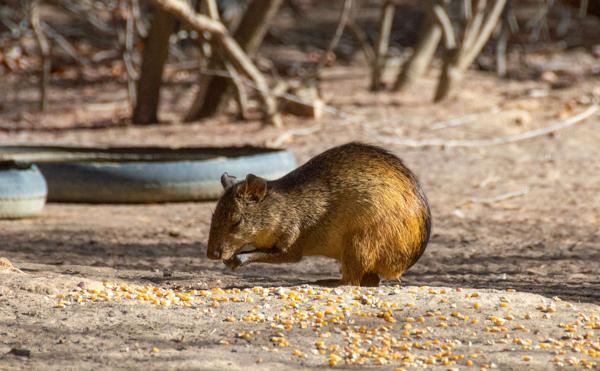
Crested Agouti

Crested Agouti

Dasyprocta leporina

Silhouette: Margot Michaud · PhyloPic

LCLeast ConcernNTVUENCR
Daily sighting probability ~40% · Likely
at Belém

In 3 days ~80% in a week >90%

27 Verified sightings at Belém
57 In all 3 parks From 2019 to 2026
August Best month
☀️ Diurnal When it's spotted

About the Crested Agouti

The red-rumped agouti (Dasyprocta leporina), also known as the golden-rumped agouti, orange-rumped agouti or Brazilian agouti, is a species of agouti from the family Dasyproctidae. It is native to northeastern South America, mainly in Venezuela, Guyana, Suriname, French Guiana, northeastern Brazil, Trinidad and Tobago and Saint Lucia in the Caribbean. It has also been introduced to Florida, the U.S. Virgin Islands, Grenada, and Dominica.

Despite the alternative name Brazilian agouti, it is neither the only nor the most widespread species of agouti in Brazil. In Brazil all agoutis are often called "cutia" [kuˈtʃiɐ]. It is found in a wide range of forests, including rainforest and secondary forest.

The red-rumped agouti weighs about 3 to 6 kilograms (6.6 to 13.2 lb). It is about 48 to 64 cm (19 to 25 in) long. The females are larger than males but otherwise look similar. It is brownish with darker spots on the upper body. The fur becomes more orange as it goes past (going down) the middle area of the animal. The ears are somewhat square in shape. The front feet have four toes and the back have three each. It can be distinguished... Wikipedia →

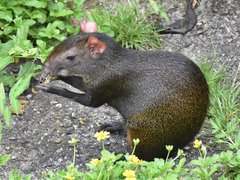
Sounds

Recording4:29

Brazil · 2020

© Henry Miller Alexandre · iNaturalist · CC BY-NC 4.0

Global Distribution

Parks Where Found

# Park Country Daily sighting probability
1 Brownsberg Nature Park 🇸🇷 Suriname
~50%
2 Main Ridge Forest Reserve 🇹🇹 Trinidad and Tobago
~30%
3 Tijuca National Park 🇧🇷 Brazil
~10%

Cities Where Found

# City Country Daily sighting probability
1 Manaus 🇧🇷 Brazil
~40%
2 Belém 🇧🇷 Brazil
~40%
3 Valencia 🇻🇪 Venezuela
~30%
4 Rio de Janeiro 🇧🇷 Brazil
~20%
5 Campinas 🇧🇷 Brazil
~10%
6 Santos 🇧🇷 Brazil
~10%
7 Caracas 🇻🇪 Venezuela
~10%
8 São Paulo 🇧🇷 Brazil
<5%

Zoos & Centres Where Found

# Zoo / Centre Country
1 San Diego Zoo 🇺🇸 United States In captivity
2 National Zoological Park 🇺🇸 United States In captivity
3 Leipzig Zoological Garden 🇩🇪 Germany In captivity
4 Minnesota Zoo 🇺🇸 United States In captivity
5 Parc zoologique de Montpellier 🇫🇷 France In captivity
6 Los Angeles Zoo 🇺🇸 United States In captivity
7 Detroit Zoo 🇺🇸 United States In captivity
8 São Paulo Zoo 🇧🇷 Brazil In captivity
9 Zoológico de San Juan de Aragón 🇲🇽 Mexico In captivity
10 Woodland Park Zoo 🇺🇸 United States In captivity
11 Darling Downs Zoo 🇦🇺 Australia In captivity
12 Parque Zoobotânico Getúlio Vargas 🇧🇷 Brazil In captivity
13 Zoologischer Garten Leipzig 🇩🇪 Germany In captivity
14 Memphis Zoo 🇺🇸 United States In captivity
15 Hamilton Zoo 🇳🇿 New Zealand In captivity
16 Melbourne Zoo 🇦🇺 Australia In captivity
17 Riverview Park & Zoo 🇨🇦 Canada In captivity
18 Cameron Park Zoo 🇺🇸 United States In captivity
19 Philadelphia Zoo 🇺🇸 United States In captivity
20 Chapultepec Zoo 🇲🇽 Mexico In captivity
21 Auckland Zoo 🇳🇿 New Zealand In captivity
22 Bosque Rodrigues Alves 🇧🇷 Brazil In captivity
23 Naples Zoo 🇺🇸 United States In captivity
24 Roger Williams Park Zoo 🇺🇸 United States In captivity
25 Bosque dos Jequitibás 🇧🇷 Brazil In captivity
26 Wellington Zoo 🇳🇿 New Zealand In captivity
27 Zagreb Zoo 🇭🇷 Croatia In captivity
28 Parque Zoobotânico do Museu Paraense Emílio Goeldi 🇧🇷 Brazil In captivity
29 Museu Paraense Emílio Goeldi 🇧🇷 Brazil In captivity
30 Bergen County Zoological Park 🇺🇸 United States In captivity
31 Parque Zoobotânico Orquidário Municipal de Santos 🇧🇷 Brazil In captivity
32 Zoo Sedlec 🇨🇿 Czechia In captivity
33 Emperor Valley Zoo 🇹🇹 Trinidad & Tobago In captivity
34 Raritätenzoo Ebbs 🇦🇹 Austria In captivity
35 Cango Wildlife Ranch 🇿🇦 South Africa In captivity
36 Jacques Huber Aquarium 🇧🇷 Brazil In captivity
37 The Zoo In Forest Park 🇺🇸 United States In captivity
38 Wolfgang-Köhler-Primaten-Forschungszentrum 🇩🇪 Germany In captivity

Before you go

What are the chances of seeing a Crested Agouti in Belém?

Likely

About 40% of wildlife watchers report a Crested Agouti sighting in Belém on a given day, based on 27 verified sightings from GBIF citizen-science data. It is the 3rd most-seen of the 6 mammals we can rate there. Over three days the chance rises to about 80%, and over a week to over 90%, if each day is a fresh chance.

When is the best time to see a Crested Agouti in Belém?

August

In that month about 60% of wildlife watchers report a Crested Agouti in Belém on a given day, against about 10% in January–February, April and June, the lowest months. That is one of Belém's driest months, with about 100 mm of rain against 440 mm in March.

What time of day is best to see a Crested Agouti?

Between 4 and 7 pm

Across all the parks we cover, that three-hour window holds the most Crested Agouti sightings with a recorded time, and about 8 in 10 of them come between 6 am and 6 pm: it is a daytime animal.

Is Belém the best place to see a Crested Agouti?

Among the best

Of the 8 cities where we can rate Crested Agouti sightings, Belém ranks 2nd at about 40%, level with the leaders once rounded. The best odds are in Manaus (Brazil, about 40%).

Where does the Crested Agouti sighting chance come from?

GBIF citizen-science records

It is estimated from how often the Crested Agouti is recorded against all the mammals logged in Belém (27 verified sightings), calibrated against known sighting rates. Figures are rounded to the nearest 10% because citizen-science data supports honest approximations, not decimals, and months with records from fewer than five people show "—". How it works.

← Back to Belém