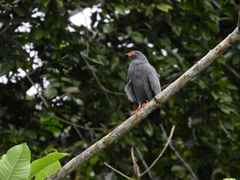
Slender-billed Kite

Slender-billed Kite

Helicolestes hamatus

Silhouette: Sheatherius · PhyloPic

LCLeast ConcernNTVUENCR
Daily sighting probability ~20% · Possible
at Belém

In 3 days ~40% in a week ~70%

38 Verified sightings at Belém
481 In all 6 parks From 2019 to 2026
September Best month
☀️ Diurnal When it's spotted

About the Slender-billed Kite

The slender-billed kite (Helicolestes hamatus) is a South American bird of prey in the family Accipitridae. It is found along a scattered range in forested parts of tropical northern and central South America, and far eastern Panama. The species was recategorized into and has once again been removed from the genus Rostrhamus.

The slender-billed kite is a slaty gray kite with broad, rounded wings and a short, square tail. The species ranges from 36 to 41 centimeters in length and possesses a wingspan of 80–90 centimeters. There is no sexual plumage dimorphism within the species; however, females tend to be larger than the males, weighing between 367 and 485 grams while males weigh between 377 and 448 grams. Their characteristically sharp black beak is hooked, matched by sharp, black talons. Their eyes are yellowish, and their face and legs are orange-red. Juveniles resemble adults, but have brownish eyes and three narrow white bands in the tail.

Both sexes resemble the male snail kite, and the slender-billed kite has often been included in the same genus, Rostrhamus. Adults are distinguished by their yellow, rather than red, eyes and a noticeably shorter tail. Other... Wikipedia →

Sounds

Flight call1:18

Colombia · 2022

© Frank Lambert · XC1040560 · CC BY-NC-ND 4.0

Song0:36

Panama · 2020

© Nando Quiroz · XC596812 · CC BY-NC-SA 4.0

Call0:33

Suriname · 2014

© Peter Boesman · XC271908 · CC BY-NC-ND 4.0

Global Distribution

Parks Where Found

# Park Country Daily sighting probability
1 Yasuní National Park 🇪🇨 Ecuador
~10%
2 Anavilhanas National Park 🇧🇷 Brazil
<5%
3 Darién National Park 🇵🇦 Panama
<5%
4 Cuyabeno Wildlife Reserve 🇪🇨 Ecuador
<5%
5 Tambopata National Reserve 🇵🇪 Peru
<5%
6 Manu National Park 🇵🇪 Peru
<5%

Cities Where Found

# City Country Daily sighting probability
1 Belém 🇧🇷 Brazil
~20%

Before you go

What are the chances of seeing a Slender-billed Kite in Belém?

Possible

About 20% of wildlife watchers report a Slender-billed Kite sighting in Belém on a given day, based on 38 verified sightings from GBIF citizen-science data. It is the 49th most-seen of the 144 birds we can rate there. Over three days the chance rises to about 40%, and over a week to about 70%, if each day is a fresh chance.

When is the best time to see a Slender-billed Kite in Belém?

February–April, July, September–October and December

In those months about 20% of wildlife watchers report a Slender-billed Kite in Belém on a given day, against about 10% in January, May–June, August and November, the lowest months.

What time of day is best to see a Slender-billed Kite?

Between 7 and 10 am

Across all the parks we cover, that three-hour window holds the most Slender-billed Kite sightings with a recorded time, and about 9 in 10 of them come between 6 am and 6 pm: it is a daytime animal.

Where else can you see a Slender-billed Kite?

Only Belém, in our data

Belém is the only city on Wallace's Line with enough records to rate Slender-billed Kite sightings: about 20% of wildlife watchers there report one on a given day.

Which relatives of the Slender-billed Kite live in Belém?

Same family: Accipitridae

The closest relatives of the Slender-billed Kite that you can see in Belém (family Accipitridae, Hawks, Eagles, and Kites) are Roadside Hawk (about 30%), Gray-lined Hawk (about 10%) and Snail Kite (about 10%), with each one's daily chance of a sighting.

Where does the Slender-billed Kite sighting chance come from?

GBIF citizen-science records

It is estimated from how often the Slender-billed Kite is recorded against all the birds logged in Belém (38 verified sightings), calibrated against known sighting rates. Figures are rounded to the nearest 10% because citizen-science data supports honest approximations, not decimals, and months with records from fewer than five people show "—". How it works.

← Back to Belém