
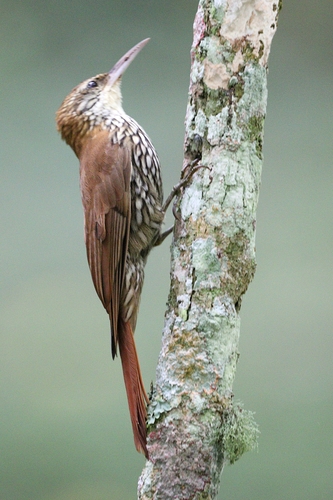
Rufous-fronted Thornbird

Rufous-fronted Thornbird

Phacellodomus rufifrons

Silhouette: Sheatherius · PhyloPic

LCLeast ConcernNTVUENCR
Daily sighting probability <5% · Rare
at Belo Horizonte

In 3 days ~10% in a week ~20%

39 Verified sightings at Belo Horizonte
323 In all 7 parks From 2019 to 2026
March Best month
☀️ Diurnal When it's spotted

About the Rufous-fronted Thornbird

The rufous-fronted thornbird, or common thornbird, (Phacellodomus rufifrons) is a species of bird in the family Furnariidae. It is found in Brazil, Bolivia, Argentina, Ecuador, Paraguay, and Peru. The rufous-fronted thornbird's taxonomy is unsettled. The International Ornithological Committee (IOC), BirdLife International's Handbook of the Birds of the World (HBW), and the Clements taxonomy assign it these four subspecies:

The IOC, HBW, and Clements treat those taxa as the plain thornbird (P. inornatus). This article follows the four-subspecies model. The rufous-fronted thornbird is 16 to 17 cm (6.3 to 6.7 in) long and weighs about 18 to 31 g (0.63 to 1.1 oz). The sexes have the same plumage. Adults of the nominate subspecies P. r. rufifrons have a dull buff supercilium that continues past the eye, a dark brown stripe behind the eye,... Wikipedia →

Sounds

Call0:20

Brazil · 2025

© Robson Silva e Silva · XC1067277 · CC BY-NC-SA 4.0

Song0:05

Brazil · 2023

© JAYRSON ARAUJO DE OLIVEIRA · XC832949 · CC BY-NC-SA 4.0

Duet0:17

Brazil · 2020

© Daniel Mello · XC587498 · CC BY-NC-ND 4.0

Global Distribution

Parks Where Found

# Park Country Daily sighting probability
1 El Impenetrable National Park 🇦🇷 Argentina
~30%
2 Serra da Canastra National Park 🇧🇷 Brazil
~20%
3 Chapada Diamantina National Park 🇧🇷 Brazil
~10%
4 Serra dos Órgãos National Park 🇧🇷 Brazil
<5%
5 Itatiaia National Park 🇧🇷 Brazil
<5%
6 Parque Estadual Encontro das Águas 🇧🇷 Brazil
<5%
7 Podocarpus National Park 🇪🇨 Ecuador
<5%

Cities Where Found

# City Country Daily sighting probability
1 Santa Cruz de la Sierra 🇧🇴 Bolivia
~10%
2 Belo Horizonte 🇧🇷 Brazil
<5%
3 Campo Grande 🇧🇷 Brazil
<5%
4 Rio de Janeiro 🇧🇷 Brazil
<5%

Before you go

What are the chances of seeing a Rufous-fronted Thornbird in Belo Horizonte?

Rare

Under 5% of wildlife watchers report a Rufous-fronted Thornbird sighting in Belo Horizonte on a given day, based on 39 verified sightings from GBIF citizen-science data. It is the 122nd most-seen of the 220 birds we can rate there. Over three days the chance rises to about 10%, and over a week to about 20%, if each day is a fresh chance.

When is the best time to see a Rufous-fronted Thornbird in Belo Horizonte?

March and November–December

In those months about 10% of wildlife watchers report a Rufous-fronted Thornbird in Belo Horizonte on a given day, against under 5% in January–February and April–October, the lowest months. Those are among Belo Horizonte's wettest months, with about 200 mm of rain a month against 5 mm in July.

What time of day is best to see a Rufous-fronted Thornbird?

Between 7 and 10 am

Across all the parks we cover, that three-hour window holds the most Rufous-fronted Thornbird sightings with a recorded time, and about 9 in 10 of them come between 6 am and 6 pm: it is a daytime animal.

Is Belo Horizonte the best place to see a Rufous-fronted Thornbird?

2nd of 4

Of the 4 cities where we can rate Rufous-fronted Thornbird sightings, Belo Horizonte ranks 2nd at under 5%. The best odds are in Santa Cruz de la Sierra (Bolivia, about 10%).

Which relatives of the Rufous-fronted Thornbird live in Belo Horizonte?

Same family: Furnariidae

The closest relatives of the Rufous-fronted Thornbird that you can see in Belo Horizonte (family Furnariidae, Ovenbirds and Woodcreepers) are Rufous Hornero (about 40%), Yellow-chinned Spinetail (about 10%) and Sooty-fronted Spinetail (about 10%), with each one's daily chance of a sighting.

Where does the Rufous-fronted Thornbird sighting chance come from?

GBIF citizen-science records

It is estimated from how often the Rufous-fronted Thornbird is recorded against all the birds logged in Belo Horizonte (39 verified sightings), calibrated against known sighting rates. Figures are rounded to the nearest 10% because citizen-science data supports honest approximations, not decimals, and months with records from fewer than five people show "—". How it works.

← Back to Belo Horizonte